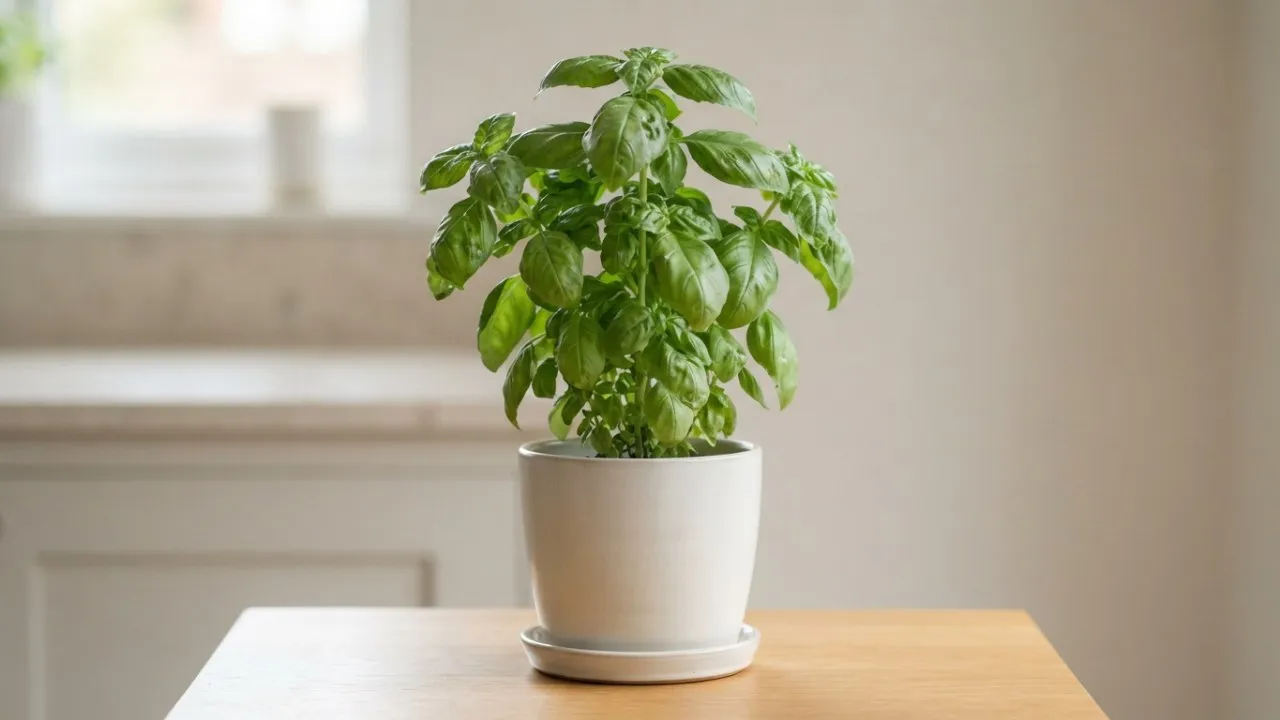
Basil
Ocimum basilicum
An essential annual aromatic herb of Mediterranean cuisine, prized for its fragrant leaves and culinary versatility.
The essentials at a glance
-
Watering
Every 2 days
-
Light
Full sun
-
Humidity
40–60 %
-
Temperature
18–30 °C


How to care for your Basil
Everything you need to keep your Basil healthy: watering, light, humidity, feeding, repotting and pruning.
Basil is one of the most popular aromatic herbs in the world, native to tropical Asia and cultivated for over 5,000 years. Its oval, glossy leaves emit an intense and distinctive fragrance, blending anise and peppery notes. There are over 60 varieties, from classic Genovese basil to purple basil and Thai basil. A warmth-loving plant par excellence, it is sensitive to cold and frost but grows easily in a pot on a sunny windowsill.

Watering your Basil
Every 2 days
Water at the base, avoiding the foliage. Keep the substrate consistently moist but never waterlogged. In pots, ensure good drainage.
How to know it needs water
- Substrate dry in the top centimetre
- Leaves beginning to droop slightly
- Pot feels abnormally light

How much light a Basil needs
Full sun
Full sun, at least 6–8 hours of direct light per day. Can tolerate light afternoon shade in summer.
- Direct sun tolerated
- 6 to 8 h a day
- Orientations that suit it
- South, South-east, South-west, East, West

Humidity and misting
40–60 %
40–60% No misting necessary. Avoid wetting the foliage to prevent fungal diseases such as basil downy mildew.

Feeding and fertiliser
Every 21 days
Fertilize every 3 weeks during the growing season (April to September). Avoid fertilizers too high in nitrogen, which reduce essential oil concentration.
- Recommended feed
- Balanced organic liquid fertilizer diluted to half dose. · 2-1-2

Repotting your Basil
Every 12 months
Use rich, well-draining compost. Choose a slightly larger pot with drainage holes. Basil is often grown as an annual and resown each year.
- When
- Spring (April–May)
- Potting mix
- All-purpose potting mix
- Mix in
- perlite, coco fibre
The tell-tale signs
- Roots emerging from drainage holes
- Growth slowing despite good care
- Plant drying very quickly between waterings

Pruning your Basil
Regularly from when the plant reaches 15–20 cm in height. Pinch out flowering shoots as soon as they appear to extend the harvest. Pinch stem tips just above a two-leaf node. This encourages branching and produces a bushier plant. Harvest leaves from the top down.

Through the year
Watering is not set once and for all: it follows the light and the growth. Allow 3 days between waterings in the depth of winter, against 1 in the growing season.
- 3 J
- 2 F
- 2 M
- 1 A
- 1 M
- 1 J
- 1 J
- 1 A
- 2 S
- 2 O
- 3 N
- 3 D
Active growth · Days between waterings

Good to know
- Basil is considered a sacred plant in India, where it is dedicated to the god Vishnu and grown in nearly every Hindu household.
- In Italy, giving someone a pot of basil is traditionally a sign of love and fidelity.

Frequently asked questions about the Basil
How do you care for a Basil?
Water it every 2 days. Give it full sun. Ideal humidity: 40–60 %. Ideal temperature: 18–30 °C. Water at the base, avoiding the foliage. Keep the substrate consistently moist but never waterlogged. In pots, ensure good drainage.
How often should you water a Basil?
Every 2 days Water at the base, avoiding the foliage. Keep the substrate consistently moist but never waterlogged. In pots, ensure good drainage. How to know it needs water : Substrate dry in the top centimetre ; Leaves beginning to droop slightly ; Pot feels abnormally light.
How much light does a Basil need?
Full sun Full sun, at least 6–8 hours of direct light per day. Can tolerate light afternoon shade in summer. 6 to 8 h a day
Is the Basil toxic to cats and dogs?
No, the Basil is not listed as toxic to cats and dogs. That is still no reason to let your pets chew on it.
Why are my Basil leaves turning yellow?
Yellowing most often comes from too much water: the mix stays wet and the roots suffocate. Check that the pot drains, empty the saucer, and let the mix dry before watering again. Too little light or a cold draught cause the same symptom.
When should you repot a Basil?
Repot every 12 months, ideally in spring (april–may). Use rich, well-draining compost. Choose a slightly larger pot with drainage holes. Basil is often grown as an annual and resown each year.

At a glance
- Family
- Lamiaceae
- Category
- Herb
- Placement
- Indoor and outdoor
- Mature height
- 60 cm
- Growth
- Fast
- Temperature
- 18–30 °C
- Pot materials
- terracotta, ceramic, plastic
- Growth
- Reaches maturity in 1 years
These figures are for an average plant. In the app they are recalculated for yours, based on your room, its orientation and the season.
And for your plant, in your home?
In the app this plant becomes yours: a watering schedule tuned to your home, health tracking from photos, and reminders at the right moment.