 Care
The olla: the clay pot that waters your plants for you
Buried next to a plant and filled with water, an olla releases it into the soil day after day. How it works, which plants it suits, and how to set one up.
 Plenova
Contents 10
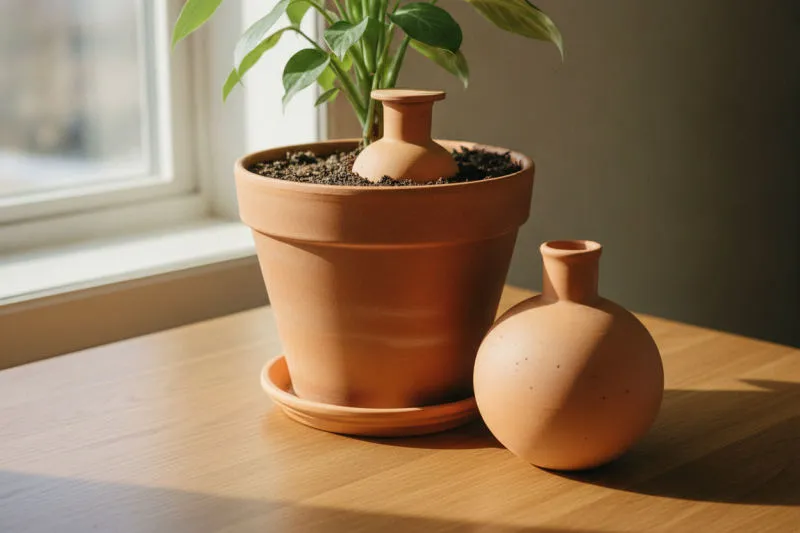
An olla is an unglazed terracotta pot with a round belly and a narrow neck. You bury it near the roots and fill it with water, and it releases that water into the soil little by little, through its walls. In the meantime, you stop watering: you just refill it from time to time.
The idea goes back more than two thousand years. A Chinese farming treatise already described it, and the technique traveled as far as North Africa and Latin America, where the vessel is called an olla, the Spanish word for pot. That is where the name comes from.
Quick recap
- The principle: porous terracotta lets water through when the soil around it dries out.
- The benefit: steady moisture, with no watering to do and no water wasted.
- Good for: plants that like their soil moist at all times.
- Not for: cacti, succulents, orchids and any plant that needs to dry out between waterings.
- Upkeep: refill it before it runs dry, and descale it from time to time.
How it works
The wall of an olla is full of tiny pores. As long as the surrounding soil is moist, the water stays almost still inside the olla. When the soil dries, it “pulls” water through the wall by capillary action until it is back in balance.
The result: the olla gives more when it's hot and the plant is drinking a lot, and almost nothing while the soil is still wet. It regulates the flow on its own, something no fixed watering schedule can do.
Roots figure this out fast. They grow toward the walls of the olla and settle there, where the soil stays moist.
The difference it makes
Less wasted water. The water arrives below the surface, right at root level. It doesn't run out of the pot, and far less of it evaporates than when you pour water on top.
Steady moisture. No more swinging between soggy soil on Monday and dry soil on Friday. That is exactly what ferns, Calathea or peace lilies need, since they don't cope well with ups and downs.
Fewer chores. A small olla lasts several days in a pot, and a large one in the ground lasts one to two weeks, depending on the heat. Handy for a long weekend or a busy week.
Leaves stay dry. The water never reaches the foliage, which means fewer spots and fewer diseases linked to wet leaves.
Plants that love it, and plants that can't stand it
An olla keeps the soil moist all the time. That is a gift for some plants and poison for others.
Plants that benefit: ferns, Calathea and Maranta, peace lily, Monstera, Pothos, Philodendron, Alocasia, thirsty herbs (basil, mint, parsley) and, in the vegetable garden, tomatoes, zucchini or strawberries.
Avoid at all costs: cacti and succulents, orchids and other epiphytes (in the wild, their roots live in the open air), snake plant, ZZ plant, aloe vera, and fleshy, water-storing plants in general. Their roots need air between waterings: soil that is always moist makes them rot.
When in doubt, one simple rule: if the plant tag says “allow to dry out between waterings,” skip the olla.
Pick the right size
- A small olla, about 10 fl oz (0.3 L), for a pot 6 to 10 in (15 to 25 cm) in diameter.
- A medium one, about 1 quart (1 L), for a 12 to 16 in (30 to 40 cm) pot or a window box.
- A large one, several quarts (several liters), for a big planter or directly in the ground, where it waters the soil for a foot or so all around it.
Better an olla that's a little small than one that's too big: in a narrow pot, a large olla would drown the root ball.
Installing an olla, step by step
- Soak the olla in water for an hour before using it for the first time. Dry terracotta absorbs water itself before it releases any.
- Place it near the roots without damaging them: the best time is when you repot.
- Bury it up to the neck. Only the opening should stick out above the soil.
- Give the plant a normal watering first: the olla releases water into soil that is already moist, not into a dried-out root ball.
- Fill the olla with water, then put its lid on (or a saucer, or a flat stone) to limit evaporation and keep mosquitoes from laying eggs in it.
How often to refill it
Refill it when it's half empty, without waiting for it to run dry: the roots that have settled against it are counting on that water.
How often depends on the size of the olla, the pot, the season and the plant. In summer, near a bright window, a small olla empties in a few days. In winter, when the plant is resting, it can last two to three weeks.
Rainwater or soft water is best: the minerals in hard water clog the pores of the terracotta.
Maintenance
Descale it. Once or twice a year, take the olla out, scrub it with a brush and soak it in water with some vinegar to dissolve the mineral buildup. Rinse it well before putting it back.
Protect it from frost. Outdoors, waterlogged terracotta bursts when it freezes. Empty your garden ollas before winter, or bring them inside.
Keep an eye on the soil. If the surface stays wet all the time or smells musty, the plant is getting too much: switch to a smaller olla, or take it out for a while to let the soil breathe.
Know its limits
An olla is no substitute for good drainage: the pot keeps its drainage hole and its drainage layer. It only waters the soil around it, so a very large planter needs several. And only UNGLAZED terracotta works: a glazed pot, however pretty, lets nothing through.
With Plenova
In your plant's details, go to the “Pot and soil” section and say whether it has an olla, and what size it is; Eve will also ask you about it. Your watering reminders then switch to “Refill the olla” and are spaced further apart the bigger the olla is. And if your plant is one of those that need to dry out between waterings, Plenova advises you to remove the olla and keeps your usual watering schedule.
Found this useful? Pass it on.
 Care 9 min
 Care
June 8, 2026
How to propagate a plant, the complete guide that actually works
Propagation turns a single plant into many. Real methods that work, broken down by species, with no gimmicks.
Read the article Care 6 min
June 7, 2026
How to repot a houseplant, step by step
Repotting can transform or kill your plant. Here is the method that works, the right timing, and the mistakes to avoid.
Read the article Care 5 min
June 4, 2026
What water to use for your houseplants: tap, rain, distilled
Is tap water really bad for your plants? The complete guide so you stop guessing.
Read the article