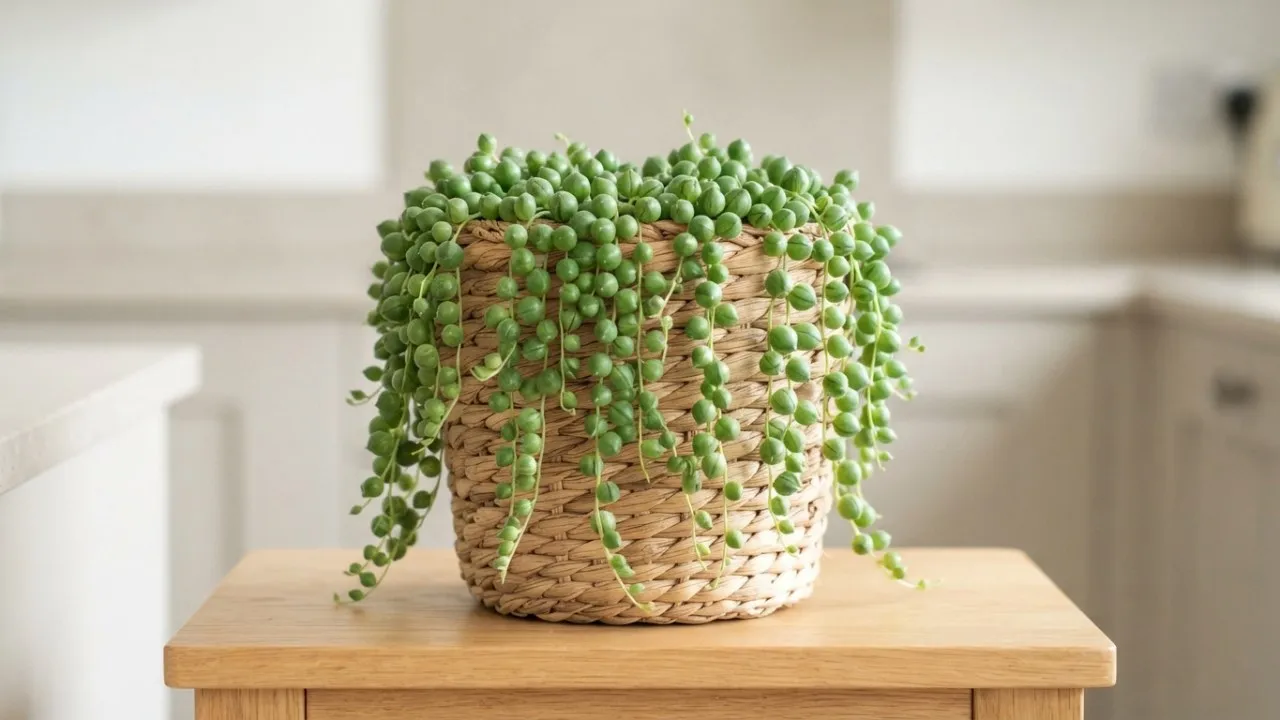
String of Pearls
Senecio rowleyanus
A trailing succulent from South Africa with thin stems bearing small round leaves that look like green pearls.
The essentials at a glance
-
Watering
Every 14 days
-
Light
Bright indirect light
-
Humidity
30–50 %
-
Temperature
12–27 °C


How to care for your String of Pearls
Everything you need to keep your String of Pearls healthy: watering, light, humidity, feeding, repotting and pruning.
Senecio rowleyanus, nicknamed string of pearls, is a fascinating trailing succulent native to the arid regions of Southwest Africa. Its long, thin, trailing stems are adorned with small perfectly spherical leaves that resemble a string of green pearls. In a hanging planter, it creates a stunning cascading effect. While slightly more demanding than other succulents in terms of watering, it remains accessible, and its unique silhouette makes it a highly sought-after plant.

Watering your String of Pearls
Every 14 days
Water moderately, allowing the substrate to dry out well between waterings. Water from above avoiding wetting the foliage. Reduce significantly in winter (once a month).
How to know it needs water
- Pearls beginning to wrinkle and lose their roundness
- Substrate completely dry
- Pearls becoming slightly pointed instead of perfectly round

How much light a String of Pearls needs
Bright indirect light
Bright indirect light. Tolerates a few hours of direct morning sun. Avoid harsh afternoon sun which desiccates the pearls.
- Direct sun tolerated
- 1 to 3 h a day
- Orientations that suit it
- North, North-east, East, South-east, South, South-west, West, North-west

Humidity and misting
30–50 %
Low to moderate (30–50%). Prefers relatively dry air. Never mist. Moisture on the stems and pearls rapidly causes rot.

Feeding and fertiliser
Every 30 days
Fertilize once a month in spring and summer only. Excess fertilizer burns the delicate roots.
- Recommended feed
- Liquid succulent fertilizer diluted to half strength. · 1-2-2

Repotting your String of Pearls
Every 24 months
Handle with extreme care as the stems are very fragile. Use a shallow, wide pot with drainage. Very well-draining substrate: cactus mix and perlite. Coil the stems gently on top of the substrate.
- When
- Spring
- Potting mix
- Cactus and succulent mix
- Mix in
- perlite, pumice, coarse sand
The tell-tale signs
- Plant becoming cramped and stems going bare at the base
- Roots very dense and compacted
- Substrate no longer draining properly

Pruning your String of Pearls
In spring or summer to control length and encourage branching. Cut bare or overly long stems with clean scissors. Cuttings can be planted directly into the substrate to fill out the plant.

Through the year
Watering is not set once and for all: it follows the light and the growth. Allow 22 days between waterings in the depth of winter, against 13 in the growing season.
- 21 J
- 17 F
- 14 M
- 13 A
- 13 M
- 13 J
- 13 J
- 13 A
- 14 S
- 15 O
- 18 N
- 22 D
Active growth · Days between waterings

Toxicity
Toxic to animals and humans. Contains pyrrolizidine alkaloids that can cause digestive and liver disorders. Handle with care and keep out of reach of children.

Good to know
- The spherical leaves of Senecio rowleyanus evolved to minimize surface area exposed to the sun while maximizing water storage — each pearl has a small translucent window that allows light to penetrate inside for photosynthesis.
- In autumn, this plant produces small white flowers with a delicate cinnamon scent, a surprising trait for a succulent.

Frequently asked questions about the String of Pearls
How do you care for a String of Pearls?
Water it every 14 days. Give it bright indirect light. Ideal humidity: 30–50 %. Ideal temperature: 12–27 °C. Water moderately, allowing the substrate to dry out well between waterings. Water from above avoiding wetting the foliage. Reduce significantly in winter (once a month).
How often should you water a String of Pearls?
Every 14 days Water moderately, allowing the substrate to dry out well between waterings. Water from above avoiding wetting the foliage. Reduce significantly in winter (once a month). How to know it needs water : Pearls beginning to wrinkle and lose their roundness ; Substrate completely dry ; Pearls becoming slightly pointed instead of perfectly round.
How much light does a String of Pearls need?
Bright indirect light Bright indirect light. Tolerates a few hours of direct morning sun. Avoid harsh afternoon sun which desiccates the pearls. 1 to 3 h a day
Is the String of Pearls toxic to cats and dogs?
Yes. Toxic to animals and humans. Contains pyrrolizidine alkaloids that can cause digestive and liver disorders. Handle with care and keep out of reach of children. Keep it out of reach of your pets and call a vet if any is swallowed.
Why are my String of Pearls leaves turning yellow?
Yellowing most often comes from too much water: the mix stays wet and the roots suffocate. Check that the pot drains, empty the saucer, and let the mix dry before watering again. Too little light or a cold draught cause the same symptom.
When should you repot a String of Pearls?
Repot every 24 months, ideally in spring. Handle with extreme care as the stems are very fragile. Use a shallow, wide pot with drainage. Very well-draining substrate: cactus mix and perlite. Coil the stems gently on top of the substrate.

At a glance
- Family
- Asteraceae
- Category
- Succulent
- Placement
- Indoor
- Mature height
- 30 cm
- Growth
- Moderate
- Temperature
- 12–27 °C
- Pot materials
- terracotta, ceramic
- Growth
- Reaches maturity in 3 years
These figures are for an average plant. In the app they are recalculated for yours, based on your room, its orientation and the season.
And for your plant, in your home?
In the app this plant becomes yours: a watering schedule tuned to your home, health tracking from photos, and reminders at the right moment.