Variety Succulent · Crassulaceae
Cobweb Houseleek 'Rubrum'
Sempervivum arachnoideum 'Rubrum' · A variety of Cobweb Houseleek
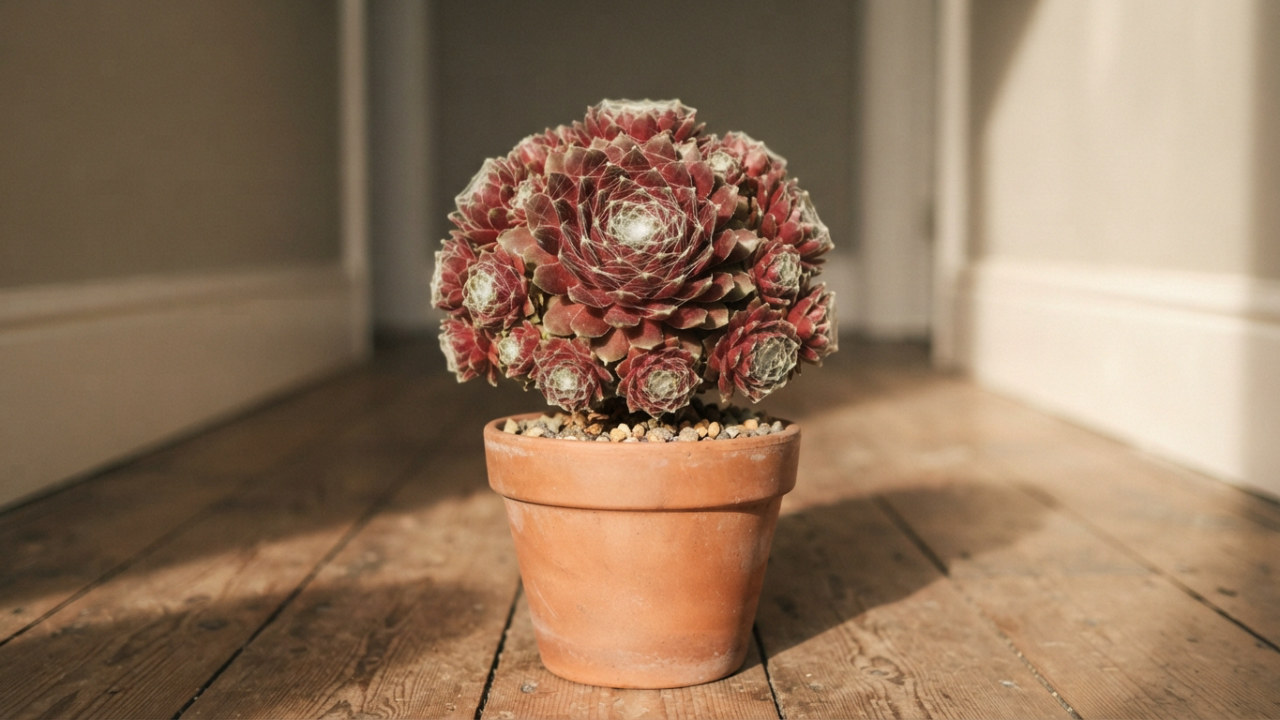
A cobweb houseleek whose small rosettes turn ruby red in sun, laced with fine white webbing at the center.
- Every 14 daysWatering
- Full sunLight
- 20–40 %Humidity
- -20–30 °CTemperature


How to care for your Cobweb Houseleek 'Rubrum'
Everything you need to keep your Cobweb Houseleek 'Rubrum' healthy: watering, light, humidity, feeding, repotting and pruning.
'Rubrum' is a selection of the cobweb houseleek, an alpine succulent. Its small, fleshy rosettes color up ruby red, sometimes gray-green flushed with red in spring, and white web-like hairs bridge the leaf tips. It spreads by offsets into a low mat. In summer a mature rosette may send up a stalk of pink stars, then dies, while its offsets carry on. Fully hardy, it belongs outdoors in a pot or a rock garden.

How to recognise Cobweb Houseleek 'Rubrum'
Ruby-red rosettes, redder than the green or reddish-green species, webbed with white hairs at the tips. 'Cebennense' is larger and pale green with heavier webbing; plain Sempervivum tectorum has no cobweb at all.

Watering your Cobweb Houseleek 'Rubrum'
Every 14 days
Water sparingly at the soil level, wetting the mix rather than the rosettes, and let it dry out completely between waterings.
How to know it needs water
- The mix is completely dry, not just on top
- The rosettes look slightly less plump

How much light a Cobweb Houseleek 'Rubrum' needs
Full sun
Full sun, at least six hours a day; the red color deepens in sun and fades toward green in shade.
- Direct sun tolerated
- 6 to 12 h a day
- Orientations that suit it
- South, South-east, South-west, East, West, North-east, North-west

Humidity and misting
20–40 %
Dry air suits it, between 20 and 40 percent humidity; winter wet is the real danger. Never mist: water trapped in the web and rosettes causes rot.

Feeding and fertiliser
It grows well on poor, gritty soil, and extra feeding only makes the rosettes soft and pale.
- Recommended feed
- None is needed; at most a very weak low-nitrogen fertilizer once in spring. · 5-10-5

Repotting your Cobweb Houseleek 'Rubrum'
Every 36 months
Divide the clump, replant offsets in very gritty mix with perlite or pumice, and keep the base of each rosette above the soil.
- When
- Spring.
- Potting mix
- Cactus and succulent mix
- Mix in
- perlite, pumice, coarse sand
The tell-tale signs
- The clump has crowded out its pot
- Offsets spill over the rim and the mix has compacted

Pruning your Cobweb Houseleek 'Rubrum'
After flowering, when the flower stalk and the rosette that bloomed turn brown. Cut the dry stalk at its base and pull out the dead rosette, leaving its offsets in place.

Through the year
Watering is not set once and for all: it follows the light and the growth. Allow 28 days between waterings in the depth of winter, against 11 in the growing season.
- 25 J
- 21 F
- 14 M
- 11 A
- 11 M
- 11 J
- 11 J
- 11 A
- 13 S
- 17 O
- 22 N
- 28 D
Active growth · Days between waterings

Good to know
- The rosette that flowers is monocarpic: it dies afterward, but its offsets replace it.
- The white hairs form a web that shades the rosette and helps it keep its moisture.

Frequently asked questions about the Cobweb Houseleek 'Rubrum'
How do you care for a Cobweb Houseleek 'Rubrum'?
Water it every 14 days. Give it full sun. Ideal humidity: 20–40 %. Ideal temperature: -20–30 °C. Water sparingly at the soil level, wetting the mix rather than the rosettes, and let it dry out completely between waterings.
How often should you water a Cobweb Houseleek 'Rubrum'?
Every 14 days Water sparingly at the soil level, wetting the mix rather than the rosettes, and let it dry out completely between waterings. How to know it needs water : The mix is completely dry, not just on top ; The rosettes look slightly less plump.
How much light does a Cobweb Houseleek 'Rubrum' need?
Full sun Full sun, at least six hours a day; the red color deepens in sun and fades toward green in shade. 6 to 12 h a day
Is the Cobweb Houseleek 'Rubrum' toxic to cats and dogs?
No, the Cobweb Houseleek 'Rubrum' is not listed as toxic to cats and dogs. That is still no reason to let your pets chew on it.
Why are my Cobweb Houseleek 'Rubrum' leaves turning yellow?
Yellowing most often comes from too much water: the mix stays wet and the roots suffocate. Check that the pot drains, empty the saucer, and let the mix dry before watering again. Too little light or a cold draught cause the same symptom.
When should you repot a Cobweb Houseleek 'Rubrum'?
Repot every 36 months, ideally in spring.. Divide the clump, replant offsets in very gritty mix with perlite or pumice, and keep the base of each rosette above the soil.

At a glance
- Family
- Crassulaceae
- Category
- Succulent
- Placement
- Outdoor
- Mature height
- 10 cm
- Growth
- Slow
- Temperature
- -20–30 °C
- Pot materials
- terracotta, ceramic
- Growth
- Reaches maturity in 3 years
These figures are for an average plant. In the app they are recalculated for yours, based on your room, its orientation and the season.
And for your plant, in your home?
In the app this plant becomes yours: a watering schedule tuned to your home, health tracking from photos, and reminders at the right moment.