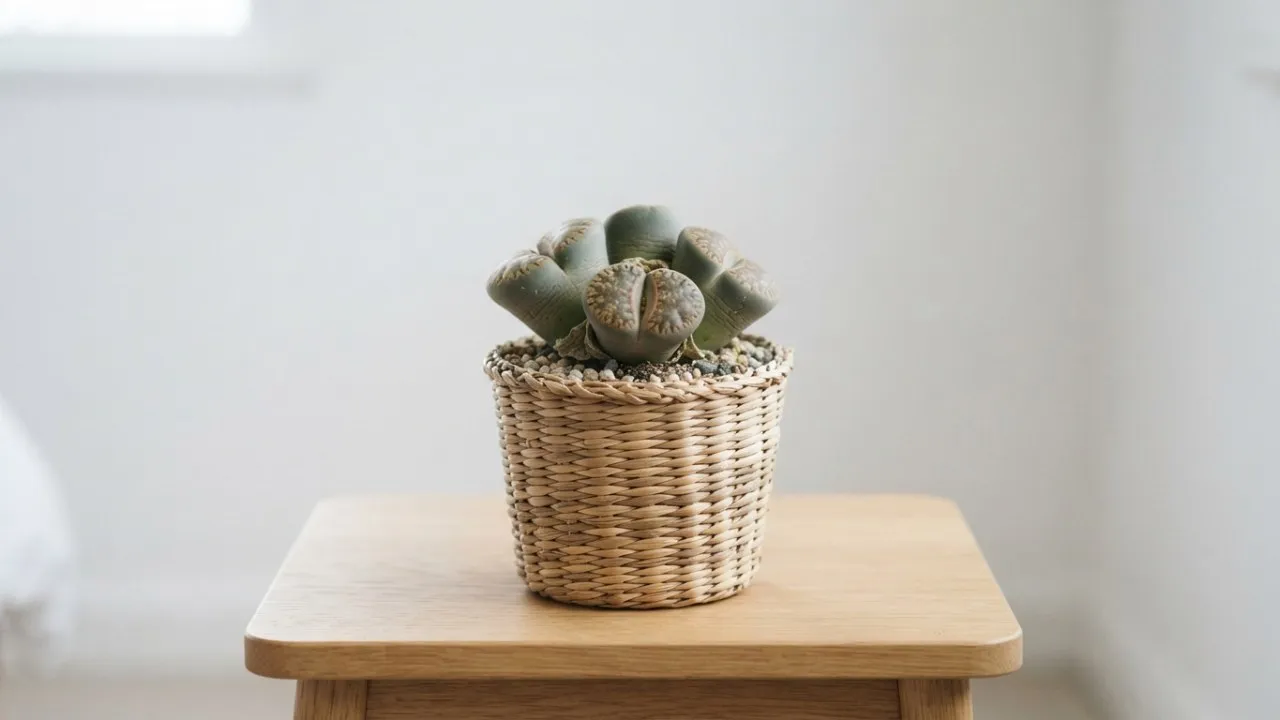
Living Stones
Lithops
A fascinating succulent from South Africa resembling a small split pebble, a master of botanical camouflage.
The essentials at a glance
-
Watering
Every 30 days
-
Light
Full sun
-
Humidity
10–30 %
-
Temperature
10–35 °C


How to care for your Living Stones
Everything you need to keep your Living Stones healthy: watering, light, humidity, feeding, repotting and pruning.
Lithops, or living stones, are among the most unusual plants in the world. Native to the deserts of southern Africa, these miniature succulents consist of two fused fleshy leaves that perfectly mimic surrounding pebbles. Each year, a new pair of leaves emerges from the central fissure while the old one dries up and nourishes the new growth. Their very particular life cycle requires strict seasonal watering, making them a fascinating challenge for succulent enthusiasts.

Watering your Living Stones
Every 30 days
Very sparingly and only during the active growing period (late summer to autumn). NEVER water during moulting (winter–spring) or in midsummer (dormancy). Excess water is fatal.
How to know it needs water
- Sides of the plant beginning to wrinkle
- Substrate has been dry for several weeks
- Plant is NOT in moulting period (no new pair of leaves visible)

How much light a Living Stones needs
Full sun
Full sun or very bright light. At least 5 hours of direct sunlight daily. Insufficient light causes etiolation and loss of coloration.
- Direct sun tolerated
- 5 to 10 h a day
- Orientations that suit it
- South, South-east, South-west, East, West

Humidity and misting
10–30 %
Very low (10–30%). Avoid any elevated humidity. Never mist. Any moisture on the plant is dangerous and can cause immediate rot.

Feeding and fertiliser
Every 60 days
Fertilize very rarely, one to two times per year maximum, in autumn. Excess fertilizer causes swelling and cracking of the plant.
- Recommended feed
- Cactus fertilizer diluted to a quarter dose, only in autumn during active growth. · 0-10-10

Repotting your Living Stones
Every 36 months
Use a deep, narrow pot with excellent drainage. Almost entirely mineral substrate: 80% pumice/perlite/gravel + 20% potting soil. Bury the plant to its natural ground level. Do not water for 2 weeks after repotting.
- When
- Late summer (just before the resumption of growth)
- Potting mix
- Cactus and succulent mix
- Mix in
- pumice, coarse sand
The tell-tale signs
- Plant has formed a dense cluster of several heads
- Roots filling the pot
- Substrate completely mineral and degraded

Pruning your Living Stones
No pruning needed. Remove dried old leaves after moulting if they do not detach by themselves.

Through the year
Watering is not set once and for all: it follows the light and the growth. Allow 90 days between waterings in the depth of winter, against 30 in the growing season.
- 75 J
- 75 F
- 30 M
- 30 A
- 30 M
- 90 J
- 90 J
- 90 A
- 30 S
- 30 O
- 30 N
- 75 D
Active growth · Days between waterings

Good to know
- Lithops evolved to perfectly resemble the pebbles in their South African desert environment — this mimicry allows them to escape herbivorous animals that cannot distinguish them from surrounding stones.
- The upper surface of Lithops has translucent windows that let light pass into the interior of the leaf where photosynthetic cells are located, allowing the plant to photosynthesize while remaining nearly buried.

Frequently asked questions about the Living Stones
How do you care for a Living Stones?
Water it every 30 days. Give it full sun. Ideal humidity: 10–30 %. Ideal temperature: 10–35 °C. Very sparingly and only during the active growing period (late summer to autumn). NEVER water during moulting (winter–spring) or in midsummer (dormancy). Excess water is fatal.
How often should you water a Living Stones?
Every 30 days Very sparingly and only during the active growing period (late summer to autumn). NEVER water during moulting (winter–spring) or in midsummer (dormancy). Excess water is fatal. How to know it needs water : Sides of the plant beginning to wrinkle ; Substrate has been dry for several weeks ; Plant is NOT in moulting period (no new pair of leaves visible).
How much light does a Living Stones need?
Full sun Full sun or very bright light. At least 5 hours of direct sunlight daily. Insufficient light causes etiolation and loss of coloration. 5 to 10 h a day
Is the Living Stones toxic to cats and dogs?
No, the Living Stones is not listed as toxic to cats and dogs. That is still no reason to let your pets chew on it.
Why are my Living Stones leaves turning yellow?
Yellowing most often comes from too much water: the mix stays wet and the roots suffocate. Check that the pot drains, empty the saucer, and let the mix dry before watering again. Too little light or a cold draught cause the same symptom.
When should you repot a Living Stones?
Repot every 36 months, ideally in late summer (just before the resumption of growth). Use a deep, narrow pot with excellent drainage. Almost entirely mineral substrate: 80% pumice/perlite/gravel + 20% potting soil. Bury the plant to its natural ground level. Do not water for 2 weeks after repotting.

At a glance
- Family
- Aizoaceae
- Category
- Succulent
- Placement
- Indoor
- Mature height
- 3 cm
- Growth
- Slow
- Temperature
- 10–35 °C
- Pot materials
- terracotta
- Growth
- Reaches maturity in 5 years
These figures are for an average plant. In the app they are recalculated for yours, based on your room, its orientation and the season.
And for your plant, in your home?
In the app this plant becomes yours: a watering schedule tuned to your home, health tracking from photos, and reminders at the right moment.