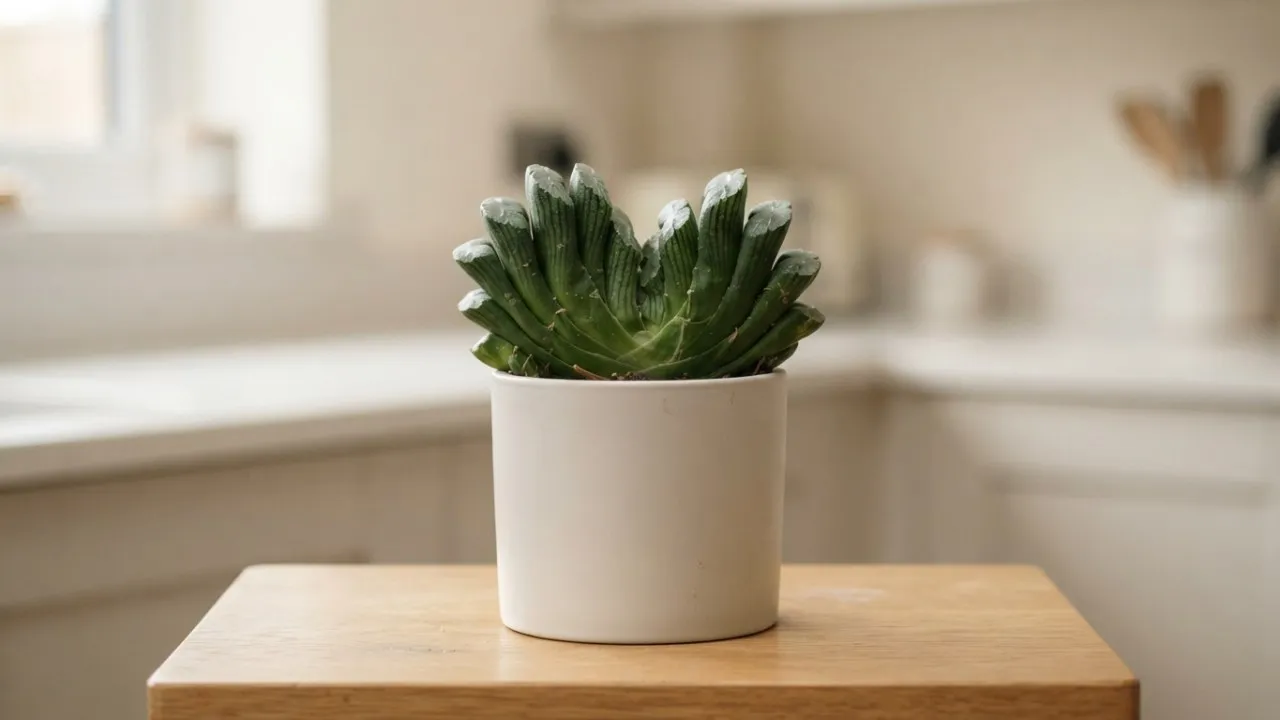
Horse's Teeth
Haworthia truncata
An unusual Haworthia with flattened, truncated, windowed leaves arranged in a distichous pattern.
The essentials at a glance
-
Watering
Every 21 days
-
Light
Bright indirect light
-
Humidity
40–60 %
-
Temperature
10–27 °C


How to care for your Horse's Teeth
Everything you need to keep your Horse's Teeth healthy: watering, light, humidity, feeding, repotting and pruning.
Haworthia truncata, aptly nicknamed 'Horse's Teeth,' is one of the most unique and sought-after succulents. Its distinctive, thickened leaves are flattened or 'truncated' at the top, exposing a translucent, window-like surface. These leaves are often arranged in two opposing rows (distichous) rather than a circular rosette. This adaptation allows the plant to bury itself to avoid harsh sun, with only the leaf windows exposed to capture light. It's a slow-growing species, rewarding careful cultivation with its architectural beauty.

Watering your Horse's Teeth
Every 21 days
Water thoroughly but sparingly when soil is completely dry.
How to know it needs water
- Leaves show slight indentation/softness
- Pot is very light

How much light a Horse's Teeth needs
Bright indirect light
Bright indirect light; avoid direct sun.
- Direct sun tolerated
- 0 to 2 h a day
- Orientations that suit it
- North, North-east, East, South-east, North-west, West

Humidity and misting
40–60 %
Low to medium (40-60%) Misting is not necessary and can lead to rot; keep foliage dry.

Feeding and fertiliser
Every 120 days
Fertilize once or twice during the growing season; minimal feeding.
- Recommended feed
- Very diluted succulent fertilizer. · 2-7-7

Repotting your Horse's Teeth
Every 36 months
Repot carefully, disturbing roots minimally, in very gritty mix.
- When
- Spring
- Potting mix
- Cactus and succulent mix
- Mix in
- pumice, coarse sand, perlite
The tell-tale signs
- Plant fills its pot completely
- Slowed growth
- Soil degradation

Pruning your Horse's Teeth
Remove any old or desiccated outer leaves and spent flower stalks. Use sterile snips to cut cleanly at the base.

Through the year
Watering is not set once and for all: it follows the light and the growth. Allow 32 days between waterings in the depth of winter, against 17 in the growing season.
- 32 J
- 25 F
- 19 M
- 17 A
- 17 M
- 17 J
- 17 J
- 17 A
- 19 S
- 21 O
- 27 N
- 32 D
Active growth · Days between waterings

Good to know
- Its leaves are flattened at the top, resembling a horse's teeth.
- The flattened tips are translucent 'windows' allowing light to internal tissue.

Frequently asked questions about the Horse's Teeth
How do you care for a Horse's Teeth?
Water it every 21 days. Give it bright indirect light. Ideal humidity: 40–60 %. Ideal temperature: 10–27 °C. Water thoroughly but sparingly when soil is completely dry.
How often should you water a Horse's Teeth?
Every 21 days Water thoroughly but sparingly when soil is completely dry. How to know it needs water : Leaves show slight indentation/softness ; Pot is very light.
How much light does a Horse's Teeth need?
Bright indirect light Bright indirect light; avoid direct sun. 0 to 2 h a day
Is the Horse's Teeth toxic to cats and dogs?
No, the Horse's Teeth is not listed as toxic to cats and dogs. That is still no reason to let your pets chew on it.
Why are my Horse's Teeth leaves turning yellow?
Yellowing most often comes from too much water: the mix stays wet and the roots suffocate. Check that the pot drains, empty the saucer, and let the mix dry before watering again. Too little light or a cold draught cause the same symptom.
When should you repot a Horse's Teeth?
Repot every 36 months, ideally in spring. Repot carefully, disturbing roots minimally, in very gritty mix.

At a glance
- Family
- Asphodelaceae
- Category
- Succulent
- Placement
- Indoor and outdoor
- Mature height
- 10 cm
- Growth
- Slow
- Temperature
- 10–27 °C
- Pot materials
- terracotta, ceramic
- Growth
- Reaches maturity in 5 years
These figures are for an average plant. In the app they are recalculated for yours, based on your room, its orientation and the season.
And for your plant, in your home?
In the app this plant becomes yours: a watering schedule tuned to your home, health tracking from photos, and reminders at the right moment.