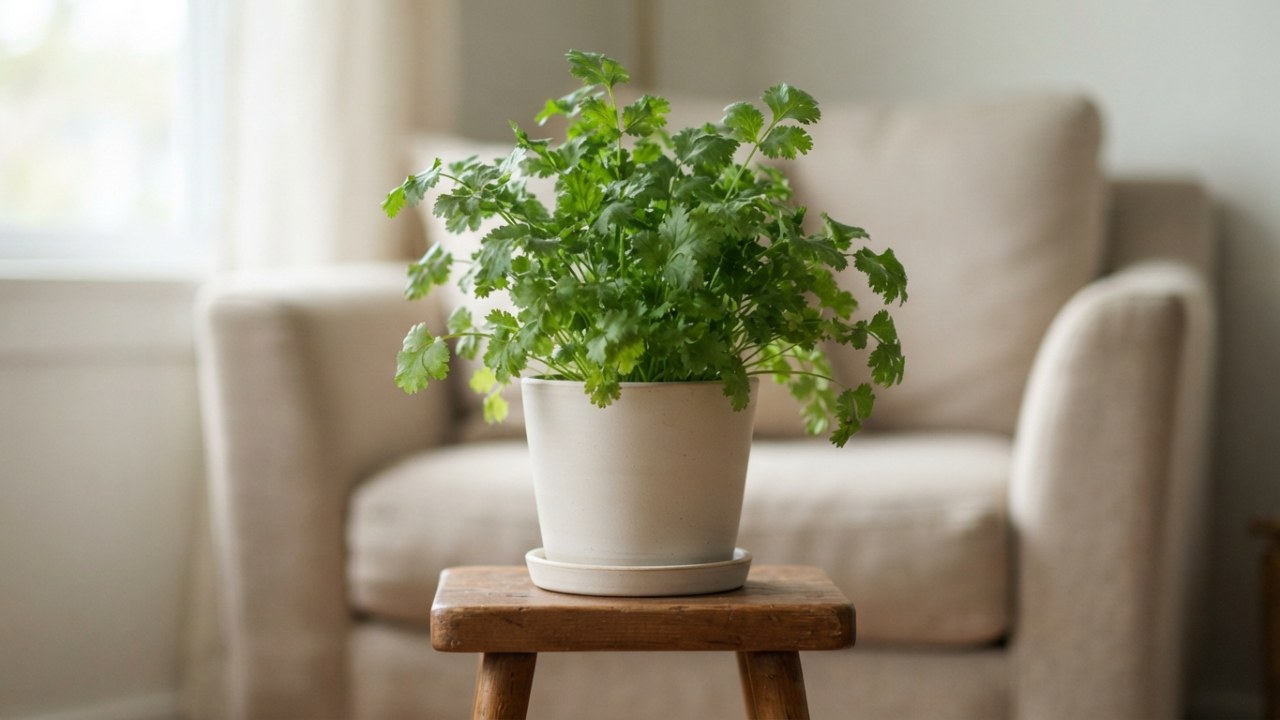
Herb · Apiaceae
Coriander
Coriandrum sativum
Coriander is a popular aromatic herb known for its distinctive fresh leaves and seeds.
- Every 3 daysWatering
- Bright indirect lightLight
- 40–60 %Humidity
- 18–24 °CTemperature


How to care for your Coriander
Everything you need to keep your Coriander healthy: watering, light, humidity, feeding, repotting and pruning.
Coriandrum sativum, commonly known as coriander or cilantro, is an annual herb in the family Apiaceae. Native to regions spanning from Southern Europe and North Africa to Southwestern Asia, it is widely cultivated for its culinary uses. Its delicate, finely divided green leaves offer a pungent, citrusy aroma, while its dried seeds provide a warm, nutty spice. Coriander thrives in bright light and moderate temperatures, making it suitable for both indoor and outdoor cultivation. It tolerates light frost down to about -5 °C but runs to seed quickly in heat above 25 °C. In a pot, bring it indoors or cover it in hard frost. Regular harvesting of leaves encourages a bushier plant and delays the onset of flowering (bolting).

How to recognise Coriander
Lower leaves are broad and lightly lobed, while upper leaves on the flowering stems are feathery and finely cut. The whole plant has a strong, citrusy smell, and small white to pink flowers form in flat umbels. Flat-leaf parsley has darker, glossier leaves with a parsley scent, and culantro (Eryngium foetidum) has long, serrated, spiny-edged leaves.

Watering your Coriander
Every 3 days
Keep the soil lightly moist, watering when the top 1 to 2 cm of soil feels dry to the touch, about every 3 days in the growing season and about every 5 days in the cool season. Ensure good drainage.
How to know it needs water
- Soil dry 1 to 2 cm deep
- Leaves slightly wilting
- Pot feels light

How much light a Coriander needs
Bright indirect light
Bright direct to indirect light; prefers morning sun and some afternoon shade.
- Direct sun tolerated
- 2 to 4 h a day
- Orientations that suit it
- East, West, South-east, South-west

Humidity and misting
40–60 %
Medium (40 to 60 %) Coriander does not need misting; ensure good air circulation.

Feeding and fertiliser
Every 28 days
Apply every 4 weeks from April to September. Do not feed in winter.
- Recommended feed
- Balanced NPK liquid fertilizer · 5-10-5

Repotting your Coriander
Coriander is grown as an annual and has a taproot that dislikes disturbance, so sow it directly in its final pot. If transplanting, move to a slightly larger pot with well-draining potting mix, disturbing roots as little as possible.
- When
- Spring
- Potting mix
- All-purpose potting mix
- Mix in
- perlite, coco fibre
The tell-tale signs
- Roots emerging from drainage holes
- Plant appears root-bound
- Growth has slowed significantly

Pruning your Coriander
Harvest outer leaves regularly to encourage new growth and delay bolting. Snip outer stems at the base with clean scissors or a sharp blade.

Through the year
Watering is not set once and for all: it follows the light and the growth. Allow 5 days between waterings in the depth of winter, against 2 in the growing season.
- 5 J
- 4 F
- 3 M
- 2 A
- 2 M
- 2 J
- 2 J
- 2 A
- 3 S
- 4 O
- 5 N
- 5 D
Active growth · Days between waterings

Good to know
- Coriander leaves are commonly referred to as fresh cilantro.
- Some people find the leaves taste soapy, a trait linked to a variant in their genes for smell receptors.
- Its dried seeds are often used whole as a spice.

Frequently asked questions about the Coriander
How do you care for a Coriander?
Water it every 3 days. Give it bright indirect light. Ideal humidity: 40–60 %. Ideal temperature: 18–24 °C. Keep the soil lightly moist, watering when the top 1 to 2 cm of soil feels dry to the touch, about every 3 days in the growing season and about every 5 days in the cool season. Ensure good drainage.
How often should you water a Coriander?
Every 3 days Keep the soil lightly moist, watering when the top 1 to 2 cm of soil feels dry to the touch, about every 3 days in the growing season and about every 5 days in the cool season. Ensure good drainage. How to know it needs water : Soil dry 1 to 2 cm deep ; Leaves slightly wilting ; Pot feels light.
How much light does a Coriander need?
Bright indirect light Bright direct to indirect light; prefers morning sun and some afternoon shade. 2 to 4 h a day
Is the Coriander toxic to cats and dogs?
No, the Coriander is not listed as toxic to cats and dogs. That is still no reason to let your pets chew on it.
Why are my Coriander leaves turning yellow?
Yellowing most often comes from too much water: the mix stays wet and the roots suffocate. Check that the pot drains, empty the saucer, and let the mix dry before watering again. Too little light or a cold draught cause the same symptom.
When should you repot a Coriander?
Repot , ideally in spring. Coriander is grown as an annual and has a taproot that dislikes disturbance, so sow it directly in its final pot. If transplanting, move to a slightly larger pot with well-draining potting mix, disturbing roots as little as possible.

At a glance
- Family
- Apiaceae
- Category
- Herb
- Placement
- Indoor and outdoor
- Mature height
- 60 cm
- Growth
- Fast
- Temperature
- 18–24 °C
- Pot materials
- terracotta, ceramic, plastic
These figures are for an average plant. In the app they are recalculated for yours, based on your room, its orientation and the season.
And for your plant, in your home?
In the app this plant becomes yours: a watering schedule tuned to your home, health tracking from photos, and reminders at the right moment.