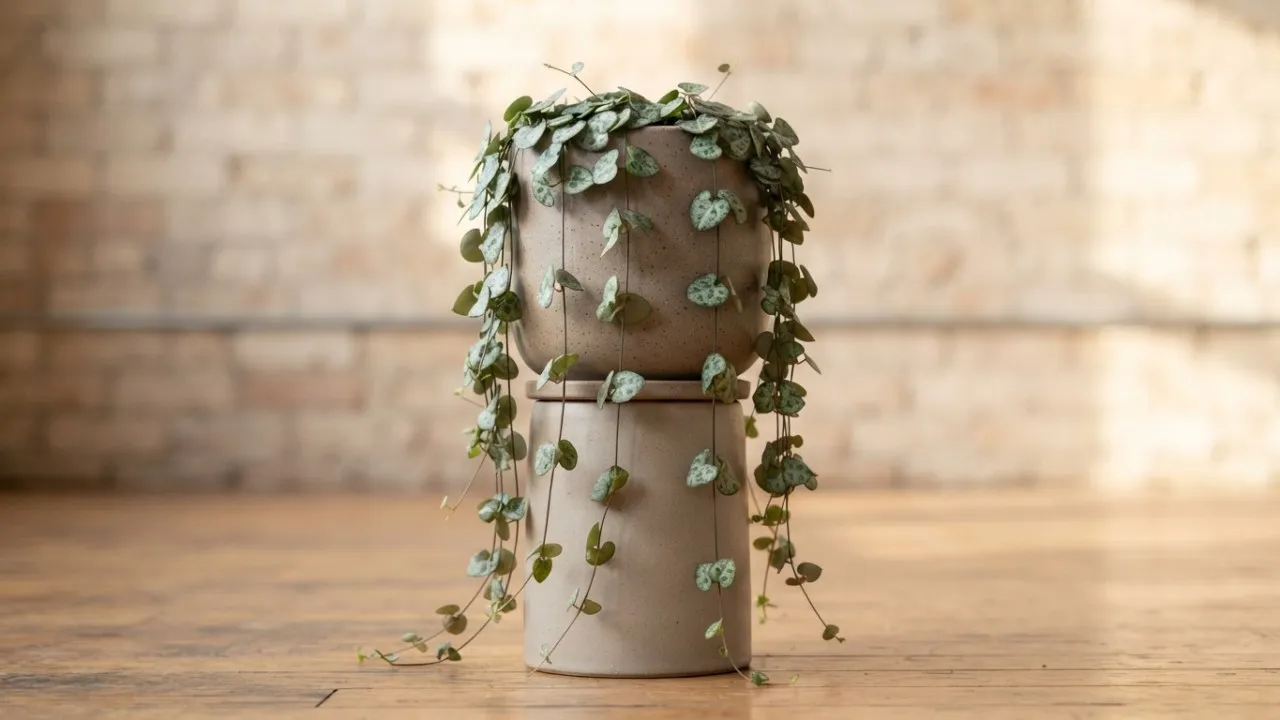
String of Hearts
Ceropegia woodii
A trailing plant with thin purple stems bearing small heart-shaped leaves marbled with silver-green and dark green.
The essentials at a glance
-
Watering
Every 12 days
-
Light
Bright indirect light
-
Humidity
30–50 %
-
Temperature
10–28 °C


How to care for your String of Hearts
Everything you need to keep your String of Hearts healthy: watering, light, humidity, feeding, repotting and pruning.
Ceropegia woodii is a trailing succulent plant native to South Africa, famous for its charming small heart-shaped leaves. Its long, thread-like purple stems bear pairs of leaves marbled silver-green on top and purplish underneath. It develops a tuberous caudex that allows it to withstand long periods of drought. Easy to grow and propagate thanks to its aerial tubers, it is an ideal hanging plant that can reach several meters in length.

Watering your String of Hearts
Every 12 days
Water moderately when the substrate is thoroughly dry. The caudiciform tuber stores water, making it drought-resistant. Reduce in winter.
How to know it needs water
- Substrate dry throughout
- Leaves curling slightly or appearing thinner
- The base tuber no longer firm to the touch

How much light a String of Hearts needs
Bright indirect light
Bright indirect light with a few hours of direct sun. The brighter the light, the more colorful and compact the foliage. Tolerates partial shade but will etiolate.
- Direct sun tolerated
- 2 to 4 h a day
- Orientations that suit it
- East, South-east, South, South-west, West, North-west

Humidity and misting
30–50 %
Low to moderate (30–50%). Tolerates dry indoor air very well. No misting needed. Prefers dry to moderate air.

Feeding and fertiliser
Every 30 days
Fertilize once a month from spring to autumn. No fertilization in winter.
- Recommended feed
- Liquid foliage plant fertilizer diluted to half strength. · 2-7-7

Repotting your String of Hearts
Every 24 months
Use a shallow pot with good drainage. Well-draining substrate (cactus mix and perlite). Place the tuber partially above the substrate surface. Small aerial tubers on the stems can be laid on the substrate to root.
- When
- Spring
- Potting mix
- Cactus and succulent mix
- Mix in
- perlite, pumice, coarse sand
The tell-tale signs
- The tuber filling the pot
- Roots very tightly packed
- Stems going bare at the base despite good conditions

Pruning your String of Hearts
In spring or summer if stems become too long or bare. Cut stems to the desired length. Portions with nodes can be replanted for propagation. Small aerial tubers on the stems can also be planted.

Through the year
Watering is not set once and for all: it follows the light and the growth. Allow 22 days between waterings in the depth of winter, against 10 in the growing season.
- 18 J
- 16 F
- 12 M
- 11 A
- 10 M
- 10 J
- 10 J
- 11 A
- 12 S
- 14 O
- 18 N
- 22 D
Active growth · Days between waterings

Good to know
- Ceropegia woodii develops a tuberous caudex at its base that serves as a water reserve, and also produces small aerial tubers on its stems that allow easy propagation.
- Its tubular flowers are actual insect traps: small flies are lured inside by downward-pointing hairs, and are only released once covered in pollen.

Frequently asked questions about the String of Hearts
How do you care for a String of Hearts?
Water it every 12 days. Give it bright indirect light. Ideal humidity: 30–50 %. Ideal temperature: 10–28 °C. Water moderately when the substrate is thoroughly dry. The caudiciform tuber stores water, making it drought-resistant. Reduce in winter.
How often should you water a String of Hearts?
Every 12 days Water moderately when the substrate is thoroughly dry. The caudiciform tuber stores water, making it drought-resistant. Reduce in winter. How to know it needs water : Substrate dry throughout ; Leaves curling slightly or appearing thinner ; The base tuber no longer firm to the touch.
How much light does a String of Hearts need?
Bright indirect light Bright indirect light with a few hours of direct sun. The brighter the light, the more colorful and compact the foliage. Tolerates partial shade but will etiolate. 2 to 4 h a day
Is the String of Hearts toxic to cats and dogs?
No, the String of Hearts is not listed as toxic to cats and dogs. That is still no reason to let your pets chew on it.
Why are my String of Hearts leaves turning yellow?
Yellowing most often comes from too much water: the mix stays wet and the roots suffocate. Check that the pot drains, empty the saucer, and let the mix dry before watering again. Too little light or a cold draught cause the same symptom.
When should you repot a String of Hearts?
Repot every 24 months, ideally in spring. Use a shallow pot with good drainage. Well-draining substrate (cactus mix and perlite). Place the tuber partially above the substrate surface. Small aerial tubers on the stems can be laid on the substrate to root.

At a glance
- Family
- Apocynaceae
- Category
- Succulent
- Placement
- Indoor
- Mature height
- 1 m
- Growth
- Moderate
- Temperature
- 10–28 °C
- Pot materials
- terracotta, ceramic, plastic
- Growth
- Reaches maturity in 3 years
These figures are for an average plant. In the app they are recalculated for yours, based on your room, its orientation and the season.
And for your plant, in your home?
In the app this plant becomes yours: a watering schedule tuned to your home, health tracking from photos, and reminders at the right moment.