
Variety Tropical · Commelinaceae
Callisia 'Pink Lady'
Callisia repens 'Pink Lady' · A variety of Creeping Inchplant
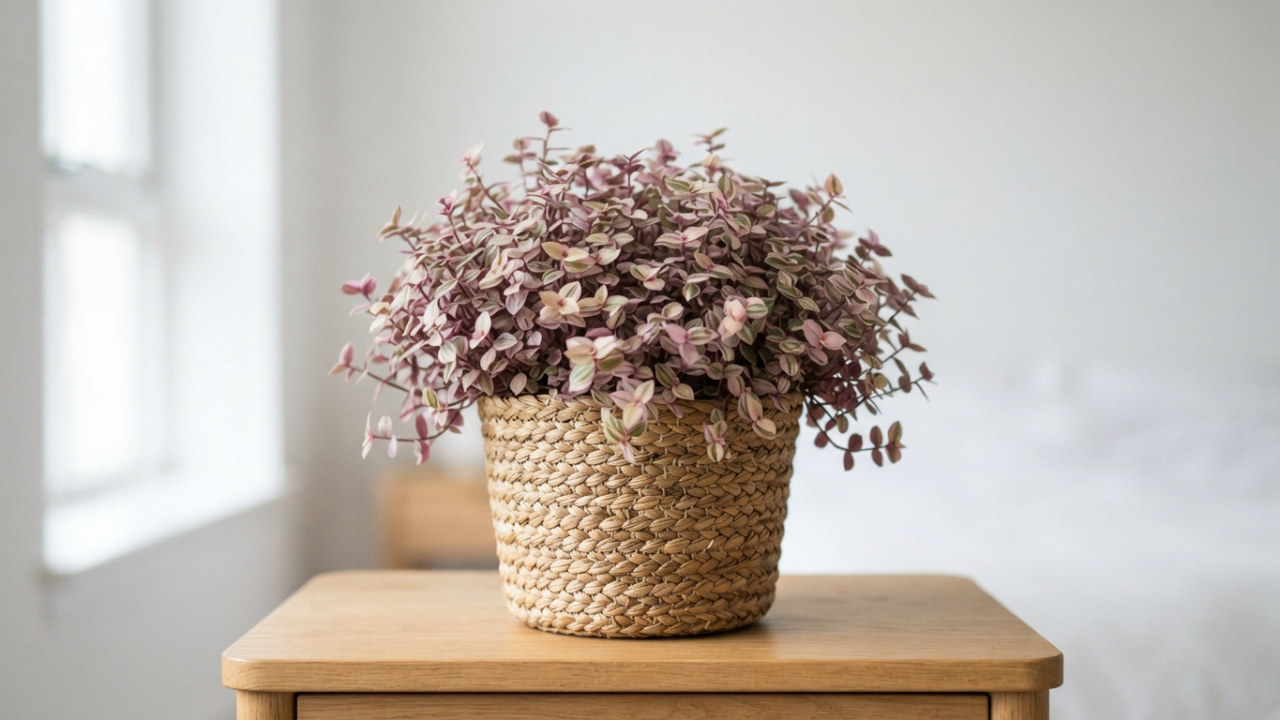
A low creeping Callisia with small waxy leaves in pink, cream and green, and a burgundy underside.
- Every 6 daysWatering
- Bright indirect lightLight
- 40–65 %Humidity
- 16–28 °CTemperature


How to care for your Callisia 'Pink Lady'
Everything you need to keep your Callisia 'Pink Lady' healthy: watering, light, humidity, feeding, repotting and pruning.
A variegated cultivar of Callisia repens, also sold as 'Bianca', 'Pink Lady' forms a dense, low mat of creeping stems with small, waxy, heart-shaped to oval leaves up to about 2.5 cm long. The upper surface is mixed pink, cream and green, and the underside is burgundy or purple. It stays around 10 to 15 cm tall and trails 60 cm or more over the pot edge. Small white flowers may open in late spring. The pink holds only in bright light; in dim light the leaves slip back to green.

How to recognise Callisia 'Pink Lady'
Tiny waxy leaves splashed pink, cream and green, burgundy beneath, on a low creeping mat. Plain Callisia repens is greener with purple only below, Callisia gentlei has larger silver-striped leaves, and Tradescantia fluminensis has longer, thin, smooth leaves on lax stems.

Watering your Callisia 'Pink Lady'
Every 6 days
Water thoroughly when the top inch of the mix is dry, empty the saucer, and let it dry a little longer in winter.
How to know it needs water
- The top inch of the mix feels dry.
- The small leaves feel a little soft instead of plump, and the pot feels light.

How much light a Callisia 'Pink Lady' needs
Bright indirect light
Bright indirect light, with at most a couple of hours of gentle sun, keeps the pink and cream; in low light the leaves turn green.
- Direct sun tolerated
- 0 to 2 h a day
- Orientations that suit it
- East, South-east, South, South-west, West

Humidity and misting
40–65 %
Average room humidity, about 40 to 65 percent, suits it if the air moves freely. Misting is not needed, since water trapped between the crowded leaves invites rot.

Feeding and fertiliser
Every 28 days
Feed about once a month from April to September, and stop in the darker months.
- Recommended feed
- A balanced liquid houseplant fertilizer at half strength. · 10-10-10

Repotting your Callisia 'Pink Lady'
Every 24 months
Move it to a shallow, wide pot one size larger with fresh, airy mix, handling the brittle stems gently.
- When
- Repot in spring, when growth restarts.
- Potting mix
- All-purpose potting mix
- Mix in
- perlite, coarse sand, coco fibre
The tell-tale signs
- Stems hide the pot rim and crowd the surface.
- Roots fill the pot and water runs straight through.

Pruning your Callisia 'Pink Lady'
Trim in spring and summer, during active growth. Pinch stem tips to thicken the mat, snip off plain green shoots, and root the cuttings in moist mix to fill bare patches.

Through the year
Watering is not set once and for all: it follows the light and the growth. Allow 9 days between waterings in the depth of winter, against 4 in the growing season.
- 9 J
- 8 F
- 7 M
- 5 A
- 5 M
- 4 J
- 4 J
- 4 A
- 5 S
- 6 O
- 8 N
- 9 D
Active growth · Days between waterings

Toxicity
The sap can irritate the skin of people and pets, and chewing it may upset the stomach of a cat or dog, so wear gloves when pruning and keep it out of reach.

Good to know
- Its stems root at nearly every node that touches the soil, so pieces of mat root easily.
- 'Pink Lady' and 'Bianca' are widely treated as the same plant sold under two names.

Frequently asked questions about the Callisia 'Pink Lady'
How do you care for a Callisia 'Pink Lady'?
Water it every 6 days. Give it bright indirect light. Ideal humidity: 40–65 %. Ideal temperature: 16–28 °C. Water thoroughly when the top inch of the mix is dry, empty the saucer, and let it dry a little longer in winter.
How often should you water a Callisia 'Pink Lady'?
Every 6 days Water thoroughly when the top inch of the mix is dry, empty the saucer, and let it dry a little longer in winter. How to know it needs water : The top inch of the mix feels dry. ; The small leaves feel a little soft instead of plump, and the pot feels light..
How much light does a Callisia 'Pink Lady' need?
Bright indirect light Bright indirect light, with at most a couple of hours of gentle sun, keeps the pink and cream; in low light the leaves turn green. 0 to 2 h a day
Is the Callisia 'Pink Lady' toxic to cats and dogs?
Yes. The sap can irritate the skin of people and pets, and chewing it may upset the stomach of a cat or dog, so wear gloves when pruning and keep it out of reach. Keep it out of reach of your pets and call a vet if any is swallowed.
Why are my Callisia 'Pink Lady' leaves turning yellow?
Yellowing most often comes from too much water: the mix stays wet and the roots suffocate. Check that the pot drains, empty the saucer, and let the mix dry before watering again. Too little light or a cold draught cause the same symptom.
When should you repot a Callisia 'Pink Lady'?
Repot every 24 months, ideally in repot in spring, when growth restarts.. Move it to a shallow, wide pot one size larger with fresh, airy mix, handling the brittle stems gently.

At a glance
- Family
- Commelinaceae
- Category
- Tropical
- Placement
- Indoor and outdoor
- Mature height
- 12 cm
- Growth
- Moderate
- Temperature
- 16–28 °C
- Pot materials
- terracotta, ceramic, plastic
- Growth
- Reaches maturity in 1 years
These figures are for an average plant. In the app they are recalculated for yours, based on your room, its orientation and the season.
And for your plant, in your home?
In the app this plant becomes yours: a watering schedule tuned to your home, health tracking from photos, and reminders at the right moment.
In the same spirit
 Every 7 days


Air Plant
Tillandsia ionantha

 Every 6 days
Alocasia amazonica
Alocasia amazonica
 Every 7 days
Alocasia baginda
Alocasia baginda
 Every 4 days
Angel Wings
Caladium bicolor
