
Tropical · Araceae
Tannia
Xanthosoma sagittifolium
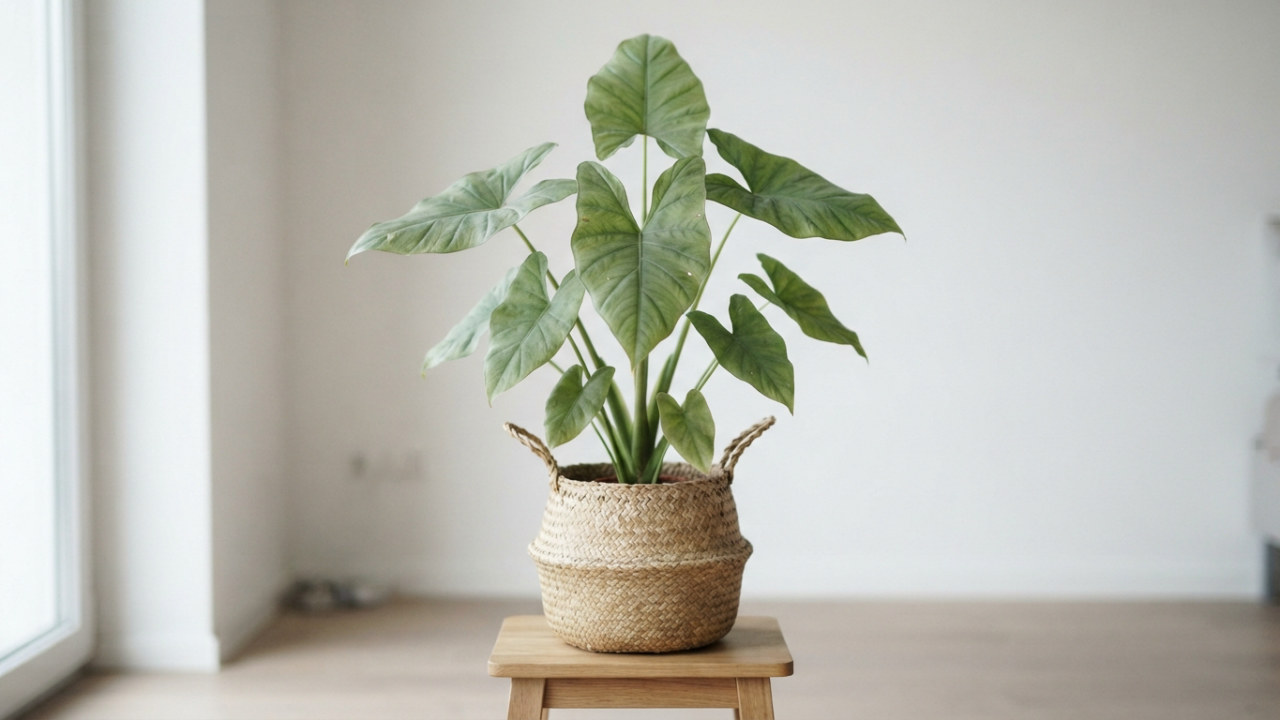
A vigorous aroid with large, arrow-shaped green leaves on long stalks, grown for its foliage and its edible corms.
- Every 5 daysWatering
- Bright indirect lightLight
- 60–80 %Humidity
- 18–30 °CTemperature


How to care for your Tannia
Everything you need to keep your Tannia healthy: watering, light, humidity, feeding, repotting and pruning.
Tannia, also called yautia, is native to tropical America, from Costa Rica to northern South America, and is grown in the tropics for food as well as for its foliage. It rises from an underground corm and spreads into a clump of long stalks, each carrying one arrow-shaped leaf with wavy margins, light to deep green and up to 60 cm long indoors. It likes warmth, humidity and bright, filtered light, and spends summer happily on a terrace in a big pot.

How to recognise Tannia
Plain green, arrow-shaped leaves with wavy edges, the stalk meeting the blade at the notch, on tall stalks in a spreading clump. Colocasia esculenta, the closest lookalike, has peltate leaves that hang down, Alocasia macrorrhizos has thicker, glossier leaves held upright, and Caladium lindenii has the same shape with bold white veins.

Watering your Tannia
Every 5 days
Water when the top half of the mix has dried, keeping it moist but well drained; unlike taro, it dislikes sitting in water.
How to know it needs water
- The top half of the mix feels dry to the touch
- The big leaves begin to droop slightly

How much light a Tannia needs
Bright indirect light
Bright, filtered light suits it and it copes with partial shade; up to about two hours of mild sun is fine, but stronger direct sun scorches the leaves.
- Direct sun tolerated
- 0 to 2 h a day
- Orientations that suit it
- North, North-east, East, South-east, South, South-west, West, North-west

Humidity and misting
60–80 %
Humid air, from 60 to 80%, suits it; very dry air browns the leaf edges. Mist about every 4 days when the air is dry, early in the day; misting lifts humidity only briefly, so a humidifier does more.

Feeding and fertiliser
Every 14 days
Feed about every 14 days from April to October, and stop in winter, when growth slows.
- Recommended feed
- A liquid fertilizer for foliage plants, with about twice as much nitrogen and potassium as phosphorus. · 2-1-2

Repotting your Tannia
Every 12 months
Move the corm to a deep pot one size larger, in a rich, well-drained mix, or divide the clump, keeping the top of the corm just below the surface.
- When
- Spring, from March to May, before the new leaves unfurl.
- Potting mix
- All-purpose potting mix
- Mix in
- perlite, coco fibre, pine bark
The tell-tale signs
- Roots circle the surface or come out of the drainage holes
- New leaves come smaller than the old ones and the pot dries within days

Pruning your Tannia
Whenever a leaf yellows or tears, and when the plant dies back in autumn. Cut the stalk at its base with clean shears and wear gloves, as the sap can irritate the skin.

Through the year
Watering is not set once and for all: it follows the light and the growth. Allow 8 days between waterings in the depth of winter, against 4 in the growing season.
- 8 J
- 7 F
- 5 M
- 5 A
- 4 M
- 4 J
- 4 J
- 5 A
- 5 S
- 6 O
- 7 N
- 8 D
Active growth · Days between waterings

Toxicity
Raw, every part contains calcium oxalate crystals that burn the mouth, lips and tongue of people, cats and dogs, causing drooling, vomiting and trouble swallowing; keep the plant out of reach.

Good to know
- Its name sagittifolium means arrow-leaved in Latin, which describes the shape of its leaves.
- Its corms are a staple food in much of the tropics under the names tannia and yautia, but they are eaten cooked.

Frequently asked questions about the Tannia
How do you care for a Tannia?
Water it every 5 days. Give it bright indirect light. Ideal humidity: 60–80 %. Ideal temperature: 18–30 °C. Water when the top half of the mix has dried, keeping it moist but well drained; unlike taro, it dislikes sitting in water.
How often should you water a Tannia?
Every 5 days Water when the top half of the mix has dried, keeping it moist but well drained; unlike taro, it dislikes sitting in water. How to know it needs water : The top half of the mix feels dry to the touch ; The big leaves begin to droop slightly.
How much light does a Tannia need?
Bright indirect light Bright, filtered light suits it and it copes with partial shade; up to about two hours of mild sun is fine, but stronger direct sun scorches the leaves. 0 to 2 h a day
Is the Tannia toxic to cats and dogs?
Yes. Raw, every part contains calcium oxalate crystals that burn the mouth, lips and tongue of people, cats and dogs, causing drooling, vomiting and trouble swallowing; keep the plant out of reach. Keep it out of reach of your pets and call a vet if any is swallowed.
Why are my Tannia leaves turning yellow?
Yellowing most often comes from too much water: the mix stays wet and the roots suffocate. Check that the pot drains, empty the saucer, and let the mix dry before watering again. Too little light or a cold draught cause the same symptom.
When should you repot a Tannia?
Repot every 12 months, ideally in spring, from march to may, before the new leaves unfurl.. Move the corm to a deep pot one size larger, in a rich, well-drained mix, or divide the clump, keeping the top of the corm just below the surface.

At a glance
- Family
- Araceae
- Category
- Tropical
- Placement
- Indoor and outdoor
- Mature height
- 1.1 m
- Growth
- Moderate
- Temperature
- 18–30 °C
- Pot materials
- ceramic, plastic, fabric
- Growth
- Reaches maturity in 3 years
These figures are for an average plant. In the app they are recalculated for yours, based on your room, its orientation and the season.
And for your plant, in your home?
In the app this plant becomes yours: a watering schedule tuned to your home, health tracking from photos, and reminders at the right moment.
In the same spirit
 Every 7 days


Air Plant
Tillandsia ionantha

 Every 6 days
Alocasia amazonica
Alocasia amazonica
 Every 7 days
Alocasia baginda
Alocasia baginda
 Every 4 days
Angel Wings
Caladium bicolor
