Variety Perennial · Commelinaceae
Purple Heart 'Purpurea'
Tradescantia pallida 'Purpurea' · A variety of Purple Heart
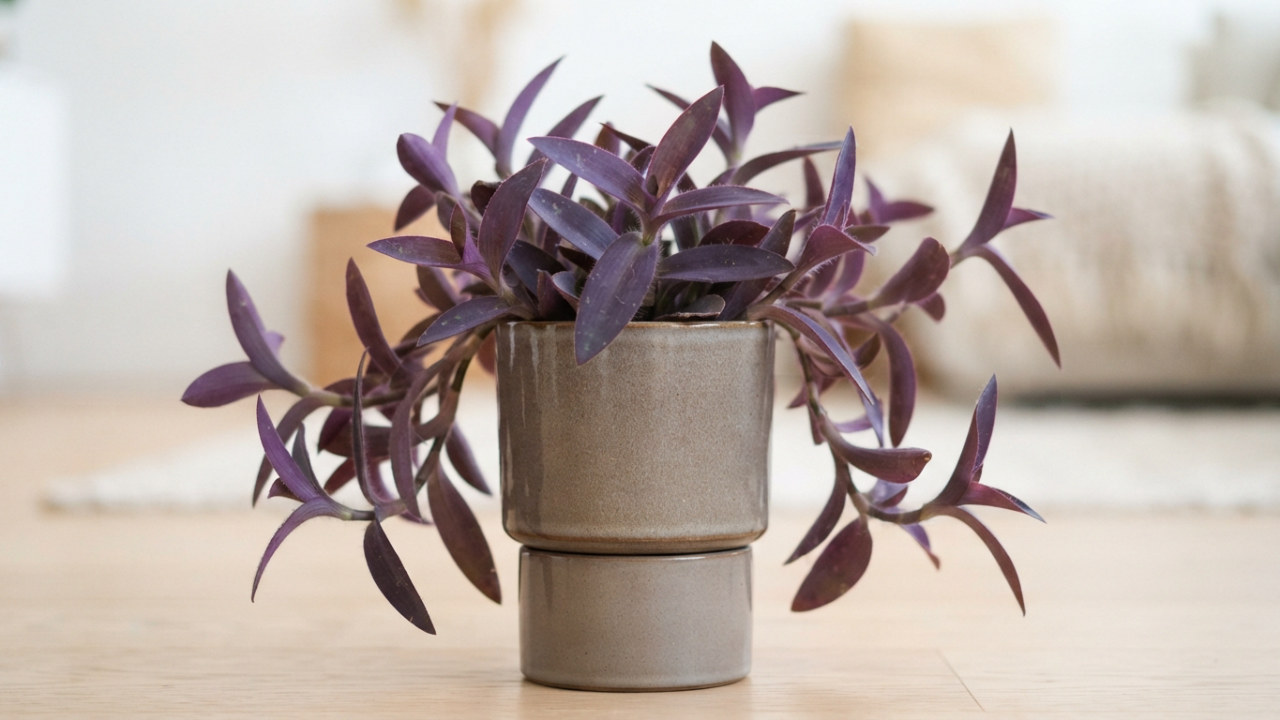
A sprawling plant with narrow, solid purple leaves and small pink flowers, sold almost always under the name Purple Heart.
- Every 7 daysWatering
- Bright indirect lightLight
- 40–60 %Humidity
- 15–28 °CTemperature


How to care for your Purple Heart 'Purpurea'
Everything you need to keep your Purple Heart 'Purpurea' healthy: watering, light, humidity, feeding, repotting and pruning.
'Purpurea' is the deep purple form of Tradescantia pallida, found in Central America in the early twentieth century and widely grown since the 1950s. Its lance-shaped leaves are covered in fine soft hairs and keep a solid royal purple color, much richer than the paler gray-green purple of the wild plant. Stems trail or sprawl, and small three-petaled pink flowers with yellow stamens open in warm weather. It suits a hanging pot, a sunny window or a terrace in summer.

How to recognise Purple Heart 'Purpurea'
Narrow lance-shaped leaves, 5 to 15 cm long, in a solid deep purple with fine soft hairs, on sprawling stems. 'Pale Puma' is more compact with green centers fading to purple edges, and T. zebrina has striped leaves with a silvery sheen.

Watering your Purple Heart 'Purpurea'
Every 7 days
Water thoroughly and let the soil dry about halfway down before the next watering, then empty the saucer.
How to know it needs water
- The soil is dry about halfway down the pot.
- The slightly fleshy leaves soften and the stem tips droop.

How much light a Purple Heart 'Purpurea' needs
Bright indirect light
Bright light with a few hours of direct sun keeps the purple deep; in shade the leaves turn greener or grayish.
- Direct sun tolerated
- 2 to 6 h a day
- Orientations that suit it
- East, South-east, South, South-west, West, North-west

Humidity and misting
40–60 %
Average household humidity, around 40 to 60 percent, is enough. Misting is not needed, and it can leave marks on the hairy leaves.

Feeding and fertiliser
Every 28 days
Feed about every four weeks from spring to early autumn, and stop in winter.
- Recommended feed
- A balanced liquid fertilizer at half strength suits it. · 10-10-10

Repotting your Purple Heart 'Purpurea'
Every 12 months
Move it to a slightly larger pot with light, well-draining mix every year, or divide and replant cuttings to refresh it.
- When
- Repot in spring, when growth restarts.
- Potting mix
- All-purpose potting mix
- Mix in
- perlite, pine bark
The tell-tale signs
- Roots circle the pot or come out of the drainage holes.
- The soil dries within a couple of days after watering.

Pruning your Purple Heart 'Purpurea'
Cut back stems in spring and again in summer whenever they get long or bare at the base. Cut just above a node with clean scissors, and root the cuttings in water or soil to thicken the plant.

Through the year
Watering is not set once and for all: it follows the light and the growth. Allow 13 days between waterings in the depth of winter, against 6 in the growing season.
- 11 J
- 8 F
- 7 M
- 6 A
- 6 M
- 6 J
- 6 J
- 6 A
- 7 S
- 8 O
- 11 N
- 13 D
Active growth · Days between waterings

Toxicity
The sap can irritate the skin of people and animals, and chewing the leaves may upset the mouth and stomach.

Good to know
- The purple color comes from anthocyanin pigments that deepen in bright light.
- It can be grown outdoors as a ground cover in frost-free climates, and it roots easily from cuttings.

Frequently asked questions about the Purple Heart 'Purpurea'
How do you care for a Purple Heart 'Purpurea'?
Water it every 7 days. Give it bright indirect light. Ideal humidity: 40–60 %. Ideal temperature: 15–28 °C. Water thoroughly and let the soil dry about halfway down before the next watering, then empty the saucer.
How often should you water a Purple Heart 'Purpurea'?
Every 7 days Water thoroughly and let the soil dry about halfway down before the next watering, then empty the saucer. How to know it needs water : The soil is dry about halfway down the pot. ; The slightly fleshy leaves soften and the stem tips droop..
How much light does a Purple Heart 'Purpurea' need?
Bright indirect light Bright light with a few hours of direct sun keeps the purple deep; in shade the leaves turn greener or grayish. 2 to 6 h a day
Is the Purple Heart 'Purpurea' toxic to cats and dogs?
Yes. The sap can irritate the skin of people and animals, and chewing the leaves may upset the mouth and stomach. Keep it out of reach of your pets and call a vet if any is swallowed.
Why are my Purple Heart 'Purpurea' leaves turning yellow?
Yellowing most often comes from too much water: the mix stays wet and the roots suffocate. Check that the pot drains, empty the saucer, and let the mix dry before watering again. Too little light or a cold draught cause the same symptom.
When should you repot a Purple Heart 'Purpurea'?
Repot every 12 months, ideally in repot in spring, when growth restarts.. Move it to a slightly larger pot with light, well-draining mix every year, or divide and replant cuttings to refresh it.

At a glance
- Family
- Commelinaceae
- Category
- Perennial
- Placement
- Indoor and outdoor
- Mature height
- 30 cm
- Growth
- Fast
- Temperature
- 15–28 °C
- Pot materials
- terracotta, ceramic, plastic
- Growth
- Reaches maturity in 1 years
These figures are for an average plant. In the app they are recalculated for yours, based on your room, its orientation and the season.
And for your plant, in your home?
In the app this plant becomes yours: a watering schedule tuned to your home, health tracking from photos, and reminders at the right moment.