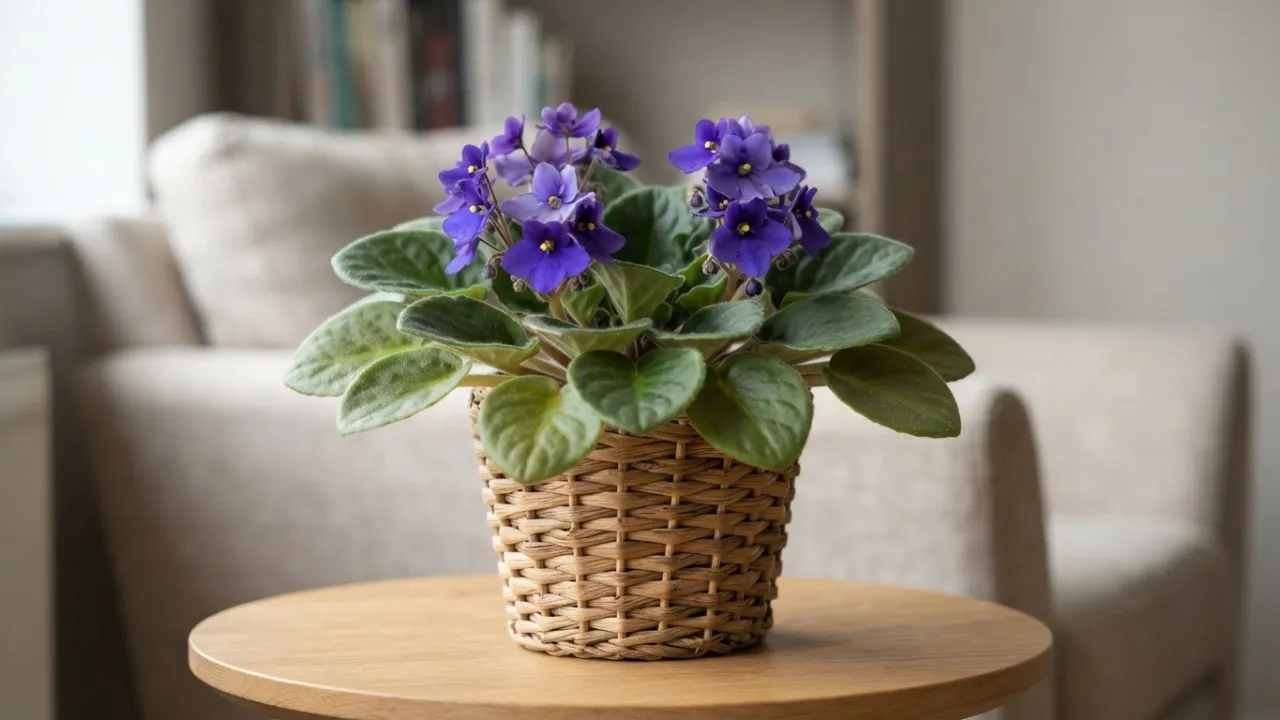
African Violet
Saintpaulia ionantha
The African Violet is a compact little plant that offers nearly permanent indoor blooming in a wide palette of colors.
The essentials at a glance
-
Watering
Every 5 days
-
Light
Bright indirect light
-
Humidity
50–60 %
-
Temperature
18–26 °C


How to care for your African Violet
Everything you need to keep your African Violet healthy: watering, light, humidity, feeding, repotting and pruning.
Saintpaulia ionantha originates from the Usambara Mountains in Tanzania, where it grows in rocky crevices under forest canopy. It is the quintessential flowering houseplant: with good lighting and regular care, it can bloom non-stop for months. Its velvety leaves arranged in a rosette serve as a setting for clusters of single or double flowers in varied colors. Propagation by leaf cutting is remarkably easy and rewarding.

Watering your African Violet
Every 5 days
Water from below (via the saucer) with lukewarm water. Never wet the leaves, which stain and rot on contact with cold water. Allow to absorb for 30 minutes then empty the excess.
How to know it needs water
- Topsoil dry at the surface
- Leaves slightly soft to the touch
- Rosette drooping a little

How much light a African Violet needs
Bright indirect light
Bright indirect light. Ideal on an east- or north-facing windowsill. Avoid direct sun which scorches the velvety leaves.
- Direct sun tolerated
- 0 to 2 h a day
- Orientations that suit it
- North, North-east, East

Humidity and misting
50–60 %
50–60% NEVER mist the velvety leaves. Water on the leaves causes brown spots and rot. Maintain humidity with a pebble tray.

Feeding and fertiliser
Every 14 days
Fertilize year-round as the African Violet can bloom continuously. Use a quarter dose at each watering rather than a full dose periodically.
- Recommended feed
- African violet-specific fertilizer or very dilute balanced liquid fertilizer (NPK 14-12-14). · 14-12-14

Repotting your African Violet
Every 12 months
Use light African violet-specific compost (peat, perlite, vermiculite). Use a shallow, small pot — African violets flower better slightly pot-bound. Bury any bare trunk when repotting.
- When
- Spring, but possible year-round
- Potting mix
- All-purpose potting mix
- Mix in
- perlite, vermiculite
The tell-tale signs
- Plant developing a long bare trunk at the base
- Roots emerging from the pot
- Reduced flowering despite fertilization

Pruning your African Violet
On an ongoing basis, as needed. Remove spent flowers and damaged leaves by gently snapping them off at the base. Remove lateral offshoots to maintain a single, symmetrical rosette.

Through the year
Watering is not set once and for all: it follows the light and the growth. Allow 6 days between waterings in the depth of winter, against 4 in the growing season.
- 6 J
- 5 F
- 5 M
- 5 A
- 4 M
- 4 J
- 4 J
- 4 A
- 5 S
- 5 O
- 6 N
- 6 D
Active growth · Days between waterings

Good to know
- African Violet was discovered in 1892 by Baron Walter von Saint Paul in Tanzania, hence its scientific name Saintpaulia.
- With the right conditions, it can bloom continuously throughout the year, making it one of the most floriferous houseplants.

Frequently asked questions about the African Violet
How do you care for a African Violet?
Water it every 5 days. Give it bright indirect light. Ideal humidity: 50–60 %. Ideal temperature: 18–26 °C. Water from below (via the saucer) with lukewarm water. Never wet the leaves, which stain and rot on contact with cold water. Allow to absorb for 30 minutes then empty the excess.
How often should you water a African Violet?
Every 5 days Water from below (via the saucer) with lukewarm water. Never wet the leaves, which stain and rot on contact with cold water. Allow to absorb for 30 minutes then empty the excess. How to know it needs water : Topsoil dry at the surface ; Leaves slightly soft to the touch ; Rosette drooping a little.
How much light does a African Violet need?
Bright indirect light Bright indirect light. Ideal on an east- or north-facing windowsill. Avoid direct sun which scorches the velvety leaves. 0 to 2 h a day
Is the African Violet toxic to cats and dogs?
No, the African Violet is not listed as toxic to cats and dogs. That is still no reason to let your pets chew on it.
Why are my African Violet leaves turning yellow?
Yellowing most often comes from too much water: the mix stays wet and the roots suffocate. Check that the pot drains, empty the saucer, and let the mix dry before watering again. Too little light or a cold draught cause the same symptom.
When should you repot a African Violet?
Repot every 12 months, ideally in spring, but possible year-round. Use light African violet-specific compost (peat, perlite, vermiculite). Use a shallow, small pot — African violets flower better slightly pot-bound. Bury any bare trunk when repotting.

At a glance
- Family
- Gesneriaceae
- Category
- Flowering
- Placement
- Indoor
- Mature height
- 15 cm
- Growth
- Moderate
- Temperature
- 18–26 °C
- Pot materials
- ceramic, plastic
- Growth
- Reaches maturity in 1 years
These figures are for an average plant. In the app they are recalculated for yours, based on your room, its orientation and the season.
And for your plant, in your home?
In the app this plant becomes yours: a watering schedule tuned to your home, health tracking from photos, and reminders at the right moment.