
Tropical · Araceae
Rhaphidophora decursiva
Rhaphidophora decursiva
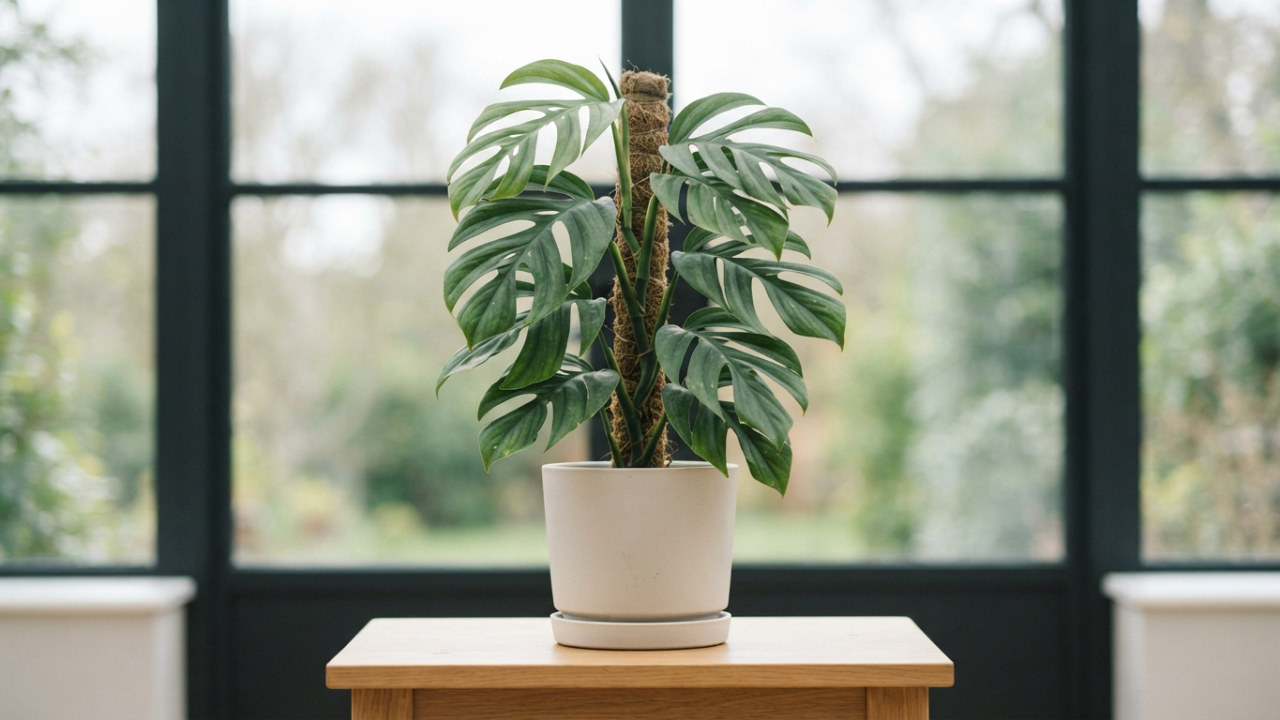
A fast climbing aroid whose oval juvenile leaves give way to huge, deeply cut, palm-like leaves when it climbs.
- Every 6 daysWatering
- Bright indirect lightLight
- 60–80 %Humidity
- 18–28 °CTemperature


How to care for your Rhaphidophora decursiva
Everything you need to keep your Rhaphidophora decursiva healthy: watering, light, humidity, feeding, repotting and pruning.
A vigorous climber native to China, the Indian subcontinent and Indochina. Young plants carry glossy, dark green, oval leaves; once the stems climb a moss pole, the leaves enlarge and become deeply lobed, reaching over 90 cm long. It needs support to mature and reaches about 1.5 m indoors. Its juvenile leaves do not press flat against the support, unlike those of R. korthalsii.

How to recognise Rhaphidophora decursiva
Its mature leaves are far bigger and more deeply cut than those of Rhaphidophora tetrasperma, and its elongated juvenile leaves never press flat against the support as R. korthalsii's do.

Watering your Rhaphidophora decursiva
Every 6 days
Water thoroughly when the top few centimeters of mix are dry and let the excess drain.
How to know it needs water
- The top few centimeters of mix are dry to the touch.
- Leaves lose their gloss and begin to curl or sag.

How much light a Rhaphidophora decursiva needs
Bright indirect light
Bright indirect light, away from midday sun that would scorch the leaves.
- Direct sun tolerated
- 0 to 2 h a day
- Orientations that suit it
- North, North-east, East, South-east, South, South-west, West, North-west

Humidity and misting
60–80 %
High humidity, about 60 to 80 percent, helps the big leaves unfurl cleanly, though average air is tolerated. Mist is not needed; raise humidity with a humidifier or by grouping plants instead.

Feeding and fertiliser
Every 28 days
Feed about every four weeks from April to September at half strength.
- Recommended feed
- A balanced liquid fertilizer for foliage plants. · 5-2-3

Repotting your Rhaphidophora decursiva
Every 24 months
Repot into a pot one size larger with a chunky, airy mix and keep the moss pole in place.
- When
- Spring, from March to May.
- Potting mix
- All-purpose potting mix
- Mix in
- perlite, pine bark, coco fibre
The tell-tale signs
- Roots circle the pot or emerge from the drainage holes.
- The top-heavy plant tips over despite its support.

Pruning your Rhaphidophora decursiva
In spring and summer, during active growth. Shorten overlong stems just above a node with clean shears to control size.

Through the year
Watering is not set once and for all: it follows the light and the growth. Allow 8 days between waterings in the depth of winter, against 5 in the growing season.
- 8 J
- 7 F
- 6 M
- 5 A
- 5 M
- 5 J
- 5 J
- 5 A
- 6 S
- 7 O
- 7 N
- 8 D
Active growth · Days between waterings

Toxicity
Calcium oxalate crystals in all parts cause burning, swelling of the mouth and throat and stomach upset in people, cats and dogs if chewed.

Good to know
- Mature leaves can grow longer than 90 cm.
- It needs a climbing support such as a moss pole to produce its big, cut leaves.

Frequently asked questions about the Rhaphidophora decursiva
How do you care for a Rhaphidophora decursiva?
Water it every 6 days. Give it bright indirect light. Ideal humidity: 60–80 %. Ideal temperature: 18–28 °C. Water thoroughly when the top few centimeters of mix are dry and let the excess drain.
How often should you water a Rhaphidophora decursiva?
Every 6 days Water thoroughly when the top few centimeters of mix are dry and let the excess drain. How to know it needs water : The top few centimeters of mix are dry to the touch. ; Leaves lose their gloss and begin to curl or sag..
How much light does a Rhaphidophora decursiva need?
Bright indirect light Bright indirect light, away from midday sun that would scorch the leaves. 0 to 2 h a day
Is the Rhaphidophora decursiva toxic to cats and dogs?
Yes. Calcium oxalate crystals in all parts cause burning, swelling of the mouth and throat and stomach upset in people, cats and dogs if chewed. Keep it out of reach of your pets and call a vet if any is swallowed.
Why are my Rhaphidophora decursiva leaves turning yellow?
Yellowing most often comes from too much water: the mix stays wet and the roots suffocate. Check that the pot drains, empty the saucer, and let the mix dry before watering again. Too little light or a cold draught cause the same symptom.
When should you repot a Rhaphidophora decursiva?
Repot every 24 months, ideally in spring, from march to may.. Repot into a pot one size larger with a chunky, airy mix and keep the moss pole in place.

At a glance
- Family
- Araceae
- Category
- Tropical
- Placement
- Indoor
- Mature height
- 1.5 m
- Growth
- Fast
- Temperature
- 18–28 °C
- Pot materials
- ceramic, plastic
- Growth
- Reaches maturity in 3 years
These figures are for an average plant. In the app they are recalculated for yours, based on your room, its orientation and the season.
And for your plant, in your home?
In the app this plant becomes yours: a watering schedule tuned to your home, health tracking from photos, and reminders at the right moment.
In the same spirit
 Every 7 days


Air Plant
Tillandsia ionantha

 Every 6 days
Alocasia amazonica
Alocasia amazonica
 Every 7 days
Alocasia baginda
Alocasia baginda
 Every 4 days
Angel Wings
Caladium bicolor
