
Tropical · Lamiaceae
Swedish ivy
Plectranthus verticillatus
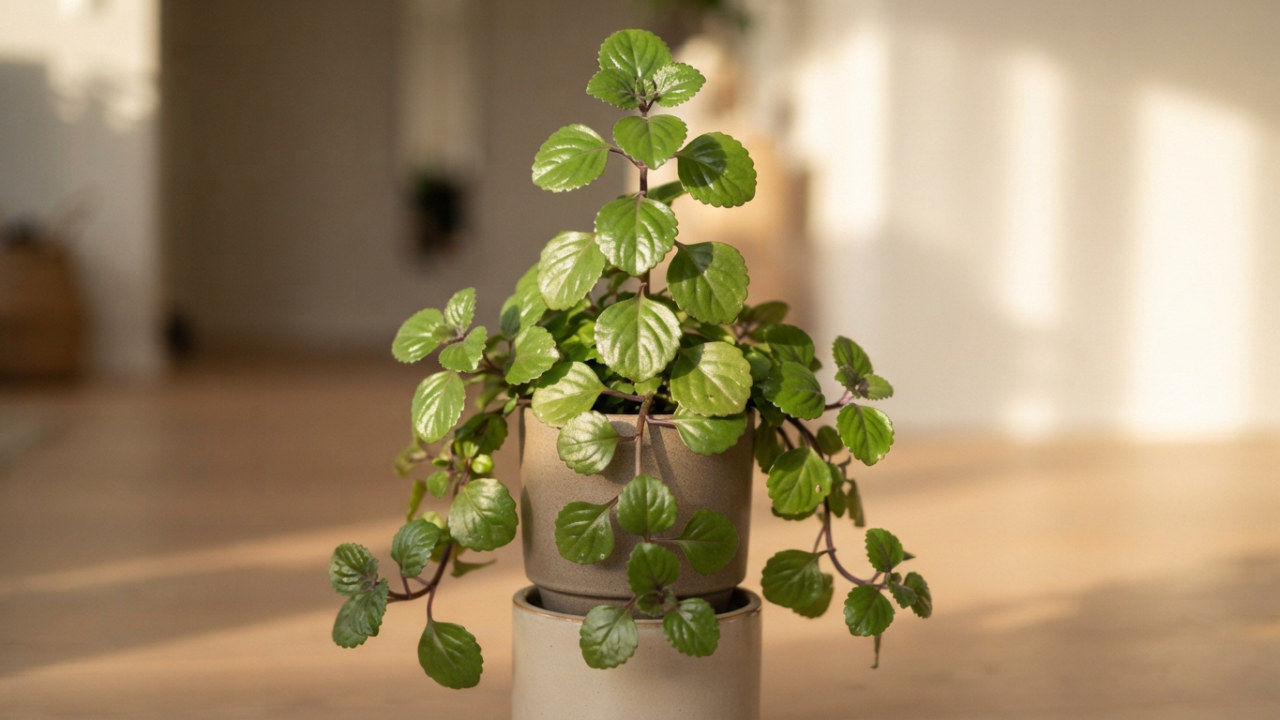
A trailing plant with glossy, rounded, scalloped leaves, made for hanging baskets and high shelves.
- Every 4 daysWatering
- Bright indirect lightLight
- 50–70 %Humidity
- 15–28 °CTemperature


How to care for your Swedish ivy
Everything you need to keep your Swedish ivy healthy: watering, light, humidity, feeding, repotting and pruning.
Swedish ivy is a fast trailing plant from southern Africa, despite its name. Its glossy, slightly fleshy leaves have rounded, scalloped edges, and its stems often turn purple. Indoors the stems hang 60 to 90 centimeters, and they root wherever they touch soil. Small white to pale mauve flower spikes appear from time to time. It is often sold as Swedish begonia.

How to recognise Swedish ivy
Glossy, rounded, plain green leaves with scalloped edges on trailing stems that are often purple, with no color pattern. Coleus (scutellarioides) has pointed, velvety, multicolored leaves, and Plectranthus coleoides and oertendahlii have hairy or silver-veined leaves. Peperomia has smooth-edged leaves and Pilea nummulariifolia tiny puckered ones, and neither has these purple, scalloped, trailing stems.

Watering your Swedish ivy
Every 4 days
Water thoroughly when the top inch of mix is dry, and let the excess drain away.
How to know it needs water
- The top inch of mix feels dry to the touch
- Leaves lose their firmness and the stems droop

How much light a Swedish ivy needs
Bright indirect light
Bright indirect light suits it best, with at most a little gentle morning sun.
- Direct sun tolerated
- 0 to 2 h a day
- Orientations that suit it
- North, North-east, East, South-east, South, South-west, West, North-west

Humidity and misting
50–70 %
Average household humidity, around 50 to 70 percent, is enough. Misting is not needed, since the plant is comfortable in normal room air.

Feeding and fertiliser
Every 14 days
Feed every two weeks from April to September, at half strength, to sustain fast growth.
- Recommended feed
- A balanced liquid fertilizer for foliage plants. · 2-1-2

Repotting your Swedish ivy
Every 12 months
Move to a pot one size larger with light, draining mix, or simply root cuttings to renew a leggy plant.
- When
- Spring, from March to May.
- Potting mix
- All-purpose potting mix
- Mix in
- perlite, coco fibre
The tell-tale signs
- Roots show at the drainage holes
- The mix dries out within a couple of days

Pruning your Swedish ivy
Trim in spring and summer whenever stems grow long and bare. Cut stems just above a node to make the plant branch, and root the pieces in water or damp mix.

Through the year
Watering is not set once and for all: it follows the light and the growth. Allow 5 days between waterings in the depth of winter, against 3 in the growing season.
- 5 J
- 4 F
- 4 M
- 3 A
- 3 M
- 3 J
- 3 J
- 3 A
- 4 S
- 4 O
- 4 N
- 5 D
Active growth · Days between waterings

Good to know
- Despite the name, it has nothing to do with Sweden's native plants; the species comes from southern Africa.
- It was described by Carl Linnaeus the Younger, who worked from southern African specimens.

Frequently asked questions about the Swedish ivy
How do you care for a Swedish ivy?
Water it every 4 days. Give it bright indirect light. Ideal humidity: 50–70 %. Ideal temperature: 15–28 °C. Water thoroughly when the top inch of mix is dry, and let the excess drain away.
How often should you water a Swedish ivy?
Every 4 days Water thoroughly when the top inch of mix is dry, and let the excess drain away. How to know it needs water : The top inch of mix feels dry to the touch ; Leaves lose their firmness and the stems droop.
How much light does a Swedish ivy need?
Bright indirect light Bright indirect light suits it best, with at most a little gentle morning sun. 0 to 2 h a day
Is the Swedish ivy toxic to cats and dogs?
No, the Swedish ivy is not listed as toxic to cats and dogs. That is still no reason to let your pets chew on it.
Why are my Swedish ivy leaves turning yellow?
Yellowing most often comes from too much water: the mix stays wet and the roots suffocate. Check that the pot drains, empty the saucer, and let the mix dry before watering again. Too little light or a cold draught cause the same symptom.
When should you repot a Swedish ivy?
Repot every 12 months, ideally in spring, from march to may.. Move to a pot one size larger with light, draining mix, or simply root cuttings to renew a leggy plant.

At a glance
- Family
- Lamiaceae
- Category
- Tropical
- Placement
- Indoor and outdoor
- Mature height
- 75 cm
- Growth
- Fast
- Temperature
- 15–28 °C
- Pot materials
- ceramic, plastic
- Growth
- Reaches maturity in 1 years
These figures are for an average plant. In the app they are recalculated for yours, based on your room, its orientation and the season.
And for your plant, in your home?
In the app this plant becomes yours: a watering schedule tuned to your home, health tracking from photos, and reminders at the right moment.
In the same spirit
 Every 7 days


Air Plant
Tillandsia ionantha

 Every 6 days
Alocasia amazonica
Alocasia amazonica
 Every 7 days
Alocasia baginda
Alocasia baginda
 Every 4 days
Angel Wings
Caladium bicolor
