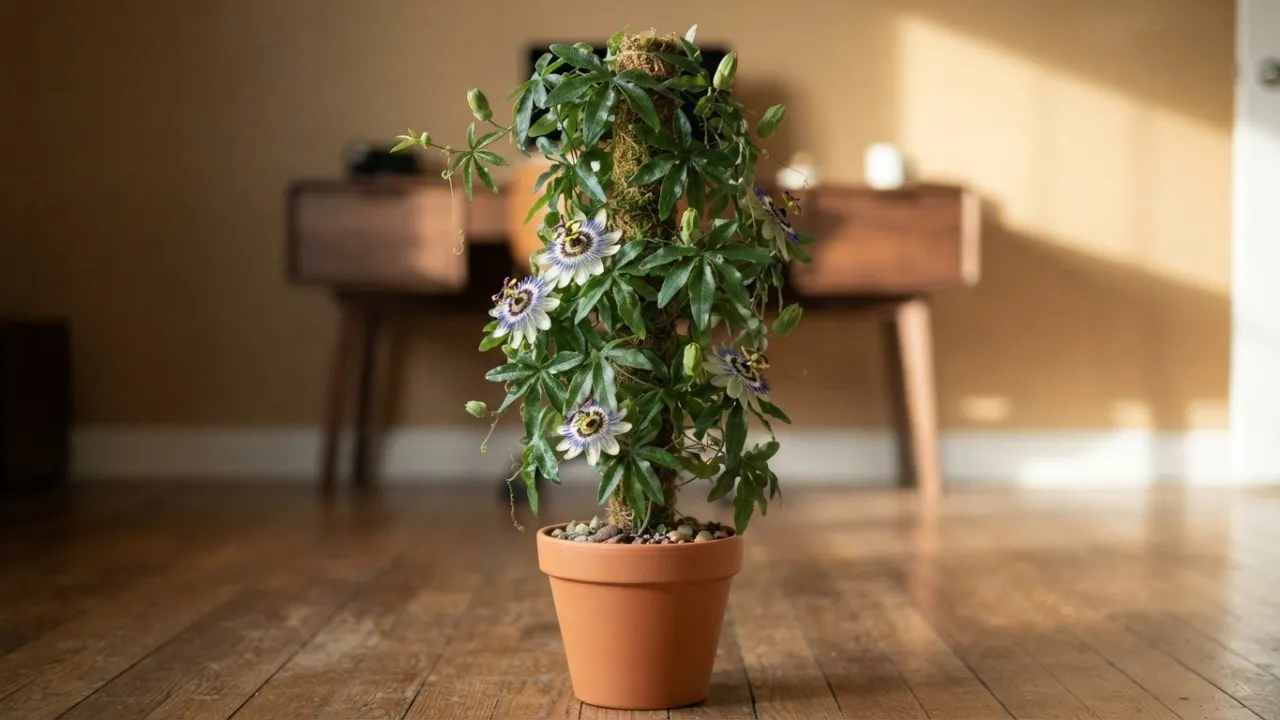
Passion Flower
Passiflora caerulea
The Passion Flower is a vigorous climber with extraordinary flowers of a unique architectural complexity in the plant kingdom.
The essentials at a glance
-
Watering
Every 4 days
-
Light
Full sun
-
Humidity
40–60 %
-
Temperature
-5–30 °C


How to care for your Passion Flower
Everything you need to keep your Passion Flower healthy: watering, light, humidity, feeding, repotting and pruning.
Passiflora caerulea originates from South America, mainly Argentina and Brazil. It is a vigorous vine that clings with its tendrils and can easily cover a wall or trellis in a single season. Its spectacular flowers, of fascinating complexity with their crown of blue and white filaments, open in the morning and close in the evening, replaced by new ones each day in summer. It is one of the hardiest passion flowers, able to withstand brief frosts and regrow from the base after a harsh winter.

Watering your Passion Flower
Every 4 days
Water regularly in summer to keep the soil moist. Reduce in winter. Passion Flower is reasonably drought-tolerant once established.
How to know it needs water
- Soil dry 3–4 cm deep
- Leaves wilting during the hottest part of the day
- Growth of tendrils slowing

How much light a Passion Flower needs
Full sun
Full sun to bright light. At least 6 hours of direct sunlight daily for good flowering. Tolerates semi-shade but flowers less.
- Direct sun tolerated
- 6 to 12 h a day
- Orientations that suit it
- South, South-east, South-west, East, West

Humidity and misting
40–60 %
40–60% Mist occasionally indoors. Outdoors, not necessary. Passion Flower is tolerant of varied conditions.

Feeding and fertiliser
Every 14 days
Fertilize from April to September. Excess nitrogenous fertilizer produces abundant foliage but few flowers. Prioritize potassium.
- Recommended feed
- Liquid fertilizer for flowering plants, high in potassium (NPK 10-15-20). Avoid excess nitrogen which promotes foliage at the expense of flowers. · 5-10-5

Repotting your Passion Flower
Every 18 months
Use enriched universal compost, well-draining. A deep pot as the roots are vigorous. Provide a trellis or wires for the tendrils to grip.
- When
- Spring (March–April)
- Potting mix
- All-purpose potting mix
- Mix in
- perlite, coco fibre
The tell-tale signs
- Roots filling the pot
- Growth slowing
- Leaves yellowing despite adequate watering

Pruning your Passion Flower
In late winter (February–March), before vegetation resumes. Prune secondary stems hard back to 2–3 buds from the main framework. Passion Flower flowers on new-season wood — an annual prune stimulates flowering and contains its vigour.

Through the year
Watering is not set once and for all: it follows the light and the growth. Allow 7 days between waterings in the depth of winter, against 3 in the growing season.
- 7 J
- 6 F
- 4 M
- 3 A
- 3 M
- 3 J
- 3 J
- 3 A
- 4 S
- 5 O
- 6 N
- 7 D
Active growth · Days between waterings

Good to know
- Spanish missionaries named this flower 'passion flower' because they saw in its structure the instruments of Christ's Passion: the crown of thorns, nails, and hammer.
- Passiflora caerulea is one of the few hardy passion flowers capable of surviving mild European winters, withstanding temperatures down to -10°C.

Frequently asked questions about the Passion Flower
How do you care for a Passion Flower?
Water it every 4 days. Give it full sun. Ideal humidity: 40–60 %. Ideal temperature: -5–30 °C. Water regularly in summer to keep the soil moist. Reduce in winter. Passion Flower is reasonably drought-tolerant once established.
How often should you water a Passion Flower?
Every 4 days Water regularly in summer to keep the soil moist. Reduce in winter. Passion Flower is reasonably drought-tolerant once established. How to know it needs water : Soil dry 3–4 cm deep ; Leaves wilting during the hottest part of the day ; Growth of tendrils slowing.
How much light does a Passion Flower need?
Full sun Full sun to bright light. At least 6 hours of direct sunlight daily for good flowering. Tolerates semi-shade but flowers less. 6 to 12 h a day
Is the Passion Flower toxic to cats and dogs?
No, the Passion Flower is not listed as toxic to cats and dogs. That is still no reason to let your pets chew on it.
Why are my Passion Flower leaves turning yellow?
Yellowing most often comes from too much water: the mix stays wet and the roots suffocate. Check that the pot drains, empty the saucer, and let the mix dry before watering again. Too little light or a cold draught cause the same symptom.
When should you repot a Passion Flower?
Repot every 18 months, ideally in spring (march–april). Use enriched universal compost, well-draining. A deep pot as the roots are vigorous. Provide a trellis or wires for the tendrils to grip.

At a glance
- Family
- Passifloraceae
- Category
- Climber
- Placement
- Indoor and outdoor
- Mature height
- 5 m
- Growth
- Fast
- Temperature
- -5–30 °C
- Pot materials
- terracotta, ceramic, plastic
- Growth
- Reaches maturity in 3 years
These figures are for an average plant. In the app they are recalculated for yours, based on your room, its orientation and the season.
And for your plant, in your home?
In the app this plant becomes yours: a watering schedule tuned to your home, health tracking from photos, and reminders at the right moment.