
Flowering · Amaryllidaceae
Amaryllis
Hippeastrum x hortorum
Amaryllis is a popular flowering bulb known for its large, showy, trumpet-shaped flowers, typically blooming in winter or early spring.
- Every 7 daysWatering
- Bright indirect lightLight
- 40–60 %Humidity
- 18–24 °CTemperature


How to care for your Amaryllis
Everything you need to keep your Amaryllis healthy: watering, light, humidity, feeding, repotting and pruning.
Hippeastrum x hortorum, commonly known as Amaryllis, is a hybrid group of flowering bulbs prized for their spectacular, large blooms. Their parent species come from tropical and subtropical regions of the Americas, and the plants are often grown indoors as houseplants, especially for their vibrant winter flowers. With proper care, including a period of dormancy, Amaryllis bulbs can re-bloom for many years, offering a stunning display of red, pink, white, or striped flowers. The bulb is not frost hardy: it can spend summer outdoors in a pot, but must come inside before nights fall below about 5 °C.

How to recognise Amaryllis
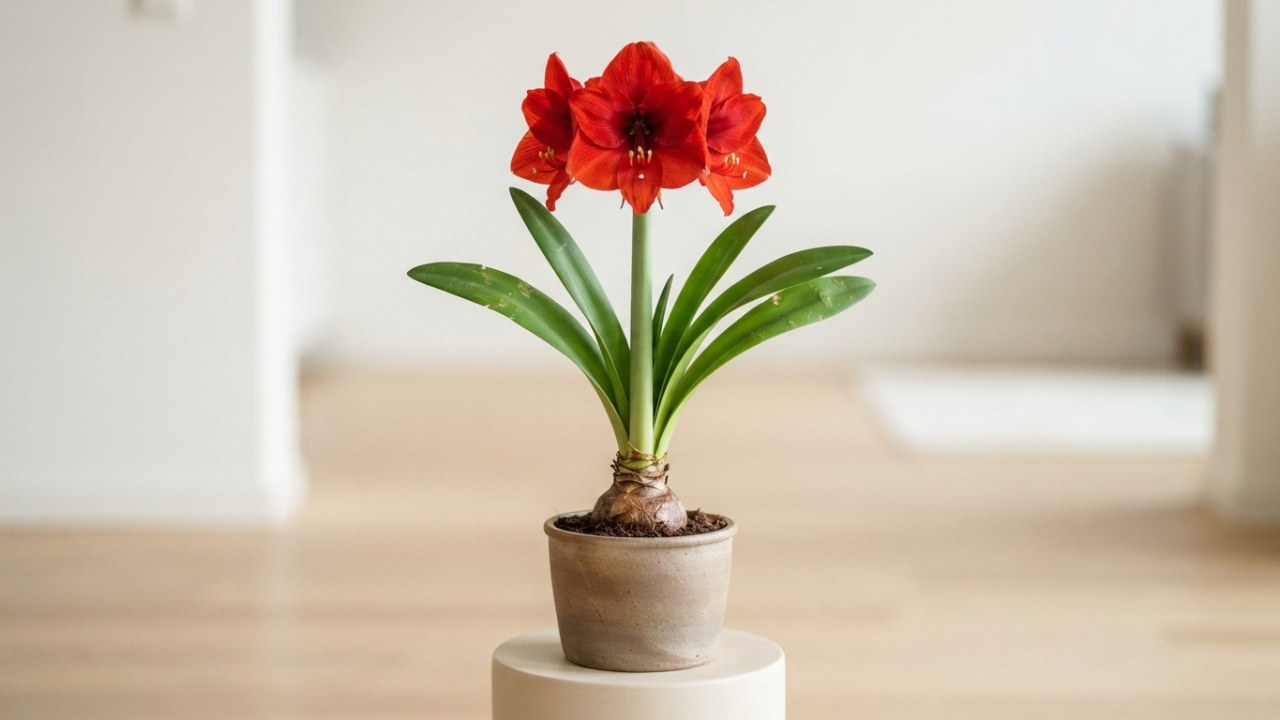
A large bulb with arching, strap-shaped leaves and a thick hollow leafless stalk carrying two to four huge trumpet flowers, 10 to 20 cm wide. It is often confused with the true Amaryllis belladonna, which flowers in late summer on bare stems with smaller, scented pink flowers, and with Clivia, which has no bulb and bears its orange flowers in a rounded cluster above evergreen leaves.

Watering your Amaryllis
Every 7 days
Water thoroughly when the top 2 to 3 cm of soil are dry, about every 7 days while the plant is growing and flowering, and keep watering after flowering so the leaves can feed the bulb. Stop watering completely during dormancy (about September to November) and resume when a new bud shows.
How to know it needs water
- Soil dry 2 to 3 cm deep
- Pot feels light
- Leaves slightly limp (during growth)

How much light a Amaryllis needs
Bright indirect light
Bright indirect light; tolerates some direct morning sun. Avoid harsh afternoon sun which can scorch leaves.
- Direct sun tolerated
- 1 to 3 h a day
- Orientations that suit it
- North, North-east, East, South-east, South, South-west, West, North-west

Humidity and misting
40–60 %
Medium (40 to 60 %) Misting is not needed. Do not wet the foliage or flowers, as this can encourage fungal issues. Humidity is not a critical factor.

Feeding and fertiliser
Every 14 days
Apply every 2 weeks from March to August, once the plant is in full leaf growth. Do not fertilize during dormancy.
- Recommended feed
- Balanced liquid fertilizer (e.g., 10-10-10), or one higher in potassium such as 5-10-10, diluted by half. · 5-10-10

Repotting your Amaryllis
Every 36 months
Repot about every 3 years, in February or March. Choose a container only slightly larger than the bulb, ensuring the top third of the bulb remains exposed above the soil line. Use a well-draining potting mix.
- When
- Late winter to early spring (February to March), as new growth starts
- Potting mix
- All-purpose potting mix
- Mix in
- perlite, coco fibre
The tell-tale signs
- Roots emerging from drainage holes
- Bulb outgrowing its pot
- Soil compaction or degradation

Pruning your Amaryllis
Remove spent flower stalks after blooming by cutting near the base. Do not remove leaves until they naturally yellow and die back. Cut flower stalks cleanly with sterilised scissors or a sharp knife. Allow leaves to wither naturally to return energy to the bulb.

Through the year
Watering is not set once and for all: it follows the light and the growth. Allow 18 days between waterings in the depth of winter, against 6 in the growing season.
- 14 J
- 7 F
- 6 M
- 6 A
- 6 M
- 6 J
- 6 J
- 6 A
- 7 S
- 11 O
- 14 N
- 18 D
Active growth · Days between waterings

Toxicity
Toxic to cats, dogs, and humans (all parts, especially the bulb, contain phenanthridine alkaloids causing vomiting, diarrhea, and lethargy). Wear gloves when handling the bulb and keep it out of reach of pets and children.

Good to know
- Often forced to bloom indoors during winter for holiday decoration
- The genus name 'Hippeastrum' comes from the Greek for 'horseman's star', and is not to be confused with the true Amaryllis of South Africa
- Can re-bloom for many years with proper care and a dormancy period

Frequently asked questions about the Amaryllis
How do you care for a Amaryllis?
Water it every 7 days. Give it bright indirect light. Ideal humidity: 40–60 %. Ideal temperature: 18–24 °C. Water thoroughly when the top 2 to 3 cm of soil are dry, about every 7 days while the plant is growing and flowering, and keep watering after flowering so the leaves can feed the bulb. Stop watering completely during dormancy (about September to November) and resume when a new bud shows.
How often should you water a Amaryllis?
Every 7 days Water thoroughly when the top 2 to 3 cm of soil are dry, about every 7 days while the plant is growing and flowering, and keep watering after flowering so the leaves can feed the bulb. Stop watering completely during dormancy (about September to November) and resume when a new bud shows. How to know it needs water : Soil dry 2 to 3 cm deep ; Pot feels light ; Leaves slightly limp (during growth).
How much light does a Amaryllis need?
Bright indirect light Bright indirect light; tolerates some direct morning sun. Avoid harsh afternoon sun which can scorch leaves. 1 to 3 h a day
Is the Amaryllis toxic to cats and dogs?
Yes. Toxic to cats, dogs, and humans (all parts, especially the bulb, contain phenanthridine alkaloids causing vomiting, diarrhea, and lethargy). Wear gloves when handling the bulb and keep it out of reach of pets and children. Keep it out of reach of your pets and call a vet if any is swallowed.
Why are my Amaryllis leaves turning yellow?
Yellowing most often comes from too much water: the mix stays wet and the roots suffocate. Check that the pot drains, empty the saucer, and let the mix dry before watering again. Too little light or a cold draught cause the same symptom.
When should you repot a Amaryllis?
Repot every 36 months, ideally in late winter to early spring (february to march), as new growth starts. Repot about every 3 years, in February or March. Choose a container only slightly larger than the bulb, ensuring the top third of the bulb remains exposed above the soil line. Use a well-draining potting mix.

At a glance
- Family
- Amaryllidaceae
- Category
- Flowering
- Placement
- Indoor and outdoor
- Mature height
- 60 cm
- Growth
- Moderate
- Temperature
- 18–24 °C
- Pot materials
- terracotta, ceramic, plastic
- Growth
- Reaches maturity in 2 years
These figures are for an average plant. In the app they are recalculated for yours, based on your room, its orientation and the season.
And for your plant, in your home?
In the app this plant becomes yours: a watering schedule tuned to your home, health tracking from photos, and reminders at the right moment.
In the same spirit
 Every 6 days


African Violet
Saintpaulia ionantha

 Every 3 days
Azalea
Rhododendron simsii
 Every 5 days
Bougainvillea
Bougainvillea glabra
 Every 3 days
Chrysanthemum
Chrysanthemum morifolium
