
Variety Tropical · Marantaceae
Calathea 'Tassmania'
Goeppertia crocata 'Tassmania' · A variety of Calathea crocata
A flowering Calathea with deep green, purple-flushed leaves and flame-orange bracts that stay colorful for months.
- Every 5 daysWatering
- Bright indirect lightLight
- 60–80 %Humidity
- 18–27 °CTemperature


How to care for your Calathea 'Tassmania'
Everything you need to keep your Calathea 'Tassmania' healthy: watering, light, humidity, feeding, repotting and pruning.
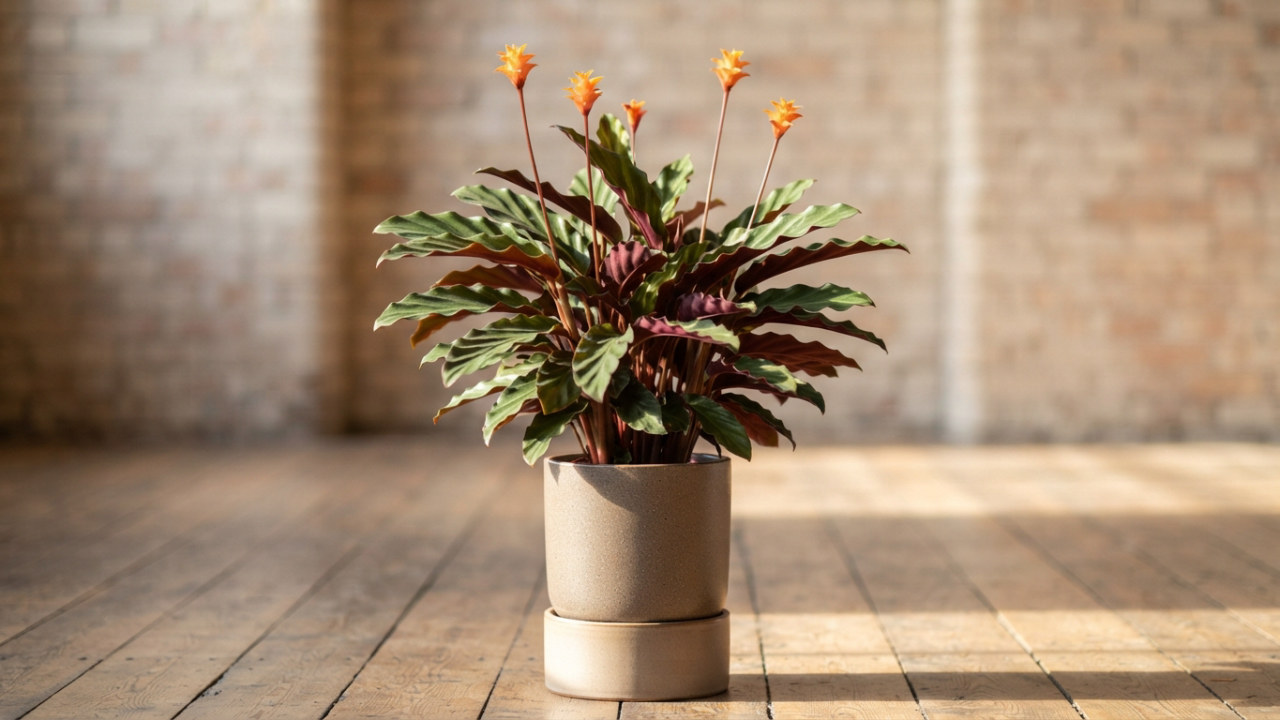
'Tassmania' is a cultivar of Goeppertia crocata, sold as Calathea crocata 'Tassmania'. Its deep green leaves are slightly puckered and wavy, flushed with purple on top and crimson-red beneath, and from long stems it lifts flame-orange flower heads whose bracts can stay colorful for up to three months. It forms a clump of 30 to 50 cm and likes steady warmth, humid air and soft water.

How to recognise Calathea 'Tassmania'
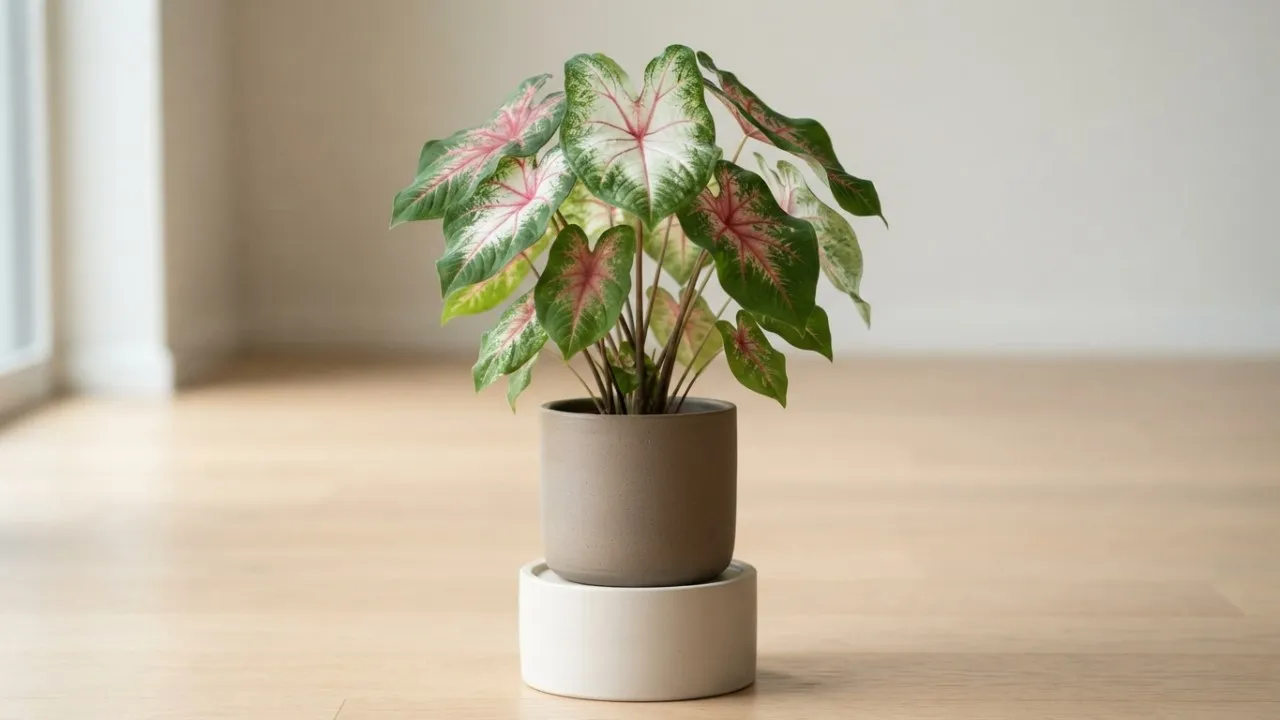
Wavy, slightly puckered deep green leaves with a purple flush on top and a crimson-red underside, and flame-orange flower heads on long stems in season. Next to the plain dark green species the purple flush is the leaf clue.

Watering your Calathea 'Tassmania'
Every 5 days
Pour rainwater or filtered water slowly once the mix has barely begun to dry at the surface, stop when it escapes from the base, and drain the saucer; the roots should stay evenly damp, with a longer interval in winter.
How to know it needs water
- The surface of the mix looks lighter in color and feels barely moist
- Leaves roll up lengthwise instead of lying open, and the pot is clearly lighter

How much light a Calathea 'Tassmania' needs
Bright indirect light
Bright indirect light, for example beside an east window behind a sheer curtain or a little back from a north one; direct sun scorches the foliage.
- Direct sun tolerated
- No direct sun
- Orientations that suit it
- North, North-east, East, North-west

Humidity and misting
60–80 %
Between 60 and 80%, a level most heated rooms do not reach on their own; in drier air the leaf margins crisp and brown. Mist the leaves about every three days with soft water, in the morning, aiming at the foliage and keeping the flower heads dry; a humidifier gives longer-lasting humidity.

Feeding and fertiliser
Every 28 days
Apply it every four weeks or so from April to September, never on dry mix, and pause from October to March; salts build up and scorch the leaf margins, so flush the pot with clear water every few months.
- Recommended feed
- A balanced liquid fertilizer for foliage plants, diluted to half the dose printed on the label. · 5-5-5

Repotting your Calathea 'Tassmania'
Every 24 months
Choose a pot one size larger and refill with a light blend of potting soil, perlite and coco fiber, or pull the clump apart at the rhizomes to get new plants.
- When
- Spring, from March to May, as new growth begins.
- Potting mix
- All-purpose potting mix
- Mix in
- perlite, coco fibre
The tell-tale signs
- Thick roots grow through the drainage holes or form a coil under the plant
- New flower stems and leaves come up crowded against the rim of the pot

Pruning your Calathea 'Tassmania'
As soon as a flower stem has faded, and whenever a leaf yellows or is damaged. Remove a spent flower stem or a damaged leaf by cutting it close to the base of the clump with clean scissors.

Through the year
Watering is not set once and for all: it follows the light and the growth. Allow 9 days between waterings in the depth of winter, against 5 in the growing season.
- 8 J
- 6 F
- 5 M
- 5 A
- 5 M
- 5 J
- 5 J
- 5 A
- 5 S
- 6 O
- 8 N
- 9 D
Active growth · Days between waterings

Good to know
- Each flame-orange head can stay colorful for up to three months, because the color comes from long-lasting bracts rather than from fragile petals.
- The family name Marantaceae honors Bartolomeo Maranta, a sixteenth-century Italian physician and botanist.

Frequently asked questions about the Calathea 'Tassmania'
How do you care for a Calathea 'Tassmania'?
Water it every 5 days. Give it bright indirect light. Ideal humidity: 60–80 %. Ideal temperature: 18–27 °C. Pour rainwater or filtered water slowly once the mix has barely begun to dry at the surface, stop when it escapes from the base, and drain the saucer; the roots should stay evenly damp, with a longer interval in winter.
How often should you water a Calathea 'Tassmania'?
Every 5 days Pour rainwater or filtered water slowly once the mix has barely begun to dry at the surface, stop when it escapes from the base, and drain the saucer; the roots should stay evenly damp, with a longer interval in winter. How to know it needs water : The surface of the mix looks lighter in color and feels barely moist ; Leaves roll up lengthwise instead of lying open, and the pot is clearly lighter.
How much light does a Calathea 'Tassmania' need?
Bright indirect light Bright indirect light, for example beside an east window behind a sheer curtain or a little back from a north one; direct sun scorches the foliage. No direct sun
Is the Calathea 'Tassmania' toxic to cats and dogs?
No, the Calathea 'Tassmania' is not listed as toxic to cats and dogs. That is still no reason to let your pets chew on it.
Why are my Calathea 'Tassmania' leaves turning yellow?
Yellowing most often comes from too much water: the mix stays wet and the roots suffocate. Check that the pot drains, empty the saucer, and let the mix dry before watering again. Too little light or a cold draught cause the same symptom.
When should you repot a Calathea 'Tassmania'?
Repot every 24 months, ideally in spring, from march to may, as new growth begins.. Choose a pot one size larger and refill with a light blend of potting soil, perlite and coco fiber, or pull the clump apart at the rhizomes to get new plants.

At a glance
- Family
- Marantaceae
- Category
- Tropical
- Placement
- Indoor
- Mature height
- 50 cm
- Growth
- Moderate
- Temperature
- 18–27 °C
- Pot materials
- plastic, ceramic
- Growth
- Reaches maturity in 3 years
These figures are for an average plant. In the app they are recalculated for yours, based on your room, its orientation and the season.
And for your plant, in your home?
In the app this plant becomes yours: a watering schedule tuned to your home, health tracking from photos, and reminders at the right moment.
In the same spirit
 Every 7 days


Air Plant
Tillandsia ionantha

 Every 6 days
Alocasia amazonica
Alocasia amazonica
 Every 7 days
Alocasia baginda
Alocasia baginda
 Every 4 days
Angel Wings
Caladium bicolor
