
Tropical · Moraceae
Mistletoe Fig
Ficus deltoidea
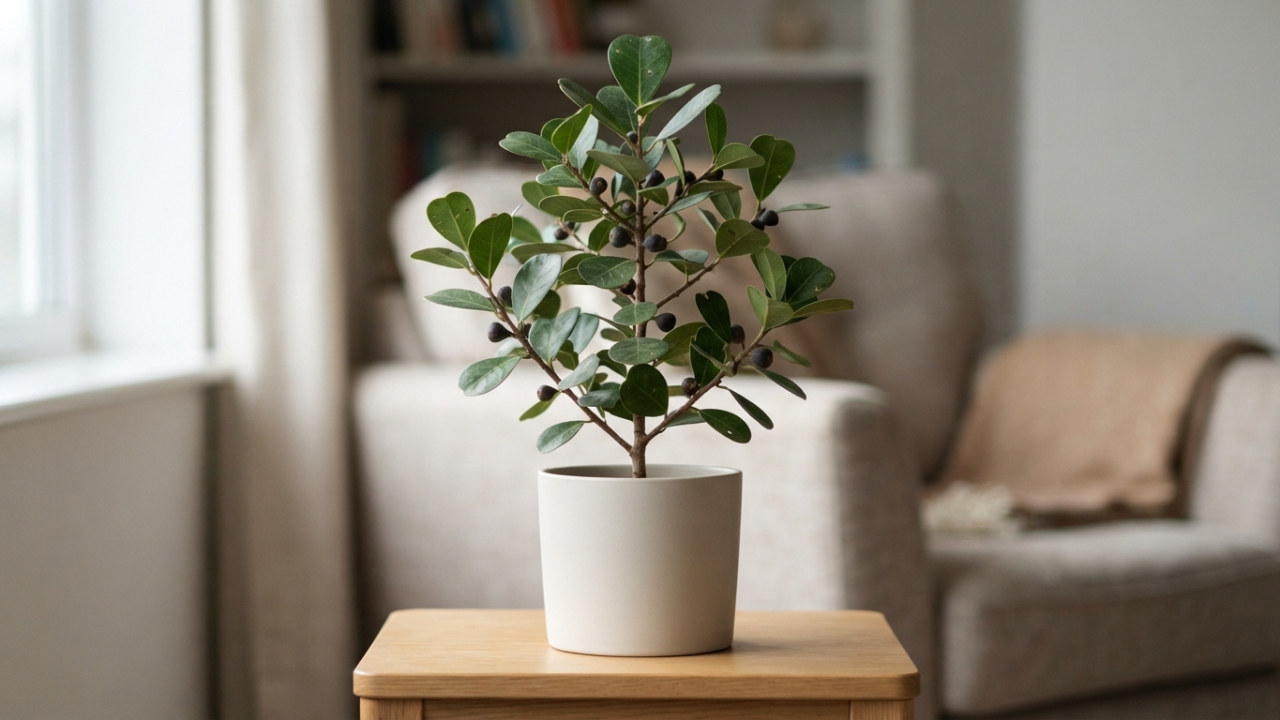
A slow, compact shrub with small, thick leaves, golden and dotted beneath, that bears small round figs all year.
- Every 9 daysWatering
- Bright indirect lightLight
- 50–70 %Humidity
- 15–30 °CTemperature


How to care for your Mistletoe Fig
Everything you need to keep your Mistletoe Fig healthy: watering, light, humidity, feeding, repotting and pruning.
Ficus deltoidea, the mistletoe fig, grows wild in Southeast Asia, from peninsular Thailand and Malaysia to Borneo, Java, Sumatra and Sulawesi. This slow, spreading shrub has thick, waxy leaves that can be round, spoon-shaped or triangular, even on a single plant, bright to dark green above and golden to tan beneath with tiny dark dots. It bears small round figs all year, ripening from green to yellow, orange or red, and stays around 90 centimeters tall indoors.

How to recognise Mistletoe Fig
Small, thick, waxy leaves of changing shape, round, spoon-shaped or triangular, bright to dark green above and golden to tan beneath with tiny dark dots, on a compact, spreading shrub with small round figs. Ficus benjamina has thinner, pointed leaves on drooping branches, Ficus microcarpa has oval leaves with a plain underside, Ficus pumila is a clinging vine with tiny heart-shaped leaves, and the plant sold as Ficus triangularis has regularly triangular leaves on an upright tree.

Watering your Mistletoe Fig
Every 9 days
Water until the excess drains away, then wait until the top few centimeters of the mix have dried before watering again, and never leave it standing in water.
How to know it needs water
- The top few centimeters of the mix feel dry to a finger
- The thick leaves feel slightly less firm and the pot is noticeably lighter

How much light a Mistletoe Fig needs
Bright indirect light
Bright, indirect light suits it best, with up to two hours of gentle morning sun, though it tolerates a dimmer spot with weaker growth.
- Direct sun tolerated
- 0 to 2 h a day
- Orientations that suit it
- North, North-east, East, South-east, South, South-west, West, North-west

Humidity and misting
50–70 %
It appreciates medium to high humidity, around 50 to 70 percent; in heated rooms, group it with other plants or place a humidifier nearby. Misting is not needed, since thick, waxy leaves gain little from it; a group of plants or a humidifier raises the humidity far longer than a spray.

Feeding and fertiliser
Every 28 days
Feed about every four weeks from April to September; as a slow grower it needs little, so lean toward a weak dose.
- Recommended feed
- A liquid fertilizer for green plants, richer in nitrogen than in phosphorus, at half the dose on the label. · 3-1-2

Repotting your Mistletoe Fig
Every 36 months
Move up one pot size at most, into universal potting mix with perlite or bark for drainage; a slightly snug pot suits this slow grower.
- When
- Spring, from March to May.
- Potting mix
- All-purpose potting mix
- Mix in
- perlite, pine bark, coco fibre
The tell-tale signs
- Roots show at the drainage holes or circle the surface of the mix
- Water runs straight through the pot, or the mix dries out within a few days

Pruning your Mistletoe Fig
In spring, to shape the shrub and keep it compact; light trimming is possible during the growing season. Shorten long shoots just above a leaf with clean shears to make it branch, blot the milky sap, and wear gloves.

Through the year
Watering is not set once and for all: it follows the light and the growth. Allow 13 days between waterings in the depth of winter, against 7 in the growing season.
- 12 J
- 11 F
- 9 M
- 8 A
- 7 M
- 7 J
- 7 J
- 8 A
- 9 S
- 10 O
- 12 N
- 13 D
Active growth · Days between waterings

Toxicity
The milky sap is irritating and toxic if swallowed, for cats, dogs and people, and on the skin it can cause dermatitis, especially in sunlight, so wear gloves to prune.

Good to know
- Leaf shape and size vary even on one plant, from round and spoon-shaped to triangular.
- Its tiny figs appear all year and change color as they ripen, from green to yellow, orange or red.

Frequently asked questions about the Mistletoe Fig
How do you care for a Mistletoe Fig?
Water it every 9 days. Give it bright indirect light. Ideal humidity: 50–70 %. Ideal temperature: 15–30 °C. Water until the excess drains away, then wait until the top few centimeters of the mix have dried before watering again, and never leave it standing in water.
How often should you water a Mistletoe Fig?
Every 9 days Water until the excess drains away, then wait until the top few centimeters of the mix have dried before watering again, and never leave it standing in water. How to know it needs water : The top few centimeters of the mix feel dry to a finger ; The thick leaves feel slightly less firm and the pot is noticeably lighter.
How much light does a Mistletoe Fig need?
Bright indirect light Bright, indirect light suits it best, with up to two hours of gentle morning sun, though it tolerates a dimmer spot with weaker growth. 0 to 2 h a day
Is the Mistletoe Fig toxic to cats and dogs?
Yes. The milky sap is irritating and toxic if swallowed, for cats, dogs and people, and on the skin it can cause dermatitis, especially in sunlight, so wear gloves to prune. Keep it out of reach of your pets and call a vet if any is swallowed.
Why are my Mistletoe Fig leaves turning yellow?
Yellowing most often comes from too much water: the mix stays wet and the roots suffocate. Check that the pot drains, empty the saucer, and let the mix dry before watering again. Too little light or a cold draught cause the same symptom.
When should you repot a Mistletoe Fig?
Repot every 36 months, ideally in spring, from march to may.. Move up one pot size at most, into universal potting mix with perlite or bark for drainage; a slightly snug pot suits this slow grower.

At a glance
- Family
- Moraceae
- Category
- Tropical
- Placement
- Indoor
- Mature height
- 90 cm
- Growth
- Slow
- Temperature
- 15–30 °C
- Pot materials
- terracotta, ceramic, plastic
- Growth
- Reaches maturity in 10 years
These figures are for an average plant. In the app they are recalculated for yours, based on your room, its orientation and the season.
And for your plant, in your home?
In the app this plant becomes yours: a watering schedule tuned to your home, health tracking from photos, and reminders at the right moment.
In the same spirit
 Every 7 days


Air Plant
Tillandsia ionantha

 Every 6 days
Alocasia amazonica
Alocasia amazonica
 Every 7 days
Alocasia baginda
Alocasia baginda
 Every 4 days
Angel Wings
Caladium bicolor
