
Tropical · Droseraceae
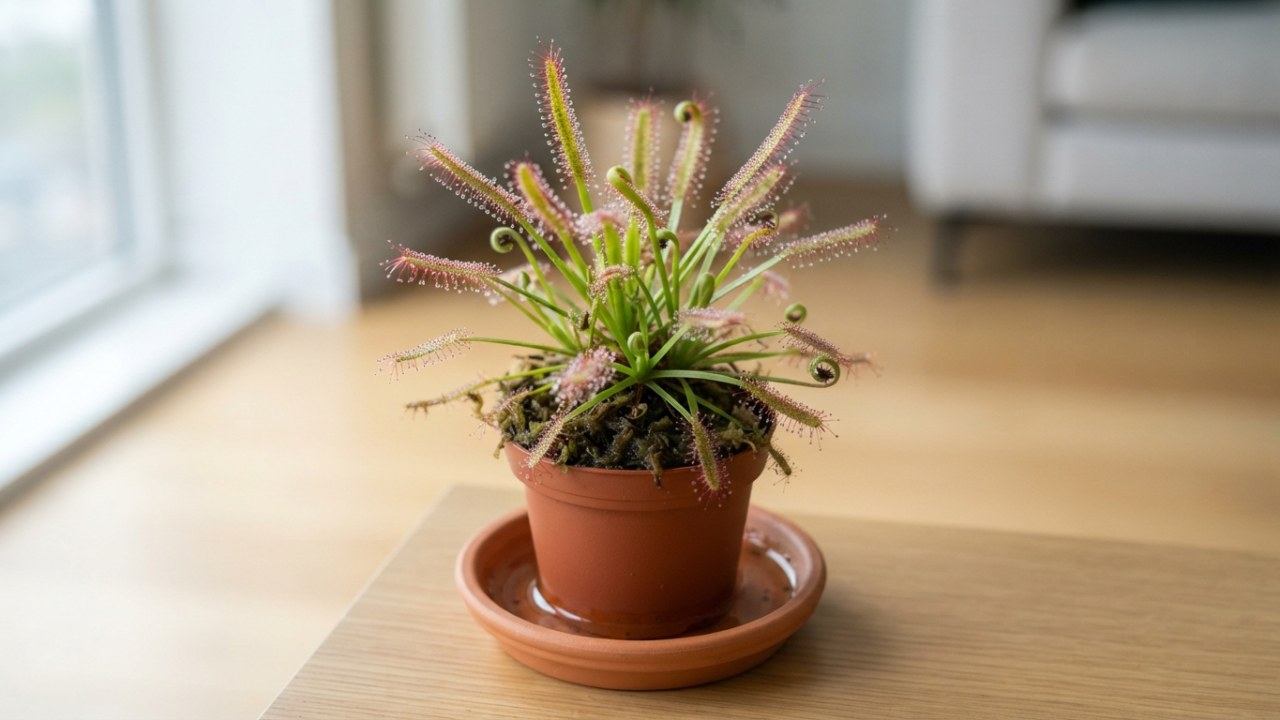
Cape Sundew
Drosera capensis
The Cape Sundew is a charming carnivorous plant known for its long, dewy tentacles that sparkle in the sun, attracting and trapping insects.
- Every 2 daysWatering
- Full sunLight
- 50–80 %Humidity
- 10–30 °CTemperature


How to care for your Cape Sundew
Everything you need to keep your Cape Sundew healthy: watering, light, humidity, feeding, repotting and pruning.
Drosera capensis, native to the wetlands of the Cape in South Africa, is a popular and relatively easy-to-grow carnivorous plant. Its strap-like leaves are covered with glandular tentacles that secrete a sticky mucilage, giving them a 'dewy' appearance. These tentacles serve to trap and digest small insects, providing the plant with essential nutrients. It thrives in very bright light and consistently moist, nutrient-poor conditions, making it an excellent choice for beginners to carnivorous plants. It grows continuously indoors without a distinct dormancy period if kept warm and well-lit. It is not frost hardy: it tolerates at most a very light, brief frost, so outdoors in a pot it must come inside before nights drop near 5 °C.

How to recognise Cape Sundew
A rosette of long, narrow, strap-shaped leaves, each fringed with red-tipped sticky tentacles that glisten like dew, with a short stem forming with age and pink to purple flowers on a tall stalk. It can be confused with Drosera aliciae, whose rosette is tighter with short spoon-shaped leaves, and with Drosera binata, whose leaves fork in two.

Watering your Cape Sundew
Every 2 days
Tray method all year, with no reduced season: the pot stands in 1 to 2 cm of rainwater, distilled water, or reverse-osmosis water. Refill the saucer when it is almost empty. Never use tap water.
How to know it needs water
- Saucer almost empty
- Substrate surface appears dry
- Dew drops on leaves are less prominent

How much light a Cape Sundew needs
Full sun
Very bright light with several hours of direct sun daily; a sunny windowsill is ideal. Insufficient light will cause the leaves to lose their characteristic 'dew'.
- Direct sun tolerated
- 4 to 8 h a day
- Orientations that suit it
- South-east, South, South-west, East, West

Humidity and misting
50–80 %
Medium to high (50 to 80%) Misting is not needed, and it can wash away the mucilage on the leaves.

Feeding and fertiliser
Never fertilize the substrate or the leaves. This plant obtains nutrients from insects it catches.
- Recommended feed
- None · 0-0-0

Repotting your Cape Sundew
Every 12 months
Repot once a year in spring into a slightly larger pot using a nutrient-poor substrate specifically for carnivorous plants, such as sphagnum peat mixed with perlite or silica sand. Avoid regular potting soil.
- When
- Spring
- Potting mix
- carnivorous
- Mix in
- sphagnum moss, perlite, coarse sand
The tell-tale signs
- Roots emerging from drainage holes
- Plant outgrowing its pot
- Substrate breaking down or becoming compacted

Pruning your Cape Sundew
Remove dead or dying leaves and flower stalks as needed. Cut cleanly at the base of the leaf or stalk with sterilised scissors or a sharp blade.

Through the year
Watering is not set once and for all: it follows the light and the growth. Allow 2 days between waterings in the depth of winter, against 2 in the growing season.
- 2 J
- 2 F
- 2 M
- 2 A
- 2 M
- 2 J
- 2 J
- 2 A
- 2 S
- 2 O
- 2 N
- 2 D
Active growth · Days between waterings

Good to know
- Its leaves are covered in sticky tentacles that trap insects, which it then digests for nutrients.
- Native to the Cape region of South Africa, it is one of the easiest carnivorous plants to grow.
- It often self-seeds, producing numerous small plantlets in its own pot or nearby containers.

Frequently asked questions about the Cape Sundew
How do you care for a Cape Sundew?
Water it every 2 days. Give it full sun. Ideal humidity: 50–80 %. Ideal temperature: 10–30 °C. Tray method all year, with no reduced season: the pot stands in 1 to 2 cm of rainwater, distilled water, or reverse-osmosis water. Refill the saucer when it is almost empty. Never use tap water.
How often should you water a Cape Sundew?
Every 2 days Tray method all year, with no reduced season: the pot stands in 1 to 2 cm of rainwater, distilled water, or reverse-osmosis water. Refill the saucer when it is almost empty. Never use tap water. How to know it needs water : Saucer almost empty ; Substrate surface appears dry ; Dew drops on leaves are less prominent.
How much light does a Cape Sundew need?
Full sun Very bright light with several hours of direct sun daily; a sunny windowsill is ideal. Insufficient light will cause the leaves to lose their characteristic 'dew'. 4 to 8 h a day
Is the Cape Sundew toxic to cats and dogs?
No, the Cape Sundew is not listed as toxic to cats and dogs. That is still no reason to let your pets chew on it.
Why are my Cape Sundew leaves turning yellow?
Yellowing most often comes from too much water: the mix stays wet and the roots suffocate. Check that the pot drains, empty the saucer, and let the mix dry before watering again. Too little light or a cold draught cause the same symptom.
When should you repot a Cape Sundew?
Repot every 12 months, ideally in spring. Repot once a year in spring into a slightly larger pot using a nutrient-poor substrate specifically for carnivorous plants, such as sphagnum peat mixed with perlite or silica sand. Avoid regular potting soil.

At a glance
- Family
- Droseraceae
- Category
- Tropical
- Placement
- Indoor and outdoor
- Mature height
- 15 cm
- Growth
- Fast
- Temperature
- 10–30 °C
- Pot materials
- plastic, ceramic
- Growth
- Reaches maturity in 1 years
These figures are for an average plant. In the app they are recalculated for yours, based on your room, its orientation and the season.
And for your plant, in your home?
In the app this plant becomes yours: a watering schedule tuned to your home, health tracking from photos, and reminders at the right moment.
In the same spirit
 Every 7 days


Air Plant
Tillandsia ionantha

 Every 6 days
Alocasia amazonica
Alocasia amazonica
 Every 7 days
Alocasia baginda
Alocasia baginda
 Every 4 days
Angel Wings
Caladium bicolor
