
Variety Tropical · Marantaceae
Calathea 'Blue Grass'
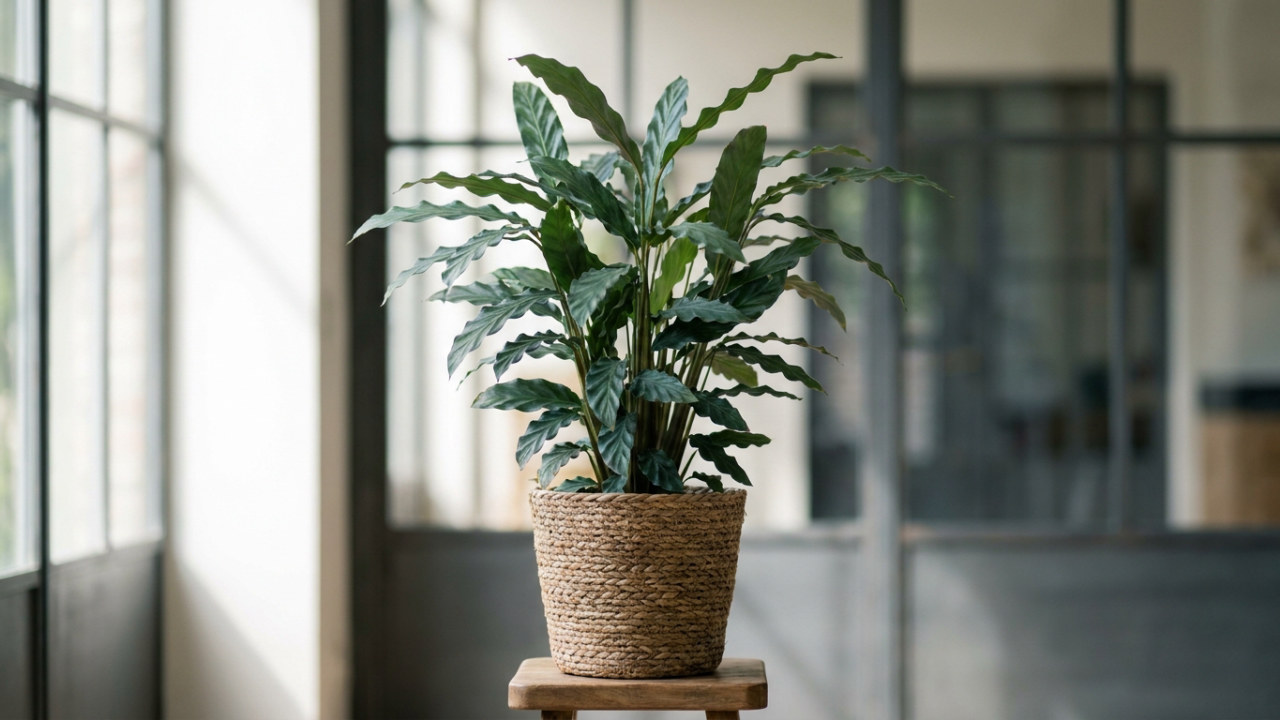
Calathea rufibarba 'Blue Grass' · A variety of Furry Feather Calathea
A compact Calathea with narrow, wavy blue-green leaves and a velvety purple underside.
- Every 5 daysWatering
- Bright indirect lightLight
- 60–80 %Humidity
- 18–27 °CTemperature


Other varieties 1
How to care for your Calathea 'Blue Grass'
Everything you need to keep your Calathea 'Blue Grass' healthy: watering, light, humidity, feeding, repotting and pruning.
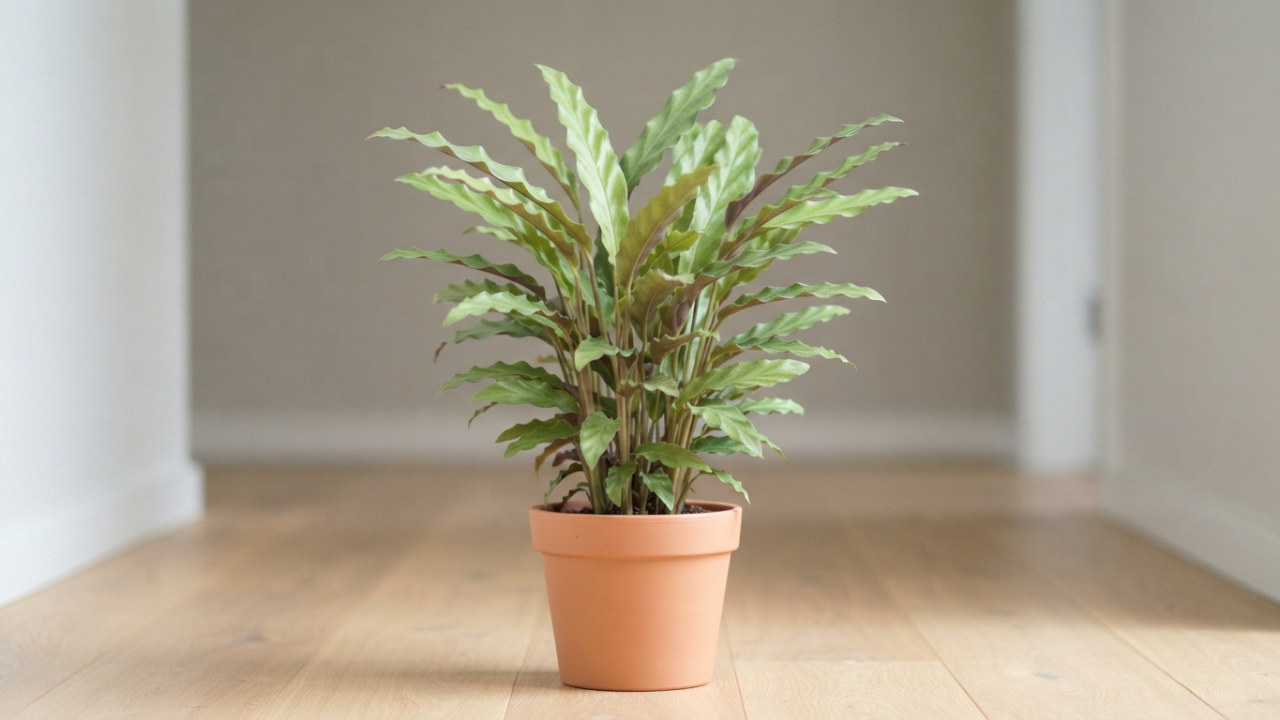
'Blue Grass' is a compact cultivar of the Furry Feather Calathea, a species from the rainforests of Brazil. Its slender, lance-shaped leaves ripple along the edges and show a cool blue-green upper surface where the species is plain green, while the stalks and the velvety purple undersides carry fine reddish hairs. It grows as an upright clump of around 50 cm and, like every Calathea, lifts its leaves at dusk and lowers them again at dawn.

How to recognise Calathea 'Blue Grass'
Narrow, wavy-edged leaves that are blue-green on top where the species is plain green. 'Wavestar' is a fresher, lighter green and grows taller and looser.

Watering your Calathea 'Blue Grass'
Every 5 days
Water with rainwater or filtered water as soon as the surface of the mix begins to dry, so the root ball stays slightly moist without ever sitting in a wet saucer.
How to know it needs water
- The surface of the mix has just begun to dry
- The leaves roll inward along their length and lose their firmness

How much light a Calathea 'Blue Grass' needs
Bright indirect light
Bright indirect light suits it, a little back from an east or north window, because direct sun bleaches the color and scorches the thin leaves.
- Direct sun tolerated
- No direct sun
- Orientations that suit it
- North, North-east, East, South-east, North-west

Humidity and misting
60–80 %
Humid air between 60 and 80%, which is more than most heated rooms offer, especially in winter. Misting is not advised, because droplets linger on the fine hairs, and a humidifier or a group of plants raises the humidity more usefully.

Feeding and fertiliser
Every 28 days
Feed about once a month from April to September, then pause through autumn and winter while growth slows.
- Recommended feed
- A liquid fertilizer for foliage plants, diluted to half the recommended dose. · 3-1-2

Repotting your Calathea 'Blue Grass'
Every 24 months
Move up one size into an airy mix of potting soil, perlite, coco fiber and pine bark, and divide the clump at the rhizome if it has outgrown the pot.
- When
- Spring, from March to May, just as growth restarts.
- Potting mix
- All-purpose potting mix
- Mix in
- perlite, coco fibre, pine bark
The tell-tale signs
- Roots circle the pot or push out of the drainage holes
- Water runs straight through, or the mix dries much faster than it used to

Pruning your Calathea 'Blue Grass'
Only when a leaf turns yellow, browns or tears, since the plant needs no routine pruning. Cut the damaged leaf stalk right at its base with clean scissors, leaving no stump.

Through the year
Watering is not set once and for all: it follows the light and the growth. Allow 8 days between waterings in the depth of winter, against 5 in the growing season.
- 8 J
- 7 F
- 5 M
- 5 A
- 5 M
- 5 J
- 5 J
- 5 A
- 5 S
- 6 O
- 7 N
- 8 D
Active growth · Days between waterings

Good to know
- The species name, rufibarba, means 'red-bearded' in Latin, a nod to the reddish hairs on the stalks and leaf undersides
- Like other Calatheas, it raises its leaves at night and lowers them in the morning, thanks to a swollen joint where each leaf meets its stalk

Frequently asked questions about the Calathea 'Blue Grass'
How do you care for a Calathea 'Blue Grass'?
Water it every 5 days. Give it bright indirect light. Ideal humidity: 60–80 %. Ideal temperature: 18–27 °C. Water with rainwater or filtered water as soon as the surface of the mix begins to dry, so the root ball stays slightly moist without ever sitting in a wet saucer.
How often should you water a Calathea 'Blue Grass'?
Every 5 days Water with rainwater or filtered water as soon as the surface of the mix begins to dry, so the root ball stays slightly moist without ever sitting in a wet saucer. How to know it needs water : The surface of the mix has just begun to dry ; The leaves roll inward along their length and lose their firmness.
How much light does a Calathea 'Blue Grass' need?
Bright indirect light Bright indirect light suits it, a little back from an east or north window, because direct sun bleaches the color and scorches the thin leaves. No direct sun
Is the Calathea 'Blue Grass' toxic to cats and dogs?
No, the Calathea 'Blue Grass' is not listed as toxic to cats and dogs. That is still no reason to let your pets chew on it.
Why are my Calathea 'Blue Grass' leaves turning yellow?
Yellowing most often comes from too much water: the mix stays wet and the roots suffocate. Check that the pot drains, empty the saucer, and let the mix dry before watering again. Too little light or a cold draught cause the same symptom.
When should you repot a Calathea 'Blue Grass'?
Repot every 24 months, ideally in spring, from march to may, just as growth restarts.. Move up one size into an airy mix of potting soil, perlite, coco fiber and pine bark, and divide the clump at the rhizome if it has outgrown the pot.

At a glance
- Family
- Marantaceae
- Category
- Tropical
- Placement
- Indoor
- Mature height
- 50 cm
- Growth
- Moderate
- Temperature
- 18–27 °C
- Pot materials
- ceramic, plastic
- Growth
- Reaches maturity in 3 years
These figures are for an average plant. In the app they are recalculated for yours, based on your room, its orientation and the season.
And for your plant, in your home?
In the app this plant becomes yours: a watering schedule tuned to your home, health tracking from photos, and reminders at the right moment.
In the same spirit
 Every 7 days


Air Plant
Tillandsia ionantha

 Every 6 days
Alocasia amazonica
Alocasia amazonica
 Every 7 days
Alocasia baginda
Alocasia baginda
 Every 4 days
Angel Wings
Caladium bicolor
