
Tropical · Araceae
Hilo Beauty
Caladium praetermissum
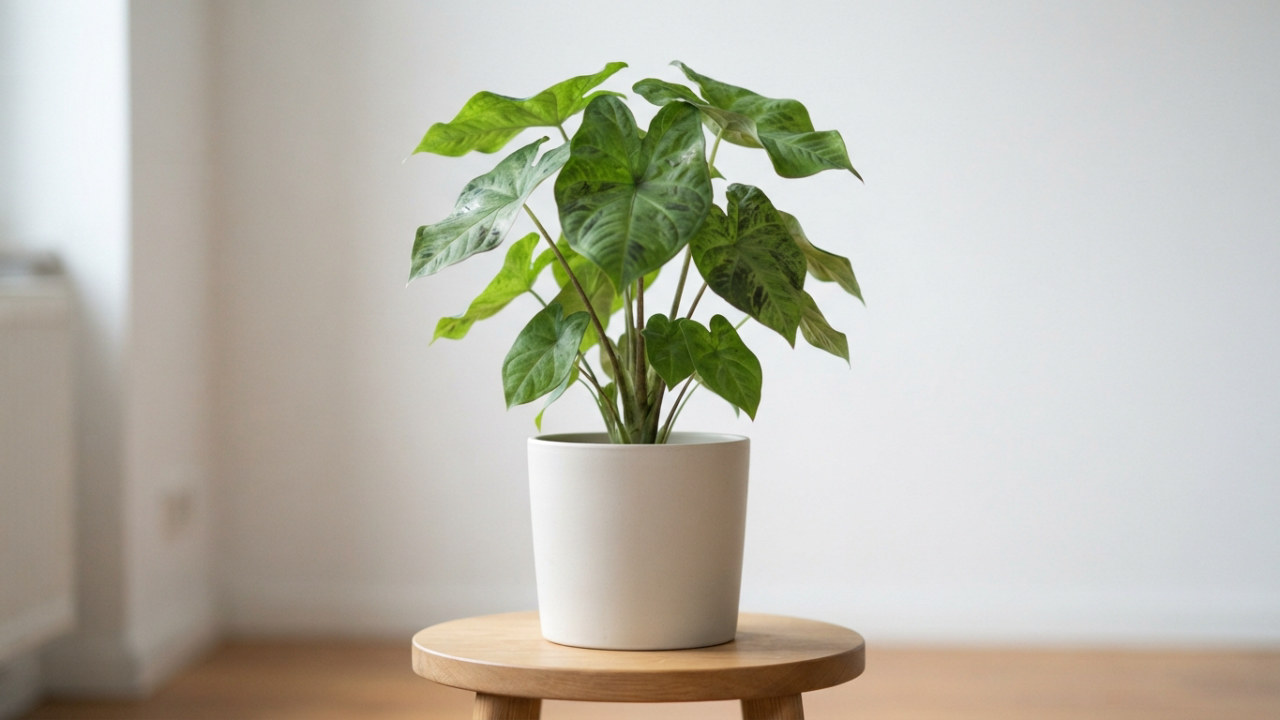
A tuberous aroid sold under the trade name 'Hilo Beauty', with heart-shaped leaves splashed with cream and chartreuse.
- Every 4 daysWatering
- Bright indirect lightLight
- 60–80 %Humidity
- 18–28 °CTemperature


How to care for your Hilo Beauty
Everything you need to keep your Hilo Beauty healthy: watering, light, humidity, feeding, repotting and pruning.
Caladium praetermissum is sold under the trade name 'Hilo Beauty'; for years it was labeled Alocasia or Colocasia 'Hilo Beauty', before it was formally described as a Caladium in 2009. The species name praetermissum means overlooked, and no wild population is known. Its heart-shaped leaves look camouflaged, splashed with cream, chartreuse and several greens, on dark bluish stems that rise straight from the tuber. The clump reaches 60 to 90 cm indoors, grows fast, and may rest in winter.

How to recognise Hilo Beauty
Heart-shaped leaves in a camouflage pattern, green splashed with cream and chartreuse, on dark bluish stems from a tuber, with no bright central veins or contrasting borders. Caladium bicolor cultivars, the closest lookalikes, have those colored veins or borders, most Alocasia hold their leaves upward, and Colocasia esculenta, which also lets its leaves hang, is taller with larger leaves.

Watering your Hilo Beauty
Every 4 days
Keep the mix evenly moist through the growing season, never letting it dry out completely or sit waterlogged, and stop watering once the leaves die back.
How to know it needs water
- The surface of the mix has begun to dry
- The leaves lose their firmness and sag a little

How much light a Hilo Beauty needs
Bright indirect light
Bright indirect light keeps the colors strong; beyond about an hour of mild morning sun the leaves scorch.
- Direct sun tolerated
- 0 to 1 h a day
- Orientations that suit it
- North, North-east, East, North-west

Humidity and misting
60–80 %
Humid air, from 60 to 80%, suits it; dry air curls and browns the leaf edges. Misting is not needed: the extra humidity fades within minutes and the leaves are better kept dry; a humidifier does more.

Feeding and fertiliser
Every 14 days
Feed about every 14 days from May to August, and not at all for the rest of the year or while the tuber rests.
- Recommended feed
- A liquid fertilizer for foliage plants, with about twice as much nitrogen and potassium as phosphorus, at half strength. · 2-1-2

Repotting your Hilo Beauty
Every 12 months
Replant the tuber just below the surface of a light, rich mix of potting soil, perlite and coco fiber, buds facing up, in a pot one size larger.
- When
- Spring, in March or April, as the tuber wakes up.
- Potting mix
- All-purpose potting mix
- Mix in
- perlite, coco fibre
The tell-tale signs
- Tubers crowd the pot or push up toward the surface
- Leaves come smaller than last season

Pruning your Hilo Beauty
Remove a leaf as soon as it fades or tears, but let the foliage yellow by itself in autumn before the rest. Cut the stalk at its base with clean scissors and wear gloves, as the sap can irritate the skin.

Through the year
Watering is not set once and for all: it follows the light and the growth. Allow 10 days between waterings in the depth of winter, against 3 in the growing season.
- 10 J
- 10 F
- 7 M
- 4 A
- 3 M
- 3 J
- 3 J
- 3 A
- 4 S
- 6 O
- 8 N
- 10 D
Active growth · Days between waterings

Toxicity
Every part contains calcium oxalate crystals that irritate the mouth and throat of people, cats and dogs if chewed or swallowed, causing pain, swelling and drooling; keep the plant out of reach.

Good to know
- Its name praetermissum means overlooked in Latin, because the plant was sold for years under other names.
- It is known only from cultivation, and is thought to come from the tropics of the Americas.

Frequently asked questions about the Hilo Beauty
How do you care for a Hilo Beauty?
Water it every 4 days. Give it bright indirect light. Ideal humidity: 60–80 %. Ideal temperature: 18–28 °C. Keep the mix evenly moist through the growing season, never letting it dry out completely or sit waterlogged, and stop watering once the leaves die back.
How often should you water a Hilo Beauty?
Every 4 days Keep the mix evenly moist through the growing season, never letting it dry out completely or sit waterlogged, and stop watering once the leaves die back. How to know it needs water : The surface of the mix has begun to dry ; The leaves lose their firmness and sag a little.
How much light does a Hilo Beauty need?
Bright indirect light Bright indirect light keeps the colors strong; beyond about an hour of mild morning sun the leaves scorch. 0 to 1 h a day
Is the Hilo Beauty toxic to cats and dogs?
Yes. Every part contains calcium oxalate crystals that irritate the mouth and throat of people, cats and dogs if chewed or swallowed, causing pain, swelling and drooling; keep the plant out of reach. Keep it out of reach of your pets and call a vet if any is swallowed.
Why are my Hilo Beauty leaves turning yellow?
Yellowing most often comes from too much water: the mix stays wet and the roots suffocate. Check that the pot drains, empty the saucer, and let the mix dry before watering again. Too little light or a cold draught cause the same symptom.
When should you repot a Hilo Beauty?
Repot every 12 months, ideally in spring, in march or april, as the tuber wakes up.. Replant the tuber just below the surface of a light, rich mix of potting soil, perlite and coco fiber, buds facing up, in a pot one size larger.

At a glance
- Family
- Araceae
- Category
- Tropical
- Placement
- Indoor
- Mature height
- 75 cm
- Growth
- Fast
- Temperature
- 18–28 °C
- Pot materials
- plastic, ceramic
- Growth
- Reaches maturity in 2 years
These figures are for an average plant. In the app they are recalculated for yours, based on your room, its orientation and the season.
And for your plant, in your home?
In the app this plant becomes yours: a watering schedule tuned to your home, health tracking from photos, and reminders at the right moment.
In the same spirit
 Every 7 days


Air Plant
Tillandsia ionantha

 Every 6 days
Alocasia amazonica
Alocasia amazonica
 Every 7 days
Alocasia baginda
Alocasia baginda
 Every 4 days
Angel Wings
Caladium bicolor
