
Tropical · Begoniaceae
Peacock Begonia
Begonia pavonina
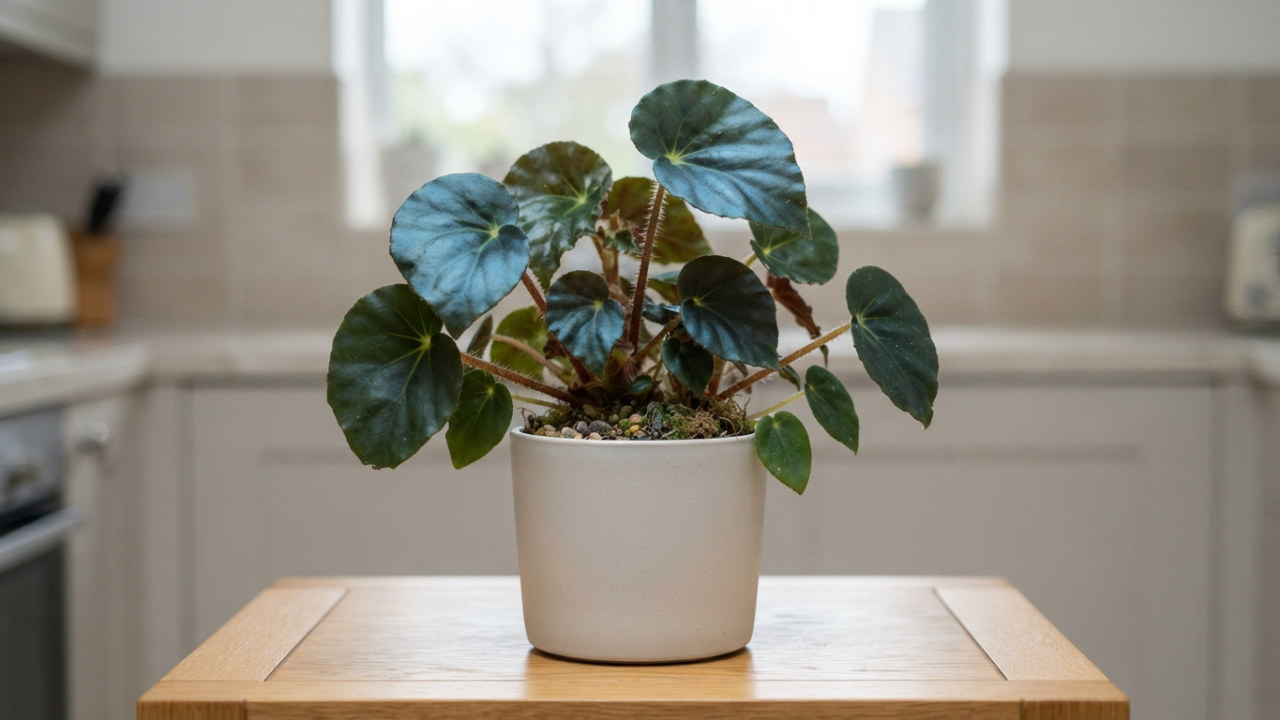
A small creeping begonia from Malaysia whose dark leaves shimmer with a metallic blue iridescence in low light.
- Every 5 daysWatering
- Medium lightLight
- 70–90 %Humidity
- 18–26 °CTemperature


How to care for your Peacock Begonia
Everything you need to keep your Peacock Begonia healthy: watering, light, humidity, feeding, repotting and pruning.
Begonia pavonina grows in the montane rainforests of Peninsular Malaysia and was described by Henry Nicholas Ridley in 1909. It is a low, creeping rhizomatous plant, 15 to 40 cm tall, with asymmetric heart-shaped to rounded dark green leaves, sometimes bronze-tinted, with deep red undersides. Its blue iridescence, strongest in low light, is its main attraction, while the small white to pale pink flowers matter less. It is usually grown in a terrarium.

How to recognise Peacock Begonia
A low creeping plant with dark green leaves that glow metallic blue in shade, with smooth-edged leaves and hairy leaf stalks. Begonia maculata is upright with silver dots, and Begonia cathayana has pink bands, not blue, on hairy leaves.

Watering your Peacock Begonia
Every 5 days
Water when the top layer of substrate is just dry, keeping it evenly moist but never waterlogged, and avoid cold water.
How to know it needs water
- The top layer of substrate is just dry
- Leaves lose their firmness

How much light a Peacock Begonia needs
Medium light
Low to medium indirect light, because the blue sheen is strongest in shade and fades in bright light, and no direct sun.
- Direct sun tolerated
- No direct sun
- Orientations that suit it
- North, North-east, East

Humidity and misting
70–90 %
Very high, from 70 to 90 percent, which a terrarium or glass cabinet provides. Do not mist the leaves, since droplets mark them and invite rot; keep the air humid in a closed container or with a humidifier.

Feeding and fertiliser
Every 21 days
Feed lightly every three weeks from spring to autumn.
- Recommended feed
- Balanced liquid fertilizer, diluted to a quarter or half strength. · 5-10-5

Repotting your Peacock Begonia
Every 12 months
Repot into a light, airy mix in a shallow pot, keeping the creeping rhizome at the surface.
- When
- Spring
- Potting mix
- All-purpose potting mix
- Mix in
- perlite, coco fibre
The tell-tale signs
- The rhizome overhangs the pot edge
- Roots appear at the drainage holes

Pruning your Peacock Begonia
Trim in spring only to remove old or damaged leaves and to limit spread. Cut leaf stalks with clean scissors at the base, and divide the rhizome if the plant gets too large.

Through the year
Watering is not set once and for all: it follows the light and the growth. Allow 7 days between waterings in the depth of winter, against 4 in the growing season.
- 6 J
- 6 F
- 5 M
- 4 A
- 4 M
- 4 J
- 4 J
- 4 A
- 5 S
- 5 O
- 6 N
- 7 D
Active growth · Days between waterings

Toxicity
Soluble calcium oxalates, mostly in the underground parts, make it toxic to cats, dogs and people if eaten, causing burning of the mouth and throat and vomiting.

Good to know
- The blue sheen comes from specialized plastids in the leaf cells, not from pigment.
- Plants sold as blue forms that have serrated leaf edges and smooth stalks are probably hybrids.

Frequently asked questions about the Peacock Begonia
How do you care for a Peacock Begonia?
Water it every 5 days. Give it medium light. Ideal humidity: 70–90 %. Ideal temperature: 18–26 °C. Water when the top layer of substrate is just dry, keeping it evenly moist but never waterlogged, and avoid cold water.
How often should you water a Peacock Begonia?
Every 5 days Water when the top layer of substrate is just dry, keeping it evenly moist but never waterlogged, and avoid cold water. How to know it needs water : The top layer of substrate is just dry ; Leaves lose their firmness.
How much light does a Peacock Begonia need?
Medium light Low to medium indirect light, because the blue sheen is strongest in shade and fades in bright light, and no direct sun. No direct sun
Is the Peacock Begonia toxic to cats and dogs?
Yes. Soluble calcium oxalates, mostly in the underground parts, make it toxic to cats, dogs and people if eaten, causing burning of the mouth and throat and vomiting. Keep it out of reach of your pets and call a vet if any is swallowed.
Why are my Peacock Begonia leaves turning yellow?
Yellowing most often comes from too much water: the mix stays wet and the roots suffocate. Check that the pot drains, empty the saucer, and let the mix dry before watering again. Too little light or a cold draught cause the same symptom.
When should you repot a Peacock Begonia?
Repot every 12 months, ideally in spring. Repot into a light, airy mix in a shallow pot, keeping the creeping rhizome at the surface.

At a glance
- Family
- Begoniaceae
- Category
- Tropical
- Placement
- Indoor
- Mature height
- 27 cm
- Growth
- Moderate
- Temperature
- 18–26 °C
- Pot materials
- terracotta, ceramic, plastic
- Growth
- Reaches maturity in 3 years
These figures are for an average plant. In the app they are recalculated for yours, based on your room, its orientation and the season.
And for your plant, in your home?
In the app this plant becomes yours: a watering schedule tuned to your home, health tracking from photos, and reminders at the right moment.
In the same spirit
 Every 7 days


Air Plant
Tillandsia ionantha

 Every 6 days
Alocasia amazonica
Alocasia amazonica
 Every 7 days
Alocasia baginda
Alocasia baginda
 Every 4 days
Angel Wings
Caladium bicolor
