
Variety Tropical · Araceae
Alocasia 'Maharani'
Alocasia 'Maharani' · A variety of Alocasia
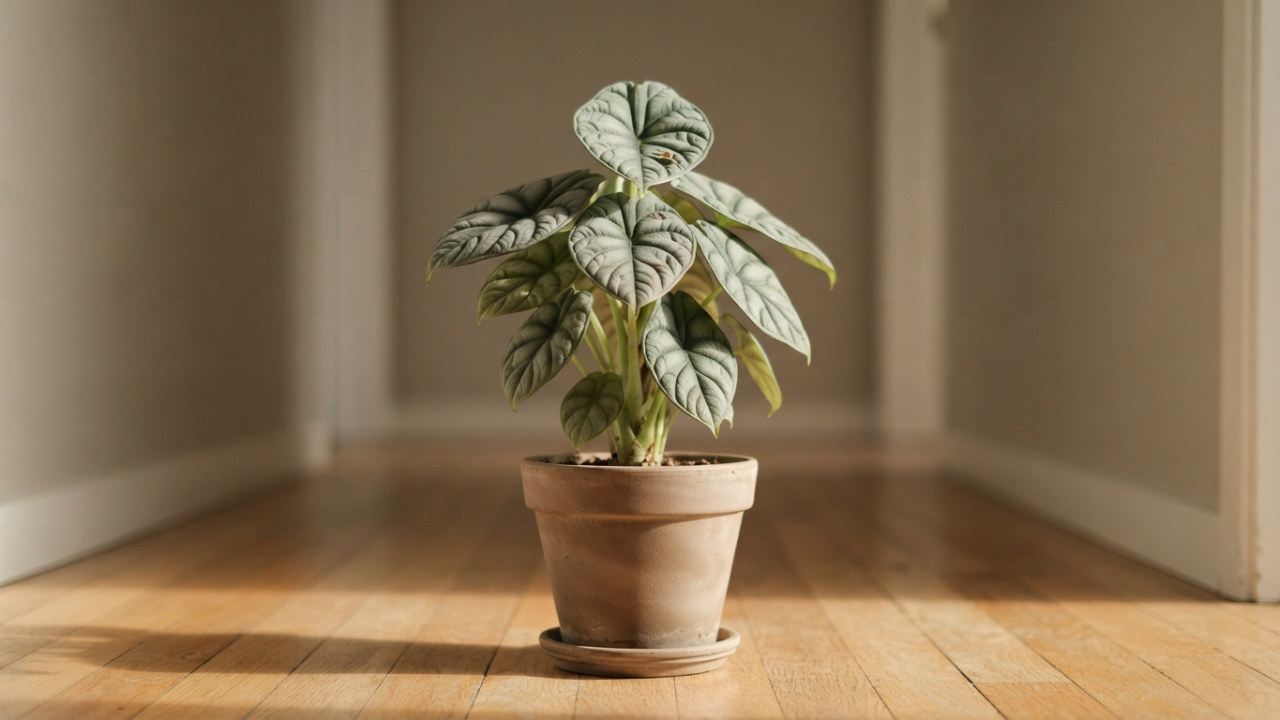
A compact jewel alocasia with thick, scale-textured heart-shaped leaves in silvery gray-green with sunken dark veins.
- Every 7 daysWatering
- Bright indirect lightLight
- 60–80 %Humidity
- 18–27 °CTemperature


Other varieties 3
How to care for your Alocasia 'Maharani'
Everything you need to keep your Alocasia 'Maharani' healthy: watering, light, humidity, feeding, repotting and pruning.
Alocasia 'Maharani' is a hybrid of Alocasia reginula and Alocasia melo, reportedly created by Peter Boyce around 2009, and it is also sold as 'Grey Dragon'. Its thick, leathery, heart-shaped leaves have a matte surface that looks scaly, silvery gray-green with deeply impressed darker veins, and the underside of mature leaves can turn reddish. The plant stays compact and grows slowly to 30 to 50 cm indoors; its small flowers are rare and unremarkable.

How to recognise Alocasia 'Maharani'
Small, thick, leathery heart-shaped leaves with a matte, scale-like surface in silvery gray-green, crossed by deeply impressed darker veins, on a compact plant of 30 to 50 cm. Alocasia baginda 'Dragon Scale' has a silvery jade green that darkens toward the center, a pale cream underside with maroon veins, and is taller, Alocasia melo has almost round, bumpy blue-green blades, and Alocasia reginula 'Black Velvet' is velvety and nearly black.

Watering your Alocasia 'Maharani'
Every 7 days
Water when the upper half of the mix has dried and let all the excess drain away; thick-leaved jewel types rot easily in wet soil, so this one needs less frequent watering than the large, thin-leaved alocasias.
How to know it needs water
- The upper half of the mix has dried and the small pot feels lighter
- The thick leaves lose a little of their stiffness

How much light a Alocasia 'Maharani' needs
Bright indirect light
Bright, indirect light suits it, set back from the window; it tolerates dimmer light than the large alocasias, but direct sun scorches the thick leaves.
- Direct sun tolerated
- No direct sun
- Orientations that suit it
- North, North-east, East, North-west, West, South-east, South-west

Humidity and misting
60–80 %
Humidity of 60 to 80% suits it, and a humidifier helps in dry, heated rooms. In dry air, mist lightly about every four days, in the morning so the drops dry quickly from the textured surface, or rely on a humidifier, which is steadier.

Feeding and fertiliser
Every 21 days
Feed about every three weeks from April to October and stop from November to March, since this compact plant grows slowly and needs little.
- Recommended feed
- A liquid fertilizer for foliage plants, diluted to half the strength on the label. · 2-1-2

Repotting your Alocasia 'Maharani'
Every 24 months
Go up one pot size at most, into a very free-draining mix of potting soil with plenty of perlite and bark, because a small plant in an oversized pot stays wet around its roots.
- When
- Spring, from March to May.
- Potting mix
- All-purpose potting mix
- Mix in
- perlite, coco fibre, pine bark
The tell-tale signs
- Roots appear at the drainage holes or circle the surface of the mix
- Water runs straight through the pot because roots fill it

Pruning your Alocasia 'Maharani'
Only when a leaf yellows, browns or is damaged; this compact, slow plant needs no routine pruning. Cut the leaf stalk at its base with clean scissors, without bruising the neighboring stalks, and wash your hands afterward because the sap can irritate skin.

Through the year
Watering is not set once and for all: it follows the light and the growth. Allow 12 days between waterings in the depth of winter, against 6 in the growing season.
- 11 J
- 9 F
- 7 M
- 6 A
- 6 M
- 6 J
- 6 J
- 6 A
- 7 S
- 8 O
- 11 N
- 12 D
Active growth · Days between waterings

Toxicity
Calcium oxalate crystals in every part irritate the mouth and throat and cause swelling, drooling and vomiting if the plant is chewed or swallowed, in cats and dogs as well as in people.

Good to know
- Both of its parents, Alocasia reginula and Alocasia melo, are small species from Sabah, in Malaysian Borneo.
- The underside of mature leaves can turn reddish, in contrast with the silvery gray-green of the upper surface.

Frequently asked questions about the Alocasia 'Maharani'
How do you care for a Alocasia 'Maharani'?
Water it every 7 days. Give it bright indirect light. Ideal humidity: 60–80 %. Ideal temperature: 18–27 °C. Water when the upper half of the mix has dried and let all the excess drain away; thick-leaved jewel types rot easily in wet soil, so this one needs less frequent watering than the large, thin-leaved alocasias.
How often should you water a Alocasia 'Maharani'?
Every 7 days Water when the upper half of the mix has dried and let all the excess drain away; thick-leaved jewel types rot easily in wet soil, so this one needs less frequent watering than the large, thin-leaved alocasias. How to know it needs water : The upper half of the mix has dried and the small pot feels lighter ; The thick leaves lose a little of their stiffness.
How much light does a Alocasia 'Maharani' need?
Bright indirect light Bright, indirect light suits it, set back from the window; it tolerates dimmer light than the large alocasias, but direct sun scorches the thick leaves. No direct sun
Is the Alocasia 'Maharani' toxic to cats and dogs?
Yes. Calcium oxalate crystals in every part irritate the mouth and throat and cause swelling, drooling and vomiting if the plant is chewed or swallowed, in cats and dogs as well as in people. Keep it out of reach of your pets and call a vet if any is swallowed.
Why are my Alocasia 'Maharani' leaves turning yellow?
Yellowing most often comes from too much water: the mix stays wet and the roots suffocate. Check that the pot drains, empty the saucer, and let the mix dry before watering again. Too little light or a cold draught cause the same symptom.
When should you repot a Alocasia 'Maharani'?
Repot every 24 months, ideally in spring, from march to may.. Go up one pot size at most, into a very free-draining mix of potting soil with plenty of perlite and bark, because a small plant in an oversized pot stays wet around its roots.

At a glance
- Family
- Araceae
- Category
- Tropical
- Placement
- Indoor
- Mature height
- 40 cm
- Growth
- Slow
- Temperature
- 18–27 °C
- Pot materials
- ceramic, plastic
- Growth
- Reaches maturity in 3 years
These figures are for an average plant. In the app they are recalculated for yours, based on your room, its orientation and the season.
And for your plant, in your home?
In the app this plant becomes yours: a watering schedule tuned to your home, health tracking from photos, and reminders at the right moment.
In the same spirit
 Every 7 days


Air Plant
Tillandsia ionantha

 Every 6 days
Alocasia amazonica
Alocasia amazonica
 Every 7 days
Alocasia baginda
Alocasia baginda
 Every 4 days
Angel Wings
Caladium bicolor
