
Variety Tropical · Araceae
Aglaonema nitidum 'Curtisii'
Aglaonema nitidum 'Curtisii' · A variety of Aglaonema nitidum
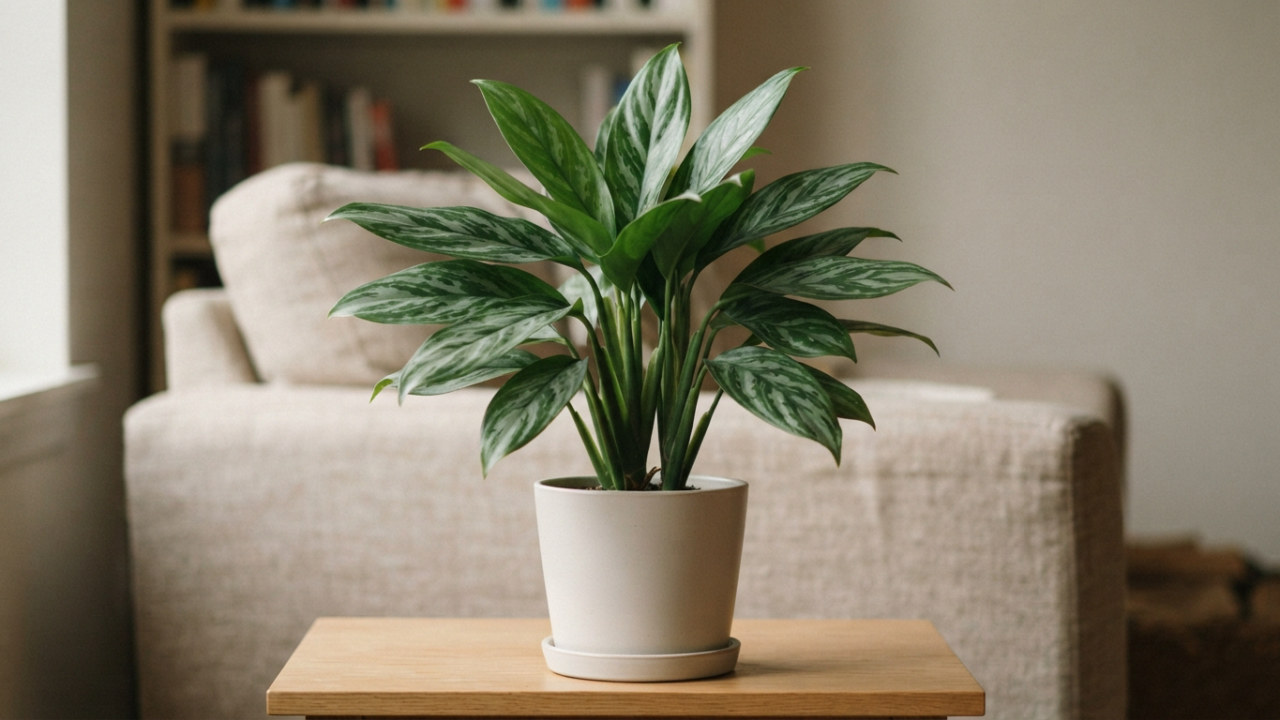
A tall, slow-growing aglaonema with glossy dark green leaves feathered in silvery gray along the lateral veins.
- Every 8 daysWatering
- Bright indirect lightLight
- 40–60 %Humidity
- 18–27 °CTemperature


How to care for your Aglaonema nitidum 'Curtisii'
Everything you need to keep your Aglaonema nitidum 'Curtisii' healthy: watering, light, humidity, feeding, repotting and pruning.
'Curtisii' comes from the humid forests of Peninsular Malaysia, the Lingga Archipelago and Sumatra. Some sources list it as a variety or form of Aglaonema nitidum, but nurseries sell it as a cultivar. Its glossy, elliptic to lance-shaped leaves, 20 to 45 cm long, are dark green with silvery gray to white feathering along the lateral veins. Indoors it is a slow, erect, shrubby plant that can reach about 1 m, and its pale green spathe, turning white, adds little to its looks.

How to recognise Aglaonema nitidum 'Curtisii'
Glossy, dark green, elliptic to lance-shaped leaves, 20 to 45 cm long, with silvery gray to white feathering along the lateral veins, where the plain species is solid green, at most flecked with silver. A tall, erect, shrubby plant on several stems, far larger than 'Maria', whose similar feathering sits on a 30 to 60 cm clump, and unlike Dieffenbachia, whose thick, fleshy canes carry larger, broader leaves.

Watering your Aglaonema nitidum 'Curtisii'
Every 8 days
Check the mix with a finger and water only once the top few centimeters have dried, pouring slowly until water escapes from the pot; space the waterings further apart from November to February.
How to know it needs water
- A finger pushed in up to the first knuckle comes out dry
- The pot feels clearly lighter when you tilt it

How much light a Aglaonema nitidum 'Curtisii' needs
Bright indirect light
Bright indirect light, such as beside an east window or a little back from a brighter one, keeps the silver feathering distinct; it tolerates a dimmer spot, with a duller pattern, but direct sun scorches the glossy leaves.
- Direct sun tolerated
- No direct sun
- Orientations that suit it
- North, North-east, East, North-west

Humidity and misting
40–60 %
Ordinary room humidity, around 40 to 60%, is enough for the thick, glossy leaves; brown leaf edges show that the air has stayed too dry. Misting is not needed and does nothing lasting for the air around the plant; wipe the broad leaves with a damp cloth from time to time to remove dust and let them catch more light.

Feeding and fertiliser
Every 28 days
Feed about every four weeks from April to September and not from October to March; a slow grower needs little, and fertilizer salts brown the leaf edges.
- Recommended feed
- A balanced liquid fertilizer for foliage plants, diluted to half the dose on the label. · 5-10-5

Repotting your Aglaonema nitidum 'Curtisii'
Every 24 months
Choose a pot one size larger and heavy enough not to tip as the stems grow tall, and fill it with a light, free-draining mix of potting soil, perlite and coco fiber.
- When
- Spring, from March to May, as growth restarts.
- Potting mix
- All-purpose potting mix
- Mix in
- perlite, coco fibre
The tell-tale signs
- Thick roots show at the drainage holes or lift the mix at the surface
- The plant leans or topples in its pot, and water runs straight through

Pruning your Aglaonema nitidum 'Curtisii'
Whenever a lower leaf yellows or dries; in spring, cut back a stem that has grown tall and bare. Snip a spent leaf off at the base of its stalk with clean scissors; to shorten a bare, leggy stem, cut it back and root the removed top in water or damp mix.

Through the year
Watering is not set once and for all: it follows the light and the growth. Allow 10 days between waterings in the depth of winter, against 6 in the growing season.
- 10 J
- 9 F
- 7 M
- 6 A
- 6 M
- 6 J
- 6 J
- 6 A
- 7 S
- 8 O
- 9 N
- 10 D
Active growth · Days between waterings

Toxicity
Insoluble calcium oxalate crystals in every part irritate the mouth and cause swelling and vomiting if chewed, in people, cats and dogs, and the sap may irritate skin.

Good to know
- It is named after Charles Curtis, a plant collector who lived from 1853 to 1928.
- In the 1994 film Léon, the hitman keeps a potted aglaonema by his side.

Frequently asked questions about the Aglaonema nitidum 'Curtisii'
How do you care for a Aglaonema nitidum 'Curtisii'?
Water it every 8 days. Give it bright indirect light. Ideal humidity: 40–60 %. Ideal temperature: 18–27 °C. Check the mix with a finger and water only once the top few centimeters have dried, pouring slowly until water escapes from the pot; space the waterings further apart from November to February.
How often should you water a Aglaonema nitidum 'Curtisii'?
Every 8 days Check the mix with a finger and water only once the top few centimeters have dried, pouring slowly until water escapes from the pot; space the waterings further apart from November to February. How to know it needs water : A finger pushed in up to the first knuckle comes out dry ; The pot feels clearly lighter when you tilt it.
How much light does a Aglaonema nitidum 'Curtisii' need?
Bright indirect light Bright indirect light, such as beside an east window or a little back from a brighter one, keeps the silver feathering distinct; it tolerates a dimmer spot, with a duller pattern, but direct sun scorches the glossy leaves. No direct sun
Is the Aglaonema nitidum 'Curtisii' toxic to cats and dogs?
Yes. Insoluble calcium oxalate crystals in every part irritate the mouth and cause swelling and vomiting if chewed, in people, cats and dogs, and the sap may irritate skin. Keep it out of reach of your pets and call a vet if any is swallowed.
Why are my Aglaonema nitidum 'Curtisii' leaves turning yellow?
Yellowing most often comes from too much water: the mix stays wet and the roots suffocate. Check that the pot drains, empty the saucer, and let the mix dry before watering again. Too little light or a cold draught cause the same symptom.
When should you repot a Aglaonema nitidum 'Curtisii'?
Repot every 24 months, ideally in spring, from march to may, as growth restarts.. Choose a pot one size larger and heavy enough not to tip as the stems grow tall, and fill it with a light, free-draining mix of potting soil, perlite and coco fiber.

At a glance
- Family
- Araceae
- Category
- Tropical
- Placement
- Indoor
- Mature height
- 1 m
- Growth
- Slow
- Temperature
- 18–27 °C
- Pot materials
- ceramic, plastic
- Growth
- Reaches maturity in 3 years
These figures are for an average plant. In the app they are recalculated for yours, based on your room, its orientation and the season.
And for your plant, in your home?
In the app this plant becomes yours: a watering schedule tuned to your home, health tracking from photos, and reminders at the right moment.
In the same spirit
 Every 7 days


Air Plant
Tillandsia ionantha

 Every 6 days
Alocasia amazonica
Alocasia amazonica
 Every 7 days
Alocasia baginda
Alocasia baginda
 Every 4 days
Angel Wings
Caladium bicolor
