Perennial · Droseraceae
Venus Flytrap
Dionaea muscipula
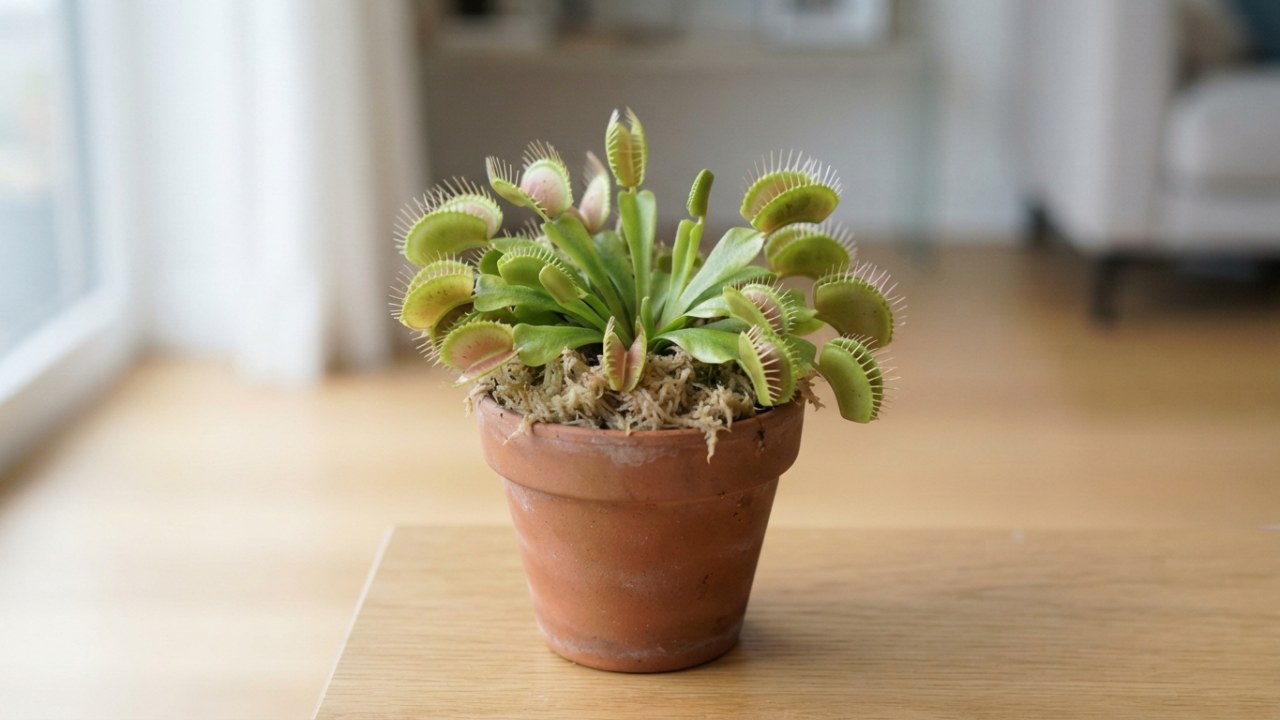
The Venus Flytrap is a fascinating carnivorous plant known for its iconic snap traps.
- Every 2 daysWatering
- Full sunLight
- 50–70 %Humidity
- 18–32 °CTemperature


How to care for your Venus Flytrap
Everything you need to keep your Venus Flytrap healthy: watering, light, humidity, feeding, repotting and pruning.
Dionaea muscipula, commonly known as the Venus Flytrap, is a unique carnivorous plant native to the bogs and wetlands of North and South Carolina. It captures insects and arachnids with its specialized leaves, which form a 'trap' that snaps shut when triggered. This plant requires specific care, including full sun, consistently moist nutrient-poor substrate (sphagnum peat and perlite/silica sand), and only rainwater, distilled, or reverse-osmosis water. It also needs a cool winter dormancy period to thrive long-term: it tolerates light frost (down to about -5 °C) when dormant, so keep it outdoors or in an unheated bright spot from November to February, and in a pot protect it from hard, prolonged freezes.

How to recognise Venus Flytrap
Dionaea muscipula forms a low rosette, 10 to 15 cm across, of flat, winged leaf stalks each ending in a hinged, two-lobed trap fringed with interlocking bristles and red on the inside. In late spring a tall stalk carries small white flowers. It can be confused with sundews (Drosera), which catch prey with sticky, dew-tipped tentacles instead of a hinged trap, or with cobra lilies and pitcher plants, whose traps are tubes.

Watering your Venus Flytrap
Every 2 days
Tray method: the pot stands in 1 to 2 cm of rainwater, distilled, or reverse-osmosis water during the growing season, topped up every 2 days or so; the substrate stays constantly moist. Water less often during winter dormancy, about once a week, but never let the substrate dry out.
How to know it needs water
- Tray is empty
- Substrate surface feels dry
- Plant appears less vigorous

How much light a Venus Flytrap needs
Full sun
Full sun: at least 4 to 6 hours of direct sun a day, outdoors or on the sunniest windowsill.
- Direct sun tolerated
- 4 to 8 h a day
- Orientations that suit it
- South, South-east, South-west, East, West

Humidity and misting
50–70 %
Medium to high (50 to 70%) Misting is not needed, and it can sometimes trigger traps unnecessarily. Keep the humidity up with the water tray instead.

Feeding and fertiliser
Carnivorous plant: never fertilize the substrate. The plant obtains nutrients from insects it catches.
- Recommended feed
- Never fertilize the substrate · 0-0-0

Repotting your Venus Flytrap
Every 24 months
Repot about every 2 years in March or April, before growth resumes, into fresh sphagnum peat mixed with perlite or silica sand, in a plastic or glazed pot. Do not use regular potting soil.
- When
- Late winter to early spring
- Potting mix
- carnivorous
- Mix in
- sphagnum moss, perlite, coarse sand
The tell-tale signs
- Roots emerging from drainage holes
- Substrate breaking down or compacting
- Noticeably slowed growth despite good care

Pruning your Venus Flytrap
Remove blackening or dead traps and flower stalks as they fade. Cut cleanly at the base of the dead trap or stalk with sterilised scissors or a sharp blade.

Through the year
Watering is not set once and for all: it follows the light and the growth. Allow 5 days between waterings in the depth of winter, against 2 in the growing season.
- 5 J
- 5 F
- 2 M
- 2 A
- 2 M
- 2 J
- 2 J
- 2 A
- 2 S
- 3 O
- 4 N
- 5 D
Active growth · Days between waterings

Good to know
- Each trap can only close a few times before it dies and is replaced by a new one.
- Native to subtropical wetlands on the East Coast of the United States.
- The 'teeth' on the traps are called cilia, and they interlock to prevent prey from escaping.

Frequently asked questions about the Venus Flytrap
How do you care for a Venus Flytrap?
Water it every 2 days. Give it full sun. Ideal humidity: 50–70 %. Ideal temperature: 18–32 °C. Tray method: the pot stands in 1 to 2 cm of rainwater, distilled, or reverse-osmosis water during the growing season, topped up every 2 days or so; the substrate stays constantly moist. Water less often during winter dormancy, about once a week, but never let the substrate dry out.
How often should you water a Venus Flytrap?
Every 2 days Tray method: the pot stands in 1 to 2 cm of rainwater, distilled, or reverse-osmosis water during the growing season, topped up every 2 days or so; the substrate stays constantly moist. Water less often during winter dormancy, about once a week, but never let the substrate dry out. How to know it needs water : Tray is empty ; Substrate surface feels dry ; Plant appears less vigorous.
How much light does a Venus Flytrap need?
Full sun Full sun: at least 4 to 6 hours of direct sun a day, outdoors or on the sunniest windowsill. 4 to 8 h a day
Is the Venus Flytrap toxic to cats and dogs?
No, the Venus Flytrap is not listed as toxic to cats and dogs. That is still no reason to let your pets chew on it.
Why are my Venus Flytrap leaves turning yellow?
Yellowing most often comes from too much water: the mix stays wet and the roots suffocate. Check that the pot drains, empty the saucer, and let the mix dry before watering again. Too little light or a cold draught cause the same symptom.
When should you repot a Venus Flytrap?
Repot every 24 months, ideally in late winter to early spring. Repot about every 2 years in March or April, before growth resumes, into fresh sphagnum peat mixed with perlite or silica sand, in a plastic or glazed pot. Do not use regular potting soil.

At a glance
- Family
- Droseraceae
- Category
- Perennial
- Placement
- Indoor and outdoor
- Mature height
- 15 cm
- Growth
- Slow
- Temperature
- 18–32 °C
- Pot materials
- plastic, ceramic
- Growth
- Reaches maturity in 3 years
These figures are for an average plant. In the app they are recalculated for yours, based on your room, its orientation and the season.
And for your plant, in your home?
In the app this plant becomes yours: a watering schedule tuned to your home, health tracking from photos, and reminders at the right moment.