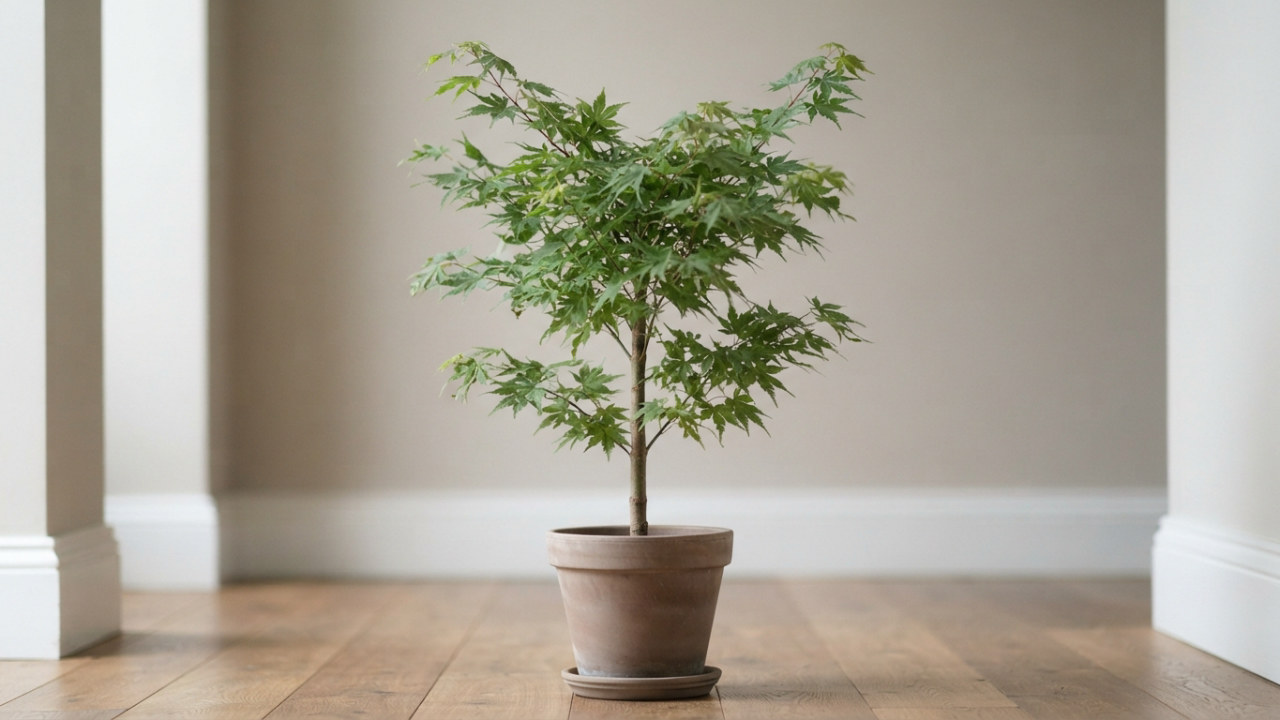
Perennial · Sapindaceae
Japanese Maple
Acer palmatum
The Japanese Maple is a small deciduous tree renowned for its delicate, deeply lobed leaves and vibrant seasonal colours.
- Every 3 daysWatering
- Bright indirect lightLight
- 40–70 %Humidity
- -9–27 °CTemperature


How to care for your Japanese Maple
Everything you need to keep your Japanese Maple healthy: watering, light, humidity, feeding, repotting and pruning.
Acer palmatum, commonly known as the Japanese Maple, is a highly prized ornamental tree native to East Asia. It is celebrated for its elegant form, intricate foliage, and spectacular autumn colours, ranging from brilliant reds and oranges to deep purples. Though typically grown outdoors in gardens, smaller cultivars can be cultivated in pots. It thrives in well-draining, slightly acidic soil and prefers partial shade, with protection from intense afternoon sun and drying wind. It is hardy to about -20 °C in the ground, but late spring frosts burn the young leaves at bud break, so cover it with a fleece on cold nights. In a pot the roots freeze much sooner than the branches: below about -10 °C, wrap the pot or move it to a sheltered, frost-free spot. Rainwater suits it better than hard, limy tap water, which can yellow the leaves.

How to recognise Japanese Maple
A small tree or shrub with opposite leaves cut into 5 to 7 pointed lobes like a hand, turning red, orange or gold in autumn, and paired winged seeds. The full-moon maple (Acer japonicum) has rounder leaves with 9 to 11 shallow lobes, and the Norway maple (Acer platanoides) is a large tree with much bigger, coarser leaves.

Watering your Japanese Maple
Every 3 days
Water thoroughly when the top 2 to 3 cm of soil feel dry, keeping the soil evenly moist but never waterlogged. In a pot, expect to water about every 3 days in the growing season (April to September) and about every 2 weeks in winter.
How to know it needs water
- Soil dry 2 to 3 cm deep
- Leaves showing slight wilting
- Pot feels lighter than usual

How much light a Japanese Maple needs
Bright indirect light
Morning sun and light shade in the afternoon suit it best. It tolerates full sun only in mild climates with cool, moist soil; harsh afternoon sun scorches the leaves.
- Direct sun tolerated
- 2 to 6 h a day
- Orientations that suit it
- North, North-east, East, South-east, South, South-west, West, North-west

Humidity and misting
40–70 %
Medium (40 to 70 %) Misting is not needed for this outdoor tree. Water at the base and mulch the soil instead; in a heatwave, shelter it from drying wind and afternoon sun.

Feeding and fertiliser
Every 42 days
Give a balanced slow-release fertilizer in early spring, then a light liquid feed about every 6 weeks from April to June. Stop from July, because late feeding keeps the new wood soft and exposes it to autumn frosts. None in autumn and winter.
- Recommended feed
- Balanced slow-release granular fertilizer or liquid fertilizer · 10-10-10

Repotting your Japanese Maple
Every 24 months
Repot every 2 years in March into a slightly larger container, using a well-draining, slightly acidic soil mix. Gently loosen the root ball if pot-bound, and trim only a few roots.
- When
- Early spring (March)
- Potting mix
- Ericaceous compost
- Mix in
- pine bark, pumice, coarse sand
The tell-tale signs
- Roots emerging from drainage holes
- Growth has slowed significantly
- Water runs straight through the pot

Pruning your Japanese Maple
In deep winter once the leaves have fallen, or in summer for small cuts. Avoid late winter, when the rising sap makes the cuts bleed heavily. Remove dead, damaged, or crossing branches. Keep to small, clean cuts with sterilised tools, as large cuts heal poorly on a maple.

Through the year
Watering is not set once and for all: it follows the light and the growth. Allow 5 days between waterings in the depth of winter, against 2 in the growing season.
- 5 J
- 4 F
- 3 M
- 2 A
- 2 M
- 2 J
- 2 J
- 2 A
- 3 S
- 3 O
- 4 N
- 5 D
Active growth · Days between waterings

Good to know
- This tree belongs to the family Sapindaceae.
- It is native to Japan, Korea, China, eastern Mongolia, and southeast Russia.
- Its foliage changes colour dramatically through the seasons, especially in autumn.
- In Japan, the custom of going out to admire the red autumn leaves is called momijigari.

Frequently asked questions about the Japanese Maple
How do you care for a Japanese Maple?
Water it every 3 days. Give it bright indirect light. Ideal humidity: 40–70 %. Ideal temperature: -9–27 °C. Water thoroughly when the top 2 to 3 cm of soil feel dry, keeping the soil evenly moist but never waterlogged. In a pot, expect to water about every 3 days in the growing season (April to September) and about every 2 weeks in winter.
How often should you water a Japanese Maple?
Every 3 days Water thoroughly when the top 2 to 3 cm of soil feel dry, keeping the soil evenly moist but never waterlogged. In a pot, expect to water about every 3 days in the growing season (April to September) and about every 2 weeks in winter. How to know it needs water : Soil dry 2 to 3 cm deep ; Leaves showing slight wilting ; Pot feels lighter than usual.
How much light does a Japanese Maple need?
Bright indirect light Morning sun and light shade in the afternoon suit it best. It tolerates full sun only in mild climates with cool, moist soil; harsh afternoon sun scorches the leaves. 2 to 6 h a day
Is the Japanese Maple toxic to cats and dogs?
No, the Japanese Maple is not listed as toxic to cats and dogs. That is still no reason to let your pets chew on it.
Why are my Japanese Maple leaves turning yellow?
Yellowing most often comes from too much water: the mix stays wet and the roots suffocate. Check that the pot drains, empty the saucer, and let the mix dry before watering again. Too little light or a cold draught cause the same symptom.
When should you repot a Japanese Maple?
Repot every 24 months, ideally in early spring (march). Repot every 2 years in March into a slightly larger container, using a well-draining, slightly acidic soil mix. Gently loosen the root ball if pot-bound, and trim only a few roots.

At a glance
- Family
- Sapindaceae
- Category
- Perennial
- Placement
- Outdoor
- Mature height
- 4 m
- Growth
- Moderate
- Temperature
- -9–27 °C
- Pot materials
- terracotta, ceramic, wood
- Growth
- Reaches maturity in 15 years
These figures are for an average plant. In the app they are recalculated for yours, based on your room, its orientation and the season.
And for your plant, in your home?
In the app this plant becomes yours: a watering schedule tuned to your home, health tracking from photos, and reminders at the right moment.