 Care
Overwatered plant: how to spot root rot and rescue it
Limp leaves on soil that is still wet? Here is what is going on below the surface, and the steps that can still save a drowned plant.
 Plenova
Contents 9
Too much water is one of the top killers of houseplants, and it almost always comes from good intentions. The good news: as long as a few healthy roots remain, most plants can bounce back. Here is how to read the signs, act fast and skip the false fixes.
Why too much water kills a plant
Roots need air as much as water: they breathe. In a well-aerated mix, tiny gaps between the particles hold oxygen. When the pot stays soaked, those gaps fill with water, the air is pushed out and the roots suffocate. They weaken, then die.
Fungi and other soil microorganisms, such as Pythium or Phytophthora, then take advantage of the weakened roots and attack them. This is what we call root rot.
Hence the paradox: the plant wilts even though the soil is wet. Dead roots absorb nothing, so the plant is thirsty in the middle of water.
The warning signs
- A limp, drooping plant while the soil is damp.
- Lower leaves that turn yellow and soft, then drop.
- Soil that stays wet for days, sometimes with a sour or musty smell.
- Fungus gnats flying around the pot: they love constantly moist mixes.
- The base of the stem turning brown and soft at soil level (crown rot).
- In succulents, leaves swollen with water, translucent, that squash under your finger.
Do not mistake it for underwatering
A wilting plant can also be thirsty, and pouring more water on it would be the worst reflex. Before doing anything, push your finger 1 inch (2 to 3 cm) into the soil and lift the pot.
- Underwatered: dry, brittle or curled leaves, dry soil, light pot.
- Overwatered: limp leaves, damp or soggy soil, heavy pot.
The rescue, step by step
- Stop watering. Also empty any water left in the saucer or decorative pot.
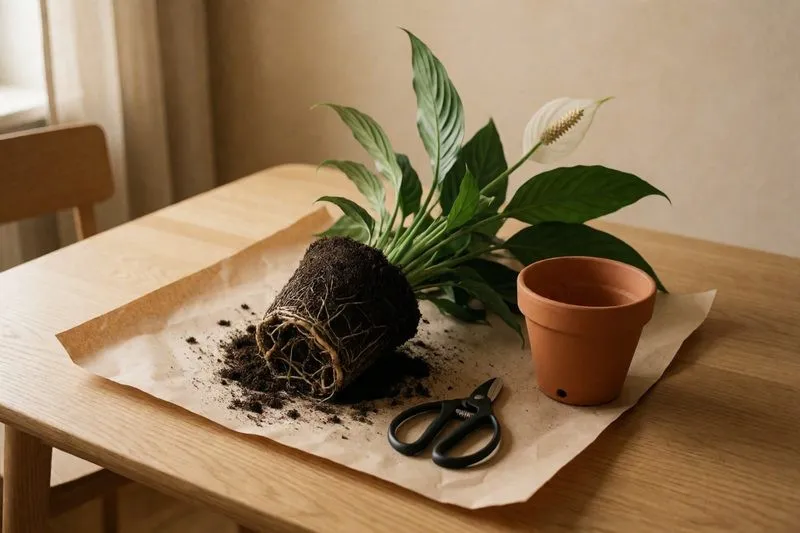
- Unpot the plant gently, supporting the base of the stem.
- Inspect the roots. Healthy roots are firm, often white or cream (naturally orange in the snake plant and dracaenas). Rotten roots are brown or black and mushy, and their outer layer slides off, leaving a thin thread.
- Cut away everything rotten with a clean tool, disinfected with rubbing alcohol or diluted bleach and then rinsed. Cut back to healthy tissue: a doubtful piece left behind will restart the rot.
- Remove the soggy soil around the root ball, without tearing off the healthy roots.
- Repot in fresh, airy mix, just moist and not wet, in a pot sized for the roots that remain (not bigger), always with a drainage hole.
- Do not fertilize: wounded roots cannot use it, and the salts would burn them.
- Put the plant in bright light, but no direct sun. It needs light to recover, not a heat blast.
- Water only once the top of the soil has dried.
If you cut away a lot of roots, remove a few leaves too: with fewer roots, the plant takes up less water, and fewer leaves lose less of it to evaporation.
When no healthy root is left
All is not lost if some stems are still firm. The pothos or the monstera root easily from cuttings: cut a healthy piece with a node (where roots form), then place it in water or a light mix. For a succulent, let the cut dry in the open air for a few days, then set it on a dry mix: it will not root in mud.
What does not help, or makes things worse
- Putting the plant in full sun to "dry it out": the foliage suffers while the roots gain nothing.
- Leaving the root ball soaked and hoping for the best: the rot spreads every day.
- A layer of clay pebbles at the bottom of the pot: it looks like drainage, but it is not. Water collects above the layer and the soggy zone moves up toward the roots.
- A bigger pot "so it can breathe": a large volume of soil holds water for a long time and stays wet around a small root ball.
How to prevent it
- Water by need, not by the calendar. Check the soil with your finger before every watering.
- Always use a pot with drainage holes, and empty the saucer about 15 minutes after watering.
- Use a mix suited to the species: fast-draining for succulents and cacti, very airy for orchids.
- Water less when the light drops: in autumn, as the days shorten, plants use less water and the soil dries more slowly.
- Pick the right pot size: too big, and it holds water for too long.
The most sensitive plants
Plants that store water, or whose roots like air, handle excess poorly: succulents such as echeveria, the jade plant or aloe vera, cacti, the ZZ plant, whose rhizomes (underground stems) hold water, and orchids such as the Phalaenopsis, whose roots need air. With these, it is better to water a little late than a little early.
With Plenova
The app reminds you to water each plant according to its species and the season, and according to the weather for plants that live outdoors. Each species card gives its light, watering, temperature and toxicity to pets. The Learn tab also offers short lessons and quizzes to better understand water needs.
In short
An overwatered plant does not die of thirst but of suffocation. Act fast: stop the water, unpot, cut away the rot, repot in fresh airy mix, then be patient. And next time, a finger in the soil beats the calendar.
Found this useful? Pass it on.
 Care 6 min
 Care
November 17, 2026
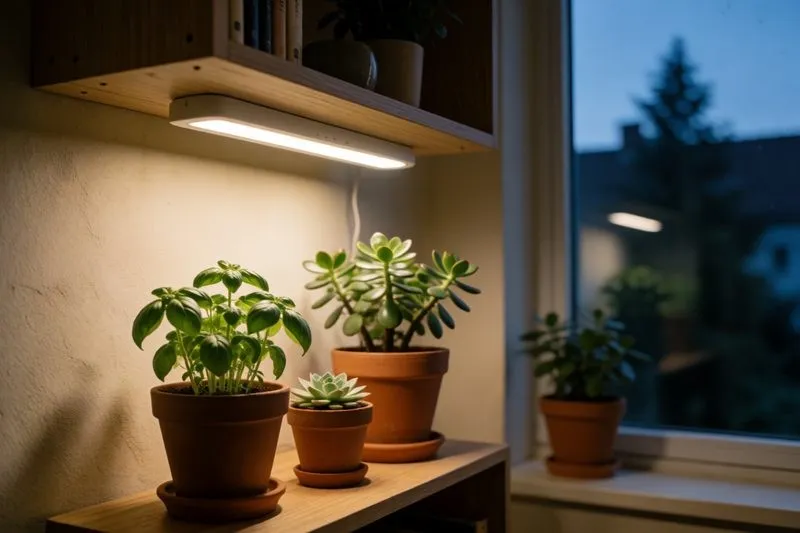
Grow Lights: How to Light Your Houseplants Well
When a lamp really helps, which one to pick, how far to hang it and how many hours to leave it on. A practical guide to giving your plants light without guesswork.
Read the article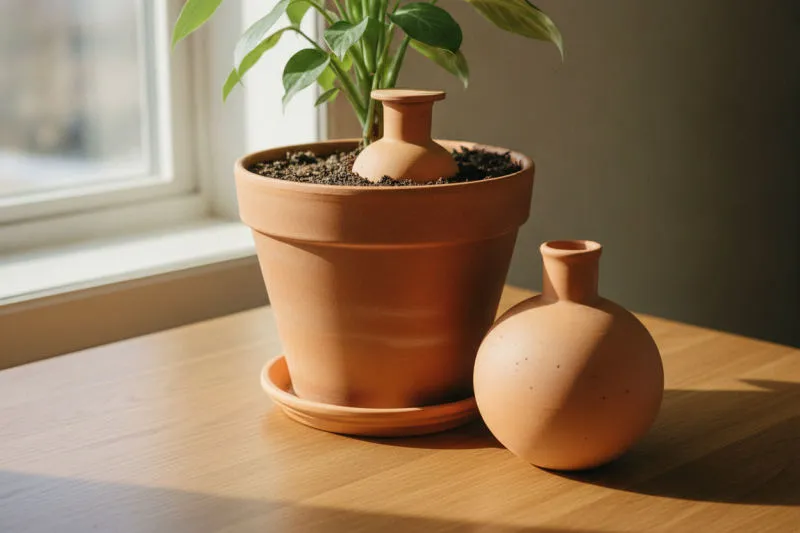 Care 5 min
October 10, 2026
The olla: the clay pot that waters your plants for you
Buried next to a plant and filled with water, an olla releases it into the soil day after day. How it works, which plants it suits, and how to set one up.
Read the article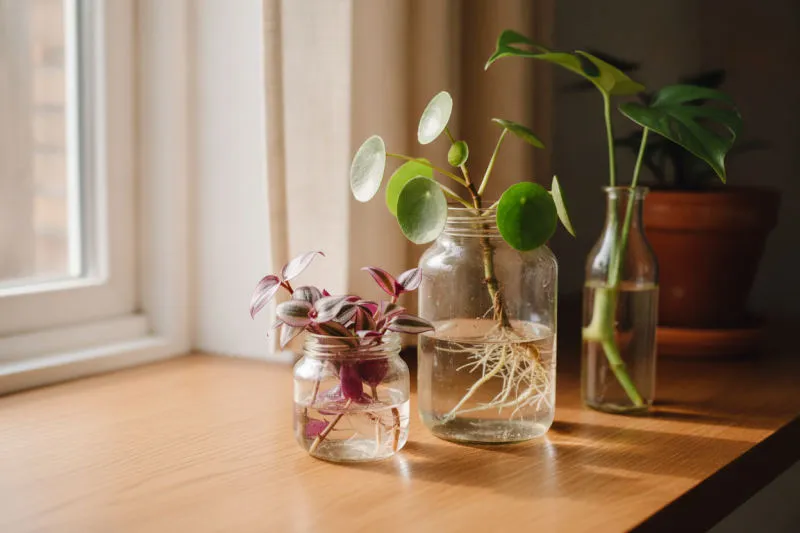 Care 9 min
June 8, 2026
How to propagate a plant, the complete guide that actually works
Propagation turns a single plant into many. Real methods that work, broken down by species, with no gimmicks.
Read the article