 Care
Grow Lights: How to Light Your Houseplants Well
When a lamp really helps, which one to pick, how far to hang it and how many hours to leave it on. A practical guide to giving your plants light without guesswork.
 Plenova
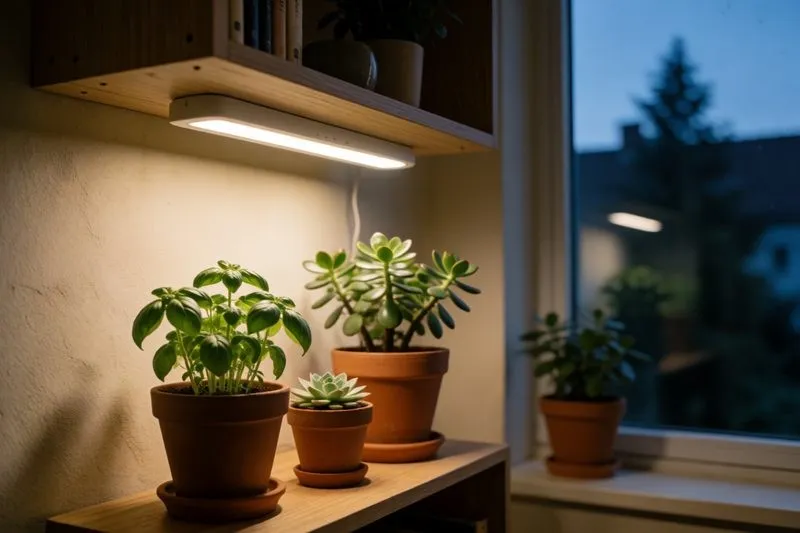
Contents 10
A dark room, a windowless desk, a gray winter: sometimes light is the thing that's missing, more than water or fertilizer. A grow light can fix that, as long as you pick it well, place it correctly and don't leave it on at random. Here are the essentials, without needless jargon.
When a lamp really helps
A lamp becomes useful in a few specific situations:
- a room far from windows, or with a north-facing window (in the northern hemisphere);
- a dark winter, especially at high latitudes, where days are short and the sun sits low;
- an office or windowless room, where natural light is close to zero.
The signs of too little light are fairly clear:
- stems stretch and lean toward the window, with long gaps between leaves (this is called etiolation);
- new leaves are smaller and paler than the older ones;
- variegation fades: marbled or white-edged leaves turn plain green again;
- a plant that used to bloom stops producing flowers.
What plants actually use
Photosynthesis mostly uses light between 400 and 700 nm (nanometers), which is roughly visible light. Chlorophyll absorbs blue and red especially well, but green isn't wasted: it's used too, and it even penetrates deeper into the leaf.
In practice, a full-spectrum white LED works very well for houseplants, and it lights the room normally. Purple LEDs (a mix of red and blue) work too, but they distort colors, which makes plants hard to inspect (you can't spot yellowing leaves or pests), and they are frankly unpleasant to live with in a living room.
Measuring light: lux and PPFD
Lux measures light as the human eye perceives it, not exactly what the plant uses. Serious manufacturers give the PPFD instead, in µmol/m²/s: the amount of usable light reaching a given surface, at a given distance from the lamp.
Here are some reference points, to be taken as rough orders of magnitude rather than strict rules:
- low-light plants (pothos, ZZ plant): about 50 to 150 µmol/m²/s;
- medium-light foliage plants (monstera): about 100 to 250;
- full-sun plants (succulents like echeveria, herbs like basil, citrus like the lemon tree): 300 and up.
For a white LED, 1 µmol/m²/s is about 70 to 80 lux. If all you have is a light meter (or a phone app, which isn't very accurate), you can estimate roughly: 100 µmol/m²/s is about 7,000 to 8,000 lux.
How many hours a day
Plan on 10 to 14 hours of light a day. Plants need a night too: that is when they distribute the sugars made during the day, and many cope poorly with constant light. Never 24 hours a day. A simple timer (a plug-in outlet timer is enough) keeps you from forgetting to switch the light on or off.
One important exception: short-day plants, such as the Christmas cactus, kalanchoe or poinsettia. To bloom, they need long, light-free nights in the fall, when the days shorten. If a lamp stays on in the evening near them at that time, flowering may never start. Switch it off early, or move the plant away.
How far to hang the lamp
Intensity drops quickly as you move away from the source. The most reliable approach is to follow the manufacturer's PPFD map, which gives the value at each distance. Failing that, a bulb or LED bar is often placed 8 to 24 inches (20 to 60 cm) above the leaves: closer for a low-power lamp, farther for a strong one.
Signs of too much light show up first at the top of the plant: bleached, yellowed or scorched leaves. An LED runs cool, but not stone cold: don't press it against the foliage. And if your plant is coming from a dark corner, don't put it straight under a powerful lamp: bring the light closer gradually, over a week or two, so the leaves can adjust.
Which type of lamp to choose
There are several formats:
- a standard-base LED bulb, screwed into an ordinary lamp: the simplest solution for one or two plants;
- a clip-on lamp, handy on a shelf or a desk;
- LED bars, which light a whole shelf well;
- panels, for many plants or high light needs.
Incandescent bulbs are best avoided: they give off a lot of heat and very little usable light for the energy they use. T5 fluorescent tubes work fine, but LEDs use less power for a similar result.
For color temperature, a neutral or cool white (4,000 to 6,500 K) is the most efficient. A warm white (2,700 to 3,000 K) works too, and it's nicer in a living room, so feel free to choose it if atmosphere matters.
What about power use?
The math is simple: watts times hours, divided by 1,000. A 20 W lamp on for 12 hours a day uses 20 × 12 = 240 Wh, which is 0.24 kWh a day, or about 7 kWh a month. Multiply by your utility's rate: for one or two plants, it's not much.
Keep an eye on watering
Under a lamp, a plant that was starved for light grows more, and drinks more. The soil dries out faster than before. Don't keep your old watering rhythm out of habit: check the soil moisture before watering, and adjust. Conversely, a plant that gets little light uses little water, which is one reason winter watering is often less frequent.
With Plenova
Plenova reminds you to water each plant according to its species and the season, which helps you follow the new rhythm of a plant under a lamp. Each species' page lists its light needs, watering, temperature and toxicity to pets: enough to tell whether your dark corner is fine or whether you need a lamp. And the Learn tab offers short lessons and quizzes to go further.
In short
A grow light isn't rocket science: a white LED, 10 to 14 hours a day on a timer, 8 to 24 inches (20 to 60 cm) from the leaves, and an eye on watering. Start gently, watch your plants for a few weeks, and adjust the distance based on how they react.
Found this useful? Pass it on.
 Care 5 min
 Care
November 17, 2026
Overwatered plant: how to spot root rot and rescue it
Limp leaves on soil that is still wet? Here is what is going on below the surface, and the steps that can still save a drowned plant.
Read the article Care 5 min
October 10, 2026
The olla: the clay pot that waters your plants for you
Buried next to a plant and filled with water, an olla releases it into the soil day after day. How it works, which plants it suits, and how to set one up.
Read the article Care 9 min
June 8, 2026
How to propagate a plant, the complete guide that actually works
Propagation turns a single plant into many. Real methods that work, broken down by species, with no gimmicks.
Read the article