 Guides
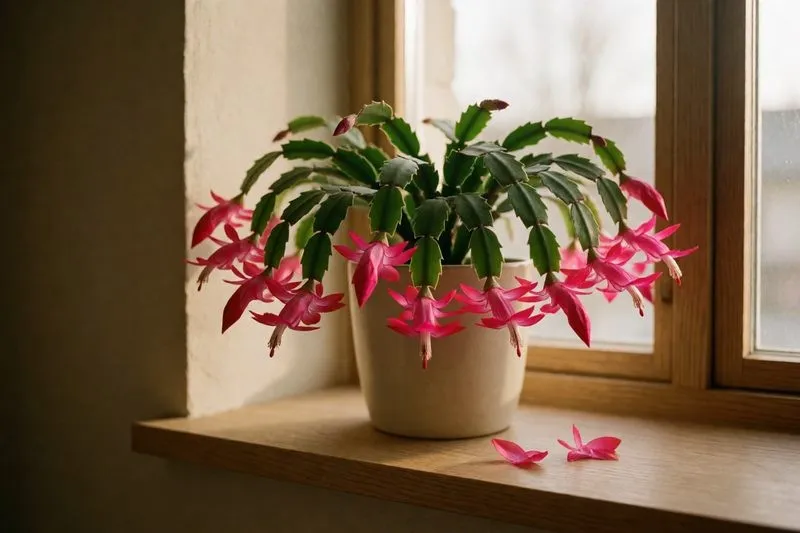
Christmas cactus: the guide to making it bloom again every winter
It is nothing like a desert cactus, and its flowers don't appear by chance. Light, watering, long cool nights: everything you need to see it bloom year after year.
 Plenova
Contents 14
The Christmas cactus gives bright flowers when everything outside is gray, yet it is often misunderstood: treat it like a desert cactus and it sulks. The good news is that it is easy going once you know where it comes from and what triggers its buds.
What is it, really?
The Christmas cactus belongs to the genus Schlumbergera. It is an epiphytic cactus: in the Atlantic forest of southeastern Brazil, it grows on tree trunks, branches, and rocks, in light shade and humid air. No sand, no blazing sun.
That explains its look. Its "leaves" are actually flattened stem segments joined end to end. It has no sharp spines, and the flowers appear at the tips of the segments.
What is its real name?
The plant most often sold at garden centers is Schlumbergera truncata or one of its hybrids: segments with pointed, toothed-looking edges, and blooming rather late in autumn. Schlumbergera × buckleyi has segments with rounded edges and blooms a little later.
Do not mix it up with the "Easter cactus", a close relative long placed in another genus (Hatiora or Rhipsalidopsis on plant tags), which botanists now often place in Schlumbergera too. It blooms in spring, with star-shaped flowers.
Light
It wants bright but indirect light. A little gentle morning sun is fine. In full sun, its segments turn red: a sign of stress, not a decoration.
Watering
Since it comes from humid trees, it drinks more often than a desert cactus. The rule of thumb is simple: water when the top 1 inch (2-3 cm) of potting mix is dry. Then water thoroughly and empty the saucer. Soil that stays soggy rots the roots, and that is a common cause of failure. After blooming, water less often.
Potting mix and pot
It needs a light, free-draining mix: potting soil with added bark or perlite. It likes to be a little snug, so there is no need for an oversized pot. Repot every 2 to 3 years, after blooming.
What triggers blooming
This is the point that changes everything: the Christmas cactus blooms thanks to long, cool nights. There are two levers, which can be combined (ballpark figures, not rules carved in stone):
- Long nights: about six weeks of 13 to 14 hour nights in complete darkness. No lamp turned on in the room in the evening, no street light coming through the window.
- Cool nights, around 50 to 59°F (10 to 15°C).
A few benchmarks: at about 50-55°F (10-13°C), buds form even when days are long. Above about 75°F (24°C), blooming is held back. A heated room with lights on late in the evening is therefore the worst scenario.
The kalanchoe and the poinsettia also need short days to bloom: if you have succeeded with them, you already know how to do this.
Once the buds are there
Once buds have formed, leave everything alone: do not move or turn the pot. Also avoid drafts, radiator heat, and soil that dries out too much. A sudden change, and the buds drop.
The yearly cycle
- After blooming: rest for about a month, with less water and no fertilizer.
- In spring and summer: the plant grows. Give it a diluted fertilizer for flowering plants, about once a month.
- At the end of summer: stop fertilizing.
- Outdoors in summer: it can spend the warm season outside, in shade. Bring it back in before nights drop below about 50°F (10°C).
Propagating your Christmas cactus
Taking cuttings is easy:
- Detach 2 or 3 segments by gently twisting them off.
- Let the cut end dry for a day.
- Plant them in a mix that is just moist.
- Roots appear within a few weeks.
Common problems
- Buds drop: the pot was moved, heat, a draft, or soil that is too dry.
- Soft, wrinkled segments: lack of water, or roots rotted by too much water. Check the soil before watering.
- Red segments: too much sun, cold, or stress.
- No flowers: room too warm, light in the evening, or a plant that is too young.
What about pets?
The Christmas cactus is considered non-toxic to cats and dogs (ASPCA list). Eaten in large quantity, it may only cause a mild digestive upset.
Its epiphyte cousins
If this tree-dwelling lifestyle appeals to you, two other plants live the same way: the rhipsalis, another epiphytic cactus with trailing stems, and the phalaenopsis orchid. Same logic: roots that love air and hate standing water.
With Plenova
Plenova reminds you to water your plant at the pace of its species and the season. The Christmas cactus sheet lists its light, watering, temperature, and toxicity for pets. And the Learn tab offers short lessons and quizzes so you can keep improving at your own pace.
In short
Think "humid forest tree" rather than "desert": bright, soft light, regular watering without excess, a snug pot. For flowers, give it long, dark, cool nights in autumn, then leave it alone once buds appear. With that rhythm, it will bloom for years.
Found this useful? Pass it on.
 Guides 8 min
 Guides
June 27, 2026
Caring for your Monstera, the guide to those iconic split leaves
Monstera deliciosa is the houseplant of the decade. Light, water, fenestration, aerial roots: here is how to turn yours into a real indoor jungle.
Read the article Guides 6 min
June 26, 2026
Pothos, the complete guide: varieties, care and propagation
Golden, Marble Queen, Neon, N'Joy: everything you need to know about pothos, the most popular houseplant in the world.
Read the article Guides 9 min
June 25, 2026
Caring for your Ficus, lyrata, benjamina or rubber tree
Ficus is a whole genus, not one plant. Light, water, latex sap, pruning: a guide to figuring out your variety and keeping it beautiful for years.
Read the article