Guides
 Caring for your Monstera, the guide to those iconic split leaves
Monstera deliciosa is the houseplant of the decade. Light, water, fenestration, aerial roots: here is how to turn yours into a real indoor jungle.
 Plenova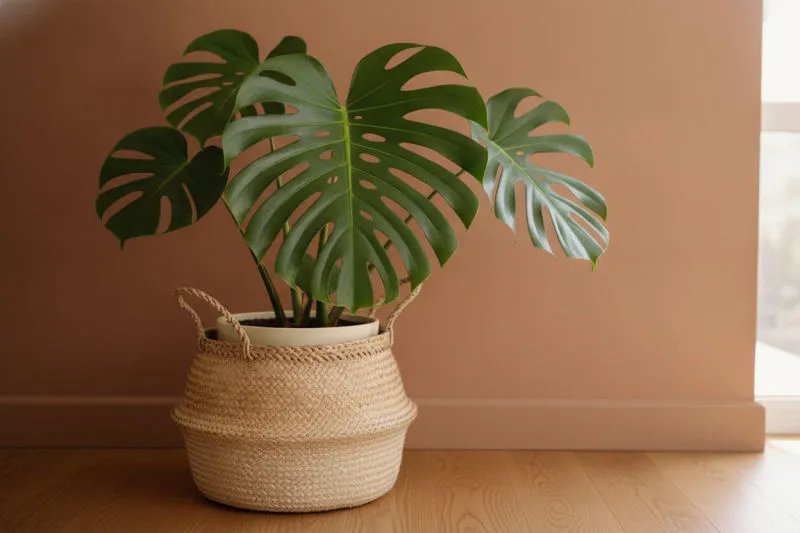
Contents 12
- 01 Quick recap
- 02 What it actually is
- 03 Light, the number one factor
- 04 Watering, simpler than it sounds
- 05 The substrate that changes everything
- 06 The moss pole, the real secret
- 07 Ambient humidity
- 08 Feeding and growth
- 09 Repotting
- 10 Propagating your Monstera
- 11 Common problems and what causes them
- 12 When to ask for help
Monstera deliciosa has been everywhere for a decade, and there is a reason. It is generous, mostly forgiving, and turns spectacular when you give it the right setup. The catch is that we see it everywhere without really knowing how it grows.
Here is how to go from a flat two-leaf plant to a proper indoor jungle with split, holey leaves.
Quick recap
The essentials in six lines.
- Light: bright indirect, no prolonged direct sun.
- Water: when the top inch of substrate feels dry.
- Humidity: 50% or more, mist if needed in winter.
- Substrate: free-draining, mix of potting soil, perlite, and bark.
- Pole: essential to get those split leaves.
- Repotting: every one to two years, slightly larger pot.
What it actually is
Monstera deliciosa is a tropical plant from Central America, in the Araceae botanical family. In the wild, it grows at the foot of trees and climbs the trunk, gripping with its aerial roots. It can reach thirty feet long.
In your living room, it will not. But it can grow leaves over twenty inches wide if the conditions are right.
Light, the number one factor
This is the single thing that makes the difference between a flat Monstera and a holey one.
It loves bright indirect light. Near an east-facing window is perfect. Near a south window, pull it back four or five feet, or filter the light with a sheer curtain. Direct sun burns the leaves and the brown patches stay forever.
The other extreme, a Monstera in a dark corner will not die, but it will not give you split leaves either. If fenestration is not happening on a plant that is two or three years old, the cause is almost always light.
Rotate the pot a quarter turn each week, otherwise phototropism tilts the whole plant to one side.
Watering, simpler than it sounds
Same rule as for most indoor tropicals. Push a finger an inch into the substrate. If it is dry, water generously until water drains out the bottom. If it is still moist, wait.
In summer with active growth, that means every seven to ten days. In winter, more like every two to three weeks. In a heated apartment with dry air, summer rhythm year-round.
Most common mistake: watering on a calendar, "every Monday", without checking. That is how you drown a Monstera. Symptoms: yellow soft leaves, stem base going mushy, bad smell. At that point, unpot, cut off the black roots, repot in dry substrate, breathe for next time.
The substrate that changes everything
Monsteras hate wet feet. A standard potting mix from a garden center holds too much water.
A good Monstera mix:
- 50% indoor potting soil,
- 25% perlite or fine pumice,
- 15% composted pine bark,
- 10% horticultural charcoal (optional, useful against rot).
It should crumble in your hand, never form a hard clump. Water should run through fast. That is where roots breathe and the plant is happy.
The moss pole, the real secret
Many beginners ignore this and it changes everything. A Monstera with nothing to climb stays flat. Give it a moss pole, its aerial roots grip on, and the plant understands it can climb.
Once it climbs, leaves get bigger and start to split and develop holes. That is what fenestration is, a signal saying "I am mature, I have found a tree".
You can build a pole with a wire mesh tube filled with sphagnum, or buy one. Keep it moist by misting it or watering the pole itself.
Ambient humidity
50% ambient humidity or more is the goal. In summer in most homes, easy. In winter with heating on, you drop below 30% fast.
Solutions, from most to least effective:
- a humidifier in the room,
- grouping plants together (they create their own microclimate through transpiration),
- a tray of pebbles and water under the pot,
- misting the leaves every two or three days.
Misting alone is not enough, humidity drops within minutes. It is a quick fix, not a solution.
Feeding and growth
April to September, liquid fertilizer for green plants every two weeks, half the dose printed on the bottle. Fertilization in winter is not needed, the plant slows down.
Repotting
Every one to two years, usually in spring. Repot when you see roots coming out of the drainage holes, or when the substrate stays soaking wet too long after watering because it is compacted.
A pot one inch larger is enough. Too big and the substrate stays wet too long, roots rot.
Propagating your Monstera
It is surprisingly simple. Cut just below a node that has an aerial root. Put the cutting in a tall glass of water, aerial root submerged. Change the water every three days. Within two to three weeks, new roots appear. When they reach two to four inches, pot up in a free-draining substrate.
If you want to dig deeper into propagation, we wrote a full guide on the blog.
Common problems and what causes them
- Yellow leaves — Overwatering → Space waterings, check drainage
- Crispy brown tips — Air too dry → Raise humidity
- Flat leaves with no holes — No pole, low light → Add a moss pole, move closer to a window
- Leggy stems — Not enough light → Move the plant, prune in spring
- Tiny critters under leaves — Spider mites (low humidity) → Lukewarm shower, raise humidity
- Irregular brown patches — Direct sun → Pull back from the window
When to ask for help
If your Monstera still struggles, snap a photo in Plenova. The diagnosis names the problem and gives you a step-by-step fix in seconds. And if you forget waterings, the app schedules reminders based on your pot, light exposure, and the season.
A settled Monstera pays back for years. With a little patience, leaves come out bigger and bigger, more and more split, until your living room actually looks like a jungle.
Found this useful? Pass it on.
 Guides 6 min
  Guides
 June 26, 2026
Pothos, the complete guide: varieties, care and propagation
Golden, Marble Queen, Neon, N'Joy: everything you need to know about pothos, the most popular houseplant in the world.
Read the article Guides 9 min
 June 25, 2026
Caring for your Ficus, lyrata, benjamina or rubber tree
Ficus is a whole genus, not one plant. Light, water, latex sap, pruning: a guide to figuring out your variety and keeping it beautiful for years.
Read the article Guides 6 min
 June 23, 2026
How to make your orchid bloom again, the guide that actually works
Your Phalaenopsis dropped its flowers and has been green for six months? Here is how to trigger a new bloom, step by step.
Read the article