Guides
 Pothos, the complete guide: varieties, care and propagation
Golden, Marble Queen, Neon, N'Joy: everything you need to know about pothos, the most popular houseplant in the world.
 Plenova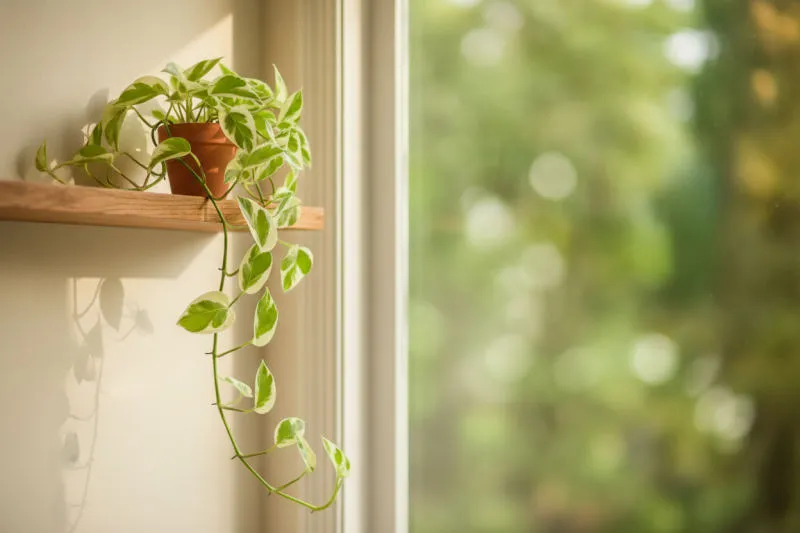
Contents 9
Pothos (Epipremnum aureum) is probably the best-selling houseplant in the world. Indestructible, beautiful, and infinitely multipliable through propagation. It exists in roughly a dozen very different varieties. Here is how to recognize, care for, and multiply each.
Where pothos comes from
Native to the Solomon Islands, pothos grows in the wild climbing tree trunks up to 60 feet tall, with leaves reaching 20 inches. Indoors, it stays in its juvenile form (small heart-shaped leaves) unless you train it on a moss pole.
Botanical family: Araceae, like Monstera and Philodendron.
The varieties to know
Golden Pothos
The classic. Green leaves variegated with golden yellow. The most tolerant of dim light, fast growth.
Marble Queen
Heavy white variegation, almost half the leaf. Slower growth than Golden (less chlorophyll, less photosynthesis). Needs more light.
Neon
Electric neon-green leaves, no variegation. Very bright in a dim room. Fast growth.
N'Joy
More compact, smaller leaves with crisp white variegation. Ideal for small spaces.
Pearls and Jade
A N'Joy variation with extra silver speckles alongside the white. Very decorative.
Manjula
Abstract variegation with white, cream, and green. Each leaf is a unique pattern. Rarer and pricier.
Cebu Blue (Epipremnum pinnatum 'Cebu Blue')
Technically a cousin but often sold as pothos. Elongated blue-green, almost metallic leaves. With a pole, it becomes spectacular.
Common care for all pothos
Light
Ideal: bright indirect light. Near an east window, or 3-6 feet from a south window.
Tolerates: dim light (slowed growth, less variegation).
Avoid: prolonged direct sun, scorches the leaves.
The more variegated the variety (Marble Queen, Manjula), the more light it needs. Variegation can fade in dim light, the plant reverts to green to compensate.
Watering
When the top inch of substrate is dry. On average:
- Summer: every 7-10 days.
- Winter: every 14-20 days.
Pothos clearly tells you when it is thirsty: leaves droop slightly, perk up immediately after watering. Ultra-reliable indicator.
Substrate
Standard green-plant mix + 20% perlite. Or aroid mix from a garden center.
Fertilizer
Once a month from April to September, half-diluted liquid green-plant fertilizer. None in winter.
Repotting
Every 1-2 years, pot 1 inch larger. Pothos grows faster when it has slight root space.
Climb or trail: your choice
Hanging: let it trail. Vines can reach 6+ feet in a few years. Spectacular cascade above a shelf.
Climbing on a moss pole: leaves grow larger, up to 12 inches. The plant takes its adult form. Mist the pole 2-3 times a week so aerial roots grip.
Propagating a pothos in 5 minutes
One of the easiest propagations on the planet.
- Cut a stem just below a node (the small bump where leaves emerge).
- Keep 2-3 leaves, remove any that would sit underwater.
- Place in a glass of water, node submerged.
- Indirect light, change the water every 4-5 days.
- After 7-14 days, roots appear.
- When roots reach 2 inches, pot up in substrate.
You can root 5 stems in parallel and have 5 new pothos in 3 weeks.
Common problems
- Yellow leaves — Overwatering → Water less, check drainage
- Crispy brown leaves — Underwatering or dry air → Water, mist foliage
- Variegation fading — Too little light → Move closer to a window
- Flat leaves even with a pole — Pole too dry → Mist the pole more often
- Leggy stems with no leaves — Chronic low light → Prune and relocate
- Black-spotted leaves — Cold water or temperature shock → Water at room temperature
Toxicity
Pothos is toxic to cats, dogs, and humans if ingested. It contains calcium oxalate crystals that irritate the mouth. Place high if pets or kids are around.
Pothos vs Heartleaf Philodendron
Often confused, but different:
- Leaf — Thicker, matte → Thinner, glossy
- Texture — Slightly textured → Smooth
- Color — Green with typical yellow variegation → Plain green, sometimes reddish underside
- Stem — Stiffer → More flexible
- Aerial roots — Visible at nodes → More discreet
With Plenova
Plenova identifies your pothos from a photo and adapts its reminders to its light and the season. Your cuttings are added as new plants: you follow their progress in their history.
A settled pothos lives 30 years. They often outlive their owners.
Found this useful? Pass it on.
 Guides 8 min
  Guides
 June 27, 2026
Caring for your Monstera, the guide to those iconic split leaves
Monstera deliciosa is the houseplant of the decade. Light, water, fenestration, aerial roots: here is how to turn yours into a real indoor jungle.
Read the article Guides 9 min
 June 25, 2026
Caring for your Ficus, lyrata, benjamina or rubber tree
Ficus is a whole genus, not one plant. Light, water, latex sap, pruning: a guide to figuring out your variety and keeping it beautiful for years.
Read the article Guides 6 min
 June 23, 2026
How to make your orchid bloom again, the guide that actually works
Your Phalaenopsis dropped its flowers and has been green for six months? Here is how to trigger a new bloom, step by step.
Read the article