Guides
 Calathea: why it dramas so much (and how to keep it happy)
Curling leaves, browning tips, daily drama: understanding the Calathea and giving it what it actually wants.
 Plenova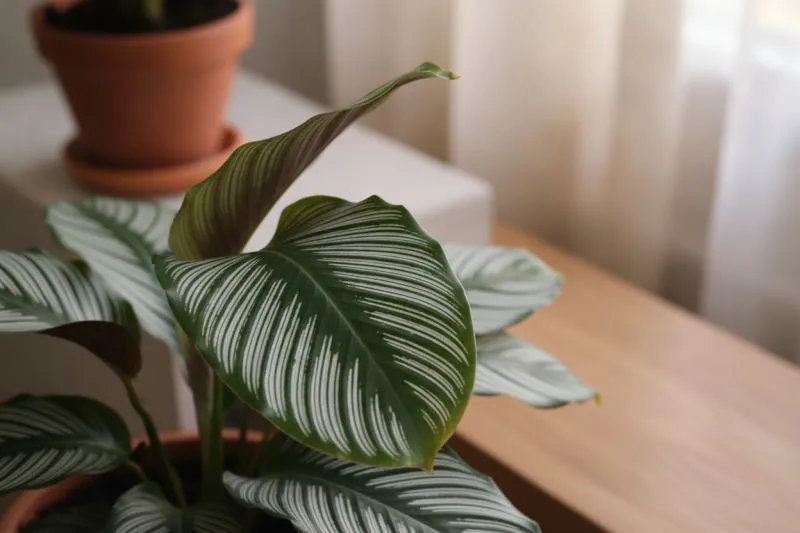
Contents 10
The Calathea is one of the most beautiful houseplants. And one of the hardest. Browning tips, leaves curling at night, daily drama when you moved it. Understanding where it comes from explains almost everything. Here is the user manual.
A tropical understory plant
Calathea grows on the forest floor of Central and South America. Under the canopy it gets steady filtered light, 70-80% humidity, and the soil stays slightly moist thanks to leaf litter. Temperature swings between 72 and 78°F with no sudden changes.
Your living room has 40% humidity, drafts, heating in winter, direct sun on the window in summer. You see the problem.
Common varieties
- Calathea orbifolia: huge round leaves, green striped with silver. The star.
- Calathea ornata: long dark green leaves with pale pink stripes.
- Calathea makoyana (peacock): patterns like peacock feathers, light green on dark green.
- Calathea lancifolia (rattlesnake): elongated leaves with spotted patterns.
- Calathea medallion: oval leaves green-white-purple.
Good news: all these cousins share the same needs.
The fascinating thing: it moves
You may have noticed leaves rising at night and lowering in the morning. That is nyctinasty, a movement triggered by light changes. The plant "prays" at night. It is healthy and normal, a sign your Calathea is doing well.
If it stops moving, or leaves stay rolled up permanently, that signals a problem (often water or light).
The 5 golden rules
1. Soft indirect light
Never direct sun. A north window, or 5 feet from an east window. Direct sun scorches its leaves in hours and fades the patterns.
A too-dark room also makes the patterns disappear. Aim for the sweet spot.
2. High ambient humidity
The deciding factor. Minimum 60%, ideally 70%. Solutions:
- Electric humidifier: essential in winter.
- Bathroom with a window: its preferred environment.
- Group with other humidified plants.
- Pebble tray with water under the pot.
Misting alone is not enough, humidity drops within 20 minutes.
3. Filtered or rainwater
Calathea hates lime and chlorine. Brown tips on leaves? Very likely your tap water.
Options:
- Collected rainwater.
- Filtered water (Brita).
- Tap water left in an open jug for 24 hours (chlorine evaporates).
4. Constantly slightly moist substrate
Not soaked, not dry. A finger pushed in an inch should come out with damp soil traces. Dry: water. Sticky wet: wait.
Aroid mix with added sphagnum to hold moisture.
5. Stability
No drafts, no nearby open window, no radiator close by. Once well placed, do not touch.
Drama diagnosis
- Crispy brown tips — Dry air OR hard water → Humidifier, filtered water
- Permanently curled leaves — Lack of water or humidity → Water, raise humidity
- Irregular yellow patches — Direct sun → Pull back from window
- Limp leaves — Overwatering, root rot → Water less, check drainage
- Patterns fading — Not enough light → Move closer (indirect)
- Tiny dots on underside + webs — Spider mites → Lukewarm shower, raise humidity
- Leaves stop rising at night — General stress → Check the 5 rules above
The trap: repotting
Calathea hates having its roots disturbed. Repot only when really necessary (every 2-3 years), in spring, gently. Untangle as little as possible.
Pot just 1 inch wider than current, never much more.
Propagating a Calathea
Not by stem cuttings (does not work). By division: take the plant out, find natural sections with their own roots, separate gently by hand, replant each section in its own pot.
Best timing: spring, during a repot.
Toxicity
Good news: Calathea is non-toxic to cats, dogs, and humans. Pet-friendly without precaution.
Worth the drama
Honestly: yes, but not for everyone. It is for those who like to observe. In return for the attention you give it, you get foliage with no equivalent in standard houseplants.
If you are starting out, begin with other species. Come back to Calathea once you are comfortable with watering rhythms and humidity.
With Plenova
Plenova identifies your Calathea (orbifolia, ornata…) and adjusts reminders. At the first sign of stress, a photo diagnosis looks for the cause and suggests a fix before the leaves are damaged for good.
A settled Calathea gives you three years of daily theater. Its beauty is worth the complexity.
Found this useful? Pass it on.
 Guides 8 min
  Guides
 June 27, 2026
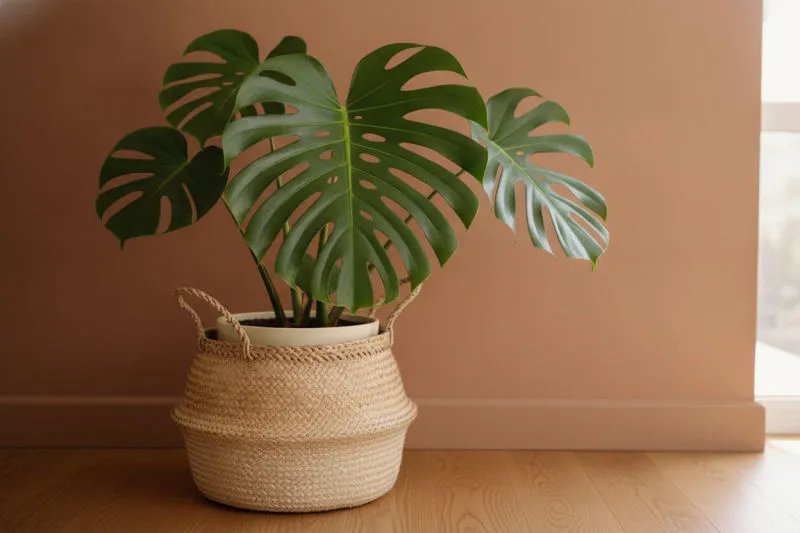
Caring for your Monstera, the guide to those iconic split leaves
Monstera deliciosa is the houseplant of the decade. Light, water, fenestration, aerial roots: here is how to turn yours into a real indoor jungle.
Read the article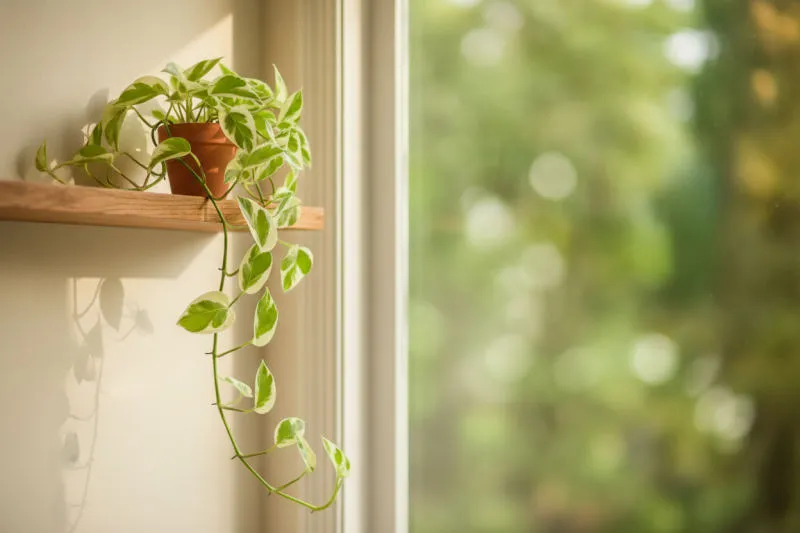 Guides 6 min
 June 26, 2026
Pothos, the complete guide: varieties, care and propagation
Golden, Marble Queen, Neon, N'Joy: everything you need to know about pothos, the most popular houseplant in the world.
Read the article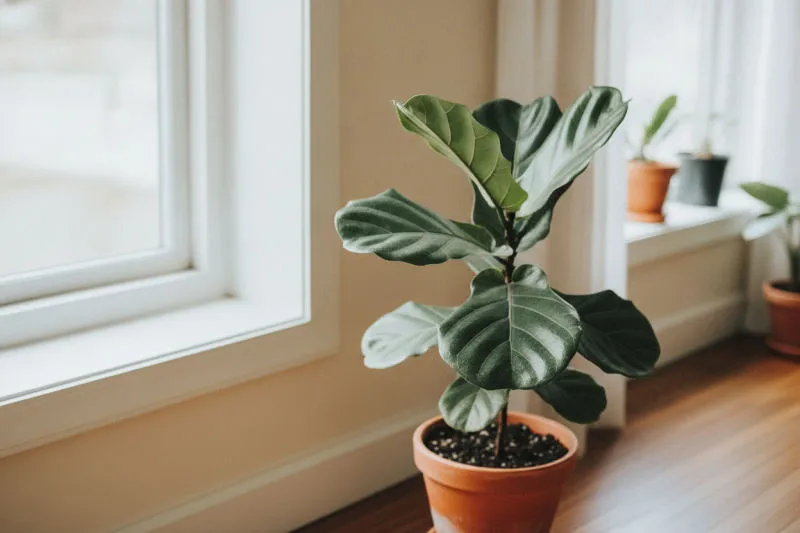 Guides 9 min
 June 25, 2026
Caring for your Ficus, lyrata, benjamina or rubber tree
Ficus is a whole genus, not one plant. Light, water, latex sap, pruning: a guide to figuring out your variety and keeping it beautiful for years.
Read the article