 Guides
Strelitzia: the complete guide to the bird of paradise
Reginae with orange flowers or giant nicolai with banana-like leaves: everything to grow your Strelitzia indoors.
 Plenova
Contents 14
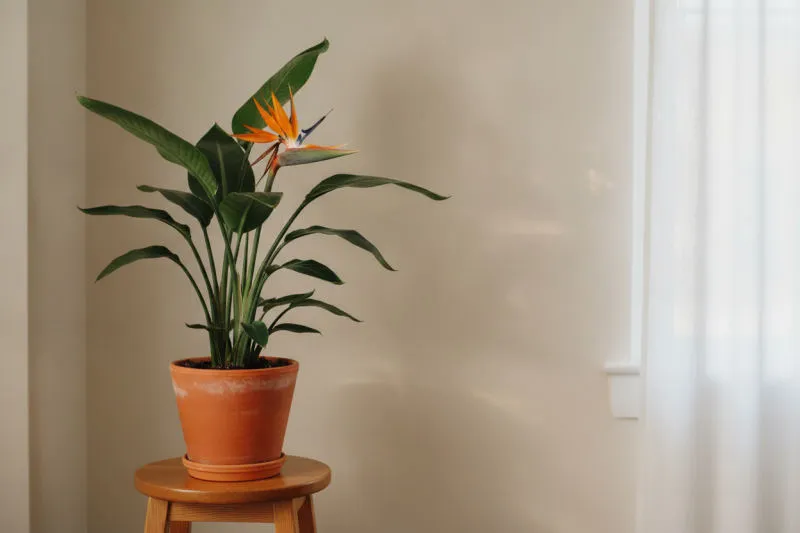
The Strelitzia, nicknamed "bird of paradise", is one of the most spectacular houseplants. Massive banana-like leaves, bird-shaped orange and blue flowers in some varieties. It can turn a living room into a tropical jungle, as long as you understand what it really wants. Here is the deep dive.
What it is
Genus Strelitzia, native to South Africa. Family Strelitziaceae, cousin of Musaceae (banana trees), which explains the leaf look.
Slow growth but majestic outcome: 5 to 10 ft indoors over a few years.
Varieties to know
Strelitzia reginae
The classic. Long matte green leaves, clump form. Blooms (indoors) after 4-6 years with spectacular orange and blue bird-head flowers.
Height: 4 to 6 ft.
Strelitzia nicolai
The giant. Huge leaves like a banana tree, tropical tree posture. Blooms (rare indoors) with white and blue flowers.
Height: 6.5 to 10 ft, sometimes more.
Strelitzia juncea
Rarer. No classic leaves, just thin upright stalks. Same flowers as reginae. Very graphic look.
Strelitzia alba (white)
Cousin of nicolai with all-white flowers. Very rare, similar height.
Light
Ideal: full sun or very bright indirect light. Near a large south or west window, or a sunroom.
Tolerates: medium bright indirect light. Slowed growth, unlikely flowers.
Avoid: dim light. The Strelitzia distorts and dies long-term in a dark room.
One of the most light-demanding houseplants. Without enough sun, forget indoor blooming.
Watering
Rhythm:
- Summer: every 5-7 days.
- Winter: every 14-21 days.
Check the top inch with a finger. Dry: water. Moist: wait. Drain fully.
Strelitzia is sensitive to standing water: fast rot. A pot with excellent drainage and a saucer always emptied.
Substrate
Universal + 30% perlite + 10% bark. Drainage essential.
Pot
Heavy stable pot (the plant can become large). Generous diameter but not too big: 1 inch wider than the root ball. Drainage holes mandatory.
Repot every 2-3 years. Strelitzia tolerates being snug well, and that even stimulates flowering on the reginae.
Fertilizer
Regular from April to September, liquid green-plant or bloom fertilizer (depending on goal), every two weeks half-diluted.
Triggering Strelitzia reginae blooms
Key conditions (rarely met indoors):
- Full sun at least 4-6 hours a day.
- Mature plant (at least 4-5 years).
- Slightly tight pot: encourages flowers.
- Bloom fertilizer regularly (high phosphorus) in spring-summer.
- Cool spell in winter (50-60°F at night) for 2 months.
Without these, your Strelitzia stays spectacular for foliage but never blooms.
The nicolai blooms very rarely indoors, even in ideal conditions. Grow it for its posture and leaves.
Propagation
By division: in spring during a repot. Identify lateral offshoots with their own roots, separate gently with a knife, replant each section.
The only reliable method. Strelitzia seeds have low germination and take years to reach a decent size.
Toxicity
Strelitzia is toxic to cats, dogs, and humans if ingested. Causes vomiting and discomfort. Ideal placement: large heavy floor pot, near a bright window, out of reach of pets that chew on plants.
The split-leaf trap
Strelitzia leaves naturally split with age. Not a problem: it is an adaptation to resist wind in the wild. Indoors, the splits are aesthetic, especially on the nicolai whose leaves then resemble a banana tree.
No need to "fix" or trim split leaves.
Common problems
- Crispy brown tips — Dry air or hard water → Mist, filtered water
- Yellow leaves — Overwatering → Stop watering, check roots
- No growth — Lack of light → Gradually move into full sun
- No flowering — Low light + young plant → Patience, full sun
- Curled leaves — Lack of water or thermal shock → Stabilize watering and temperature
- Black spots — Root rot → Repot dry, cut black roots
Buying a Strelitzia
Small plant (24-32 inches): $30-50. Patience needed (2-3 years before visual effect).
Large plant (4-5 ft): $100-200. Instant effect, but transport tricky.
Tip: buy from a specialty nursery rather than a big-box garden center. Strelitzias from chains often come in too-small pots, badly acclimated.
With Plenova
Plenova distinguishes reginae from nicolai and sets realistic expectations (flowering possible for reginae, foliage only for nicolai indoors). Reminders factor in the demanding light needs.
A settled Strelitzia lives 25-30 years. One of the rare houseplants that becomes a true living piece of furniture, a majestic presence for decades.
Found this useful? Pass it on.
 Guides 8 min
 Guides
June 27, 2026
Caring for your Monstera, the guide to those iconic split leaves
Monstera deliciosa is the houseplant of the decade. Light, water, fenestration, aerial roots: here is how to turn yours into a real indoor jungle.
Read the article Guides 6 min
June 26, 2026
Pothos, the complete guide: varieties, care and propagation
Golden, Marble Queen, Neon, N'Joy: everything you need to know about pothos, the most popular houseplant in the world.
Read the article Guides 9 min
June 25, 2026
Caring for your Ficus, lyrata, benjamina or rubber tree
Ficus is a whole genus, not one plant. Light, water, latex sap, pruning: a guide to figuring out your variety and keeping it beautiful for years.
Read the article