Round-ups
 Hanging houseplants: seven trailing stunners and how to install them
Cascades of foliage, dressed-up ceilings, overflowing shelves: the seven plants that thrive when hung and how to anchor them safely.
 Plenova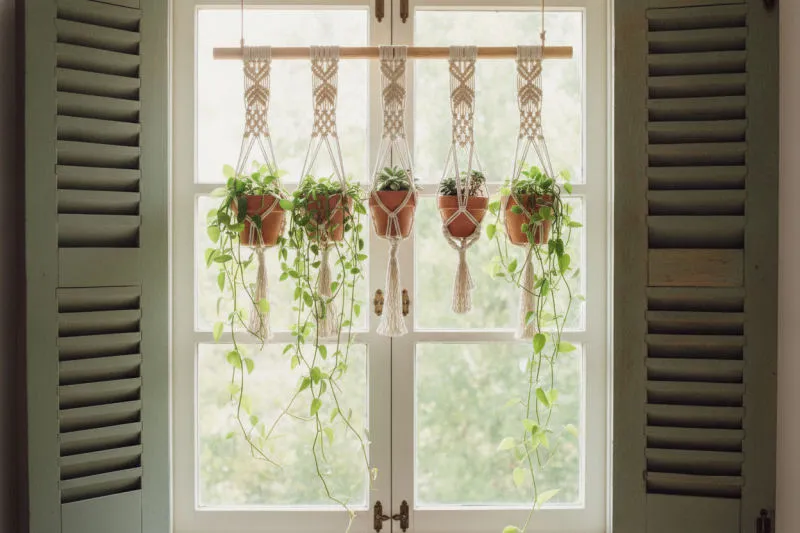
Contents 8
Hanging plants change a room within weeks. They free up the floor, draw the eye upward, and create that jungle feel even in a small studio. The trick is picking species that thrive overhead and knowing how to anchor them safely.
Quick recap
- Seven species made for trailing: Pothos, String of Pearls, Hoya, Tradescantia, Ceropegia woodii, Rhipsalis, Heartleaf Philodendron.
- The right anchor: hook screwed into a joist, never just into drywall.
- The right pot: lightweight (plastic), with attached saucer to avoid drips.
- Watering: soak in the sink every two weeks, easier than reaching up.
The seven essentials
1. Golden Pothos
The classic. Vines that can reach 6 feet in a few years. Tolerates dim light and missed waterings. Never wears out.
2. Tradescantia zebrina or nanouk
Ultra-fast growth, purple or copper-pink leaves. Pinch regularly to keep it dense.
3. String of Pearls (Senecio rowleyanus)
Tiny green beads on thin stems. Very graphic. Bright light, very spaced waterings.
4. Ceropegia woodii (string of hearts)
Heart-shaped leaves on a thin trailing stem up to 3 feet. A succulent that needs little water. Very on trend.
5. Hoya carnosa
Fleshy leaves, fragrant umbel flowers once mature. More demanding on light but rewards generously.
6. Rhipsalis
A tropical cactus without spines, cascading thin green stems. Bright indirect light, very forgiving on watering.
7. Heartleaf Philodendron
Pothos cousin with softer cordate leaves. Excellent alternative for dim spots.
Installation: pick the right anchor
Classic trap. A potted plant with water can weigh 6 to 18 pounds. A standard self-drilling drywall hook is rated for 11 lbs but loosens over time with vibrations.
Safe options:
- Ceiling hook: screw into a joist. Use a magnetic stud finder, or simply tap the ceiling — the sound changes over a joist.
- Molly bolt: for drywall when no joist is reachable. Max 22-33 lbs.
- Toggle bolt: best for drywall, holds 44+ lbs.
- Reinforced curtain rod: to align several plants at the same height.
To avoid:
- Adhesive hooks (3M and similar): hold a light plant for six months, then drop.
- Plain plastic anchors in drywall alone.
- Direct screw into drywall without an anchor.
The pot: lightweight and leak-proof
Criteria:
- Plastic: lightweight, ideal for hanging.
- Attached saucer or drip-free system: keeps water from leaking onto the floor.
- Loops or holes matched to the hanger.
- Never heavy ceramic: too heavy and too fragile if it falls.
Self-watering hanging pots exist: pricier, but go 10-15 days without intervention.
How to water a hanging plant
Most practical option: take the plant down every two weeks, soak it for 15 minutes in the sink, drain well, hang back up.
In place option: use a long-spout watering can, pour about half your usual amount to avoid overflow.
Pro option: automated drip system with timer. $30-60 for a kit, holds three weeks.
Ideal hanging heights
To avoid bumping into them and get the best visual effect:
- Above furniture: pot bottom 12 inches above the surface.
- Above a sofa: 20 inches above the back.
- Mid-room: 6.5 feet from the floor minimum, so you can walk under.
- In front of a window: at the lintel height or a bit lower, hung 12 inches off the glass.
How many plants for a jungle effect
For a hanging arrangement to really land, multiply. A single plant looks lonely, three in a row form a cascade. Five at staggered heights make a real vertical green wall.
Mix species: thin stems (Ceropegia) + dense foliage (Pothos) + pearls (Senecio) = depth and variety.
Tracking with Plenova
Plenova adjusts watering reminders based on the smaller pot volume often used in hanging setups (which dries out faster). No more "I forgot the hanging one in the living room" — the app keeps track.
A trailing plant gets noticed instantly. And a room gains height without losing a single square foot.
Found this useful? Pass it on.
 Round-ups 9 min
  Round-ups
 June 22, 2026
The best plants for beginners, six species that forgive your slip-ups
You want a bit of green at home without losing your mind over it. Here are six low-key plants, what they actually need, the mistakes to avoid.
Read the article Round-ups 5 min
 June 21, 2026
Low-maintenance houseplants: eight species that forgive neglect
No time, no patience, sometimes a faulty memory: eight indoor plants that survive almost anything without complaining.
Read the article Round-ups 6 min
 June 6, 2026
Pet-safe houseplants for cats and dogs, the reliable list
Got a curious cat or dog? Here are the indoor plants you can welcome safely, and the ones to avoid at all costs.
Read the article