DIY
DIY Build a closed terrarium: step-by-step guide to a self-watering jungle
A closed terrarium is a tiny ecosystem that can live for years without intervention. Here is how to build one from scratch.
 Plenova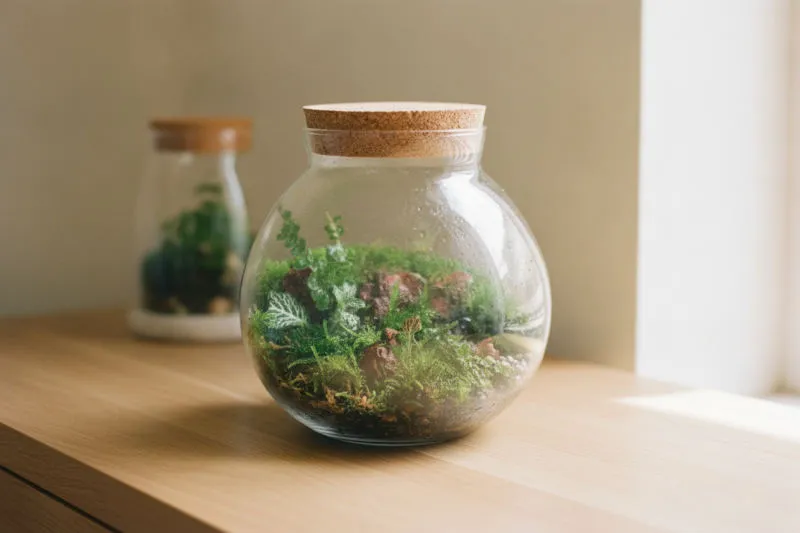
Contents 8
A closed terrarium is a glass jar, a few plants, some substrate, and a self-running water cycle. Once balanced, it can live for years untouched. The known record: a sealed terrarium from 1972, still alive today with no intervention. Here is how to make one.
The principle: a miniature ecosystem
Inside a sealed jar, water evaporated by leaves and substrate condenses on the walls and falls back. It is the water cycle, in miniature. Plants consume CO2 by day and release it at night, a stable balance. Micro-organisms in the substrate break down dead leaves and release nutrients.
No magic: just photosynthesis, transpiration, and a closed environment that recycles.
What you need
The container:
- Clear glass jar with airtight lid.
- Ideal volume: 1 to 3 gallons.
- Opening wide enough for your hand.
- Cookie jar, large pickle jar, demijohn vase, repurposed aquarium.
The layers (bottom to top):
- Drainage: 1 inch of clay pebbles or pumice. Keeps standing water away from roots.
- Horticultural charcoal: a half inch. Filters bacteria, prevents rot. Essential.
- Geotextile: optional, separates drainage from substrate.
- Substrate: 2-3 inches. Mix of potting soil + perlite (70/30).
- Surface moss: decorative, retains moisture.
The plants: 3 to 5 compatible species (see below).
Plants made for closed terrariums
Criteria: love high humidity, stable warmth, slow growth.
Easy picks:
- Fittonia: red, white, or pink veined leaves, perfect for color.
- Pilea cadierei (aluminum plant): silvery foliage, moderate growth.
- Selaginella: false moss, intense green.
- Ficus pumila: small creeping fig that covers the floor.
- Hypoestes: leaves dotted with pink or red.
- Fresh moss: for the base, bought at a garden center or harvested.
To avoid:
- Succulents and cacti: too much humidity = rot.
- Fast-growing plants: they overrun in months.
- Flowering plants: spent petals rot in the jar.
Step by step, the build
1. Clean the jar
Hot soapy water, rinse thoroughly, dry. No chemical residues.
2. Lay the layers
Pour clay pebbles at the bottom, then charcoal, then substrate. Press lightly.
3. Plant
Make a hole with a spoon, pull the plant from its pot, untangle roots, place. Repeat with each plant respecting heights (taller at the back, smaller in front).
4. Decorate
Place stones, bark, or figures. Moss between plants for that forest-floor look.
5. Mist
Spray with water (rainwater or filtered ideally) until the substrate is moist but not soaked. Better too little than too much, you can always add.
6. Close
Put the lid on. That is it.
The break-in: first 4 weeks
The terrarium does not self-regulate immediately. During the first month:
Too much condensation (huge drops constantly running): open the jar for 1 hour a day to release water, until balanced.
Not enough condensation (dry walls, substrate drying): mist lightly.
White mold on the substrate: scoop out with a spoon, leave open 24 hours, close again. Charcoal should prevent this.
Yellowing leaves: open for 2 days to ventilate, adjust the light (too much or too little).
After 4 weeks, balance is reached. No more intervention.
Light and placement
Bright indirect light, never direct sun. The glass jar acts like a magnifying lens, plants cook within hours.
A shelf near an east window, or 5 feet from a south window. No heat source nearby.
Long-term maintenance
Monthly: check that condensation is regular. Inspect plants (rot, dead leaves to remove).
Every 6 months: prune plants that take too much room. Cuttings can be planted into another terrarium.
Every 3-5 years: replace the substrate if it becomes compacted or smelly. Rare.
With Plenova
Plenova identifies common terrarium plants from a photo. Group them in a "Terrarium" place in your garden and keep their photo history, month after month.
A well-balanced closed terrarium gives you years of miniature poetry in a corner of the room. And zero maintenance.
Found this useful? Pass it on.
 DIY 6 min
  DIY
DIY May 18, 2026
Growing herbs indoors, the guide that actually works
Basil, parsley, chives, mint, thyme: how to keep fresh herbs all year long on a windowsill, no garden needed.
Read the article DIY 7 min
 May 16, 2026
Grow an avocado tree from a pit, the guide that actually works
Toothpick method, direct-to-soil, or sphagnum: how to germinate an avocado pit and grow a real plant.
Read the article