Guides
 Aloe vera: complete care guide and medicinal uses
A beautiful, indestructible plant that can soothe minor burns. Everything you need to grow your aloe vera and use it well.
 Plenova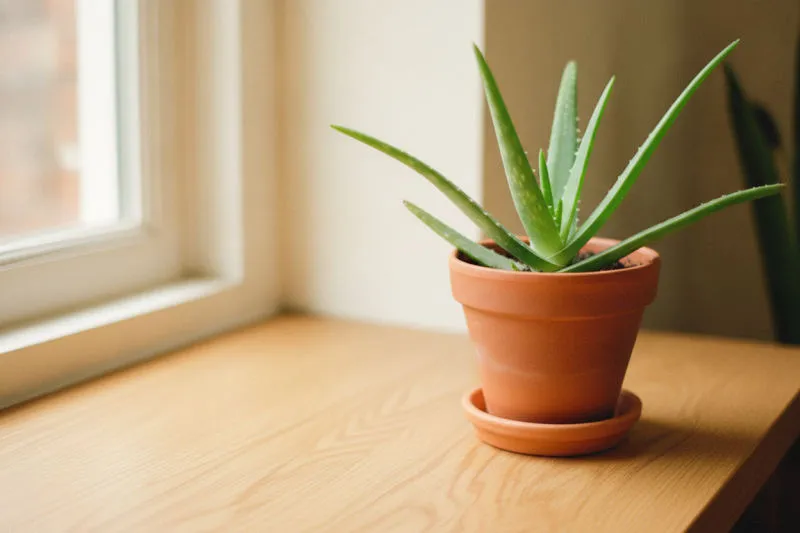
Contents 12
Aloe vera ticks more boxes than almost any houseplant: easy to grow, beautiful, and its gel works on minor burns and sunburns. Here is how to give it what it needs and harvest its gel without harming it.
Where it comes from
Aloe vera (Aloe barbadensis miller) is native to the Arabian Peninsula. It is a succulent that grows in rocky soils under intense sun. Like all succulents, it stores water in its fleshy leaves, which lets it last months without water.
Family: Asphodelaceae. Slow growth: about half an inch per month at peak.
Light: maximum
Rule number one. Full sun or very bright indirect light. A south or west window, or a balcony in summer. Without enough light:
- Leaves stretch upward.
- The plant loses its compact rosette shape.
- The gel becomes less concentrated.
If you start with a garden-center plant (often raised in limited light), acclimate it to full sun gradually over 2 weeks to avoid leaf sunburn.
Watering: little and well
Every 3-4 weeks on average. More in summer, much less in winter (sometimes 6 weeks).
Method:
- Confirm the substrate is dry 2 inches deep.
- Soak the pot for 15 minutes OR water until liquid drains out the bottom.
- Drain fully, never leave water in the saucer.
- Wait until dry before next watering.
Thirst signs: leaves slightly soft or curling at the edges. Drowning signs: yellow soft or translucent leaves, mushy base.
Substrate: ultra-draining
Cactus mix from the store + 20% extra perlite. OR DIY recipe:
- 30% green-plant potting mix
- 30% perlite
- 30% horticultural sand
- 10% fine pumice
Water should run through in seconds. If it pools, the mix is too dense.
Pot: terracotta with drainage hole
Terracotta is ideal for aloe vera: it lets roots breathe and speeds up substrate drying. Pot just an inch wider than the root ball. Drainage hole required.
Fertilizer: very little
Once in spring, once in summer, with half-diluted cactus fertilizer. That is all. Too much burns the roots and makes the plant grow too fast (stretched).
Harvesting the gel
Once the plant is at least 2-3 years old (rosette of at least 12 inches), you can harvest leaves.
How:
- Pick a thick, smooth, mature outer leaf.
- Cut at the base with a clean knife.
- Stand the leaf upright in a glass for 15 minutes: a yellow liquid (aloin) drains. It is skin-irritating, let it run out.
- Slit the leaf lengthwise.
- Scoop out the clear gel with a spoon.
Immediate uses:
- Minor kitchen burns.
- Light sunburns.
- Itching after insect bites.
- Dry hair (as a mask, mixed with olive oil).
Caution: do not ingest raw gel. The aloin (yellow) is a strong laxative and can be toxic. Edible aloe vera sold in stores is processed to remove aloin.
Storing the gel
Fresh: 1 week in the fridge in an airtight jar.
Frozen: 6 months in cubes (perfect to apply directly on sunburns).
Mixed with oil: 1 month max.
Propagating aloe vera
Easiest method: pups. A mature aloe vera produces babies at its base.
- Take the mother plant out of its pot.
- Identify pups with their own roots.
- Separate gently by hand or with a knife.
- Let the cuts callus for 2-3 days.
- Replant each pup in its own pot with dry substrate.
- Do not water for 1 week (let cuts dry).
You get 3-5 new plants per division.
Common problems
- Soft, yellow leaves — Overwatering → Stop watering, check roots
- Brown leaf tips — Low light OR hard water → Full sun, filtered water
- Stretching leaves — Lack of light → Gradually move into full sun
- No growth — Pot too small OR not enough light → Repot, relocate
- Black spots — Temperature shock → Keep above 60°F
Toxicity
Aloe vera is toxic to cats and dogs if ingested. The pure gel is safe on human skin, but aloin irritates. Place high if pets are around.
With Plenova
Plenova reminds you to repot your aloe vera when it is time, in the right season. Watering reminders match its succulent nature: very spaced, always season-aware.
A settled aloe vera lives 25 years. It is probably the best effort-to-reward ratio in the houseplant world.
Found this useful? Pass it on.
 Guides 8 min
  Guides
 June 27, 2026
Caring for your Monstera, the guide to those iconic split leaves
Monstera deliciosa is the houseplant of the decade. Light, water, fenestration, aerial roots: here is how to turn yours into a real indoor jungle.
Read the article Guides 6 min
 June 26, 2026
Pothos, the complete guide: varieties, care and propagation
Golden, Marble Queen, Neon, N'Joy: everything you need to know about pothos, the most popular houseplant in the world.
Read the article Guides 9 min
 June 25, 2026
Caring for your Ficus, lyrata, benjamina or rubber tree
Ficus is a whole genus, not one plant. Light, water, latex sap, pruning: a guide to figuring out your variety and keeping it beautiful for years.
Read the article